What Is a UGC Campaign? Meaning, Benefits and Steps
A UGC campaign coordinates how attendees, customers, or fans create and share content about a brand or event. A 2024 survey by MASV, conducted with Dynata, found that 81% of consumers trusted user-generated video more than professionally produced brand content or influencer marketing, and 85% relied on UGC video before making a purchase (2024 MASV UGC survey).
The morning after a gala, guests have already posted selfies. A sponsor wants three photos in Monday's newsletter. The photographer has a full gallery, but nobody recorded who agreed to reuse their image. At that point, the photos are only one part of the campaign. Permission, review, and measurement determine whether they can be used responsibly and whether the effort achieved its goal.
What a UGC Campaign Is in Plain Terms
A UGC campaign is a coordinated marketing effort that encourages customers, attendees, fans, or community members to create and share content featuring a brand, product, service, or experience. Think of a wedding guest book. Guests write the pages. A short rulebook decides which pages get printed in the thank-you album, and which stay private.
Unlike brand-produced advertising, the content originates with users. It may include photos, videos, reviews, testimonials, social posts, or event moments, as the Hootsuite history of social media traces through the rise of participatory platforms. An attendee's selfie, gala photo, or tournament clip becomes campaign material only after the organizer has permission and controls where it appears.
Three words do most of the work.
- Submission route: where guests find or send content, such as a QR code gallery or an event photo sharing link.
- Consent terms: who may appear, and where that image may be reused.
- Moderation: who approves each asset before anyone reposts it.
A guest posting a photo isn't the same as the organizer holding rights to reuse it in advertising.
A real campaign also names a participation prompt, incentives, and a distribution plan. Collecting posts alone doesn't get you there.
The Six Building Blocks Every Campaign Needs
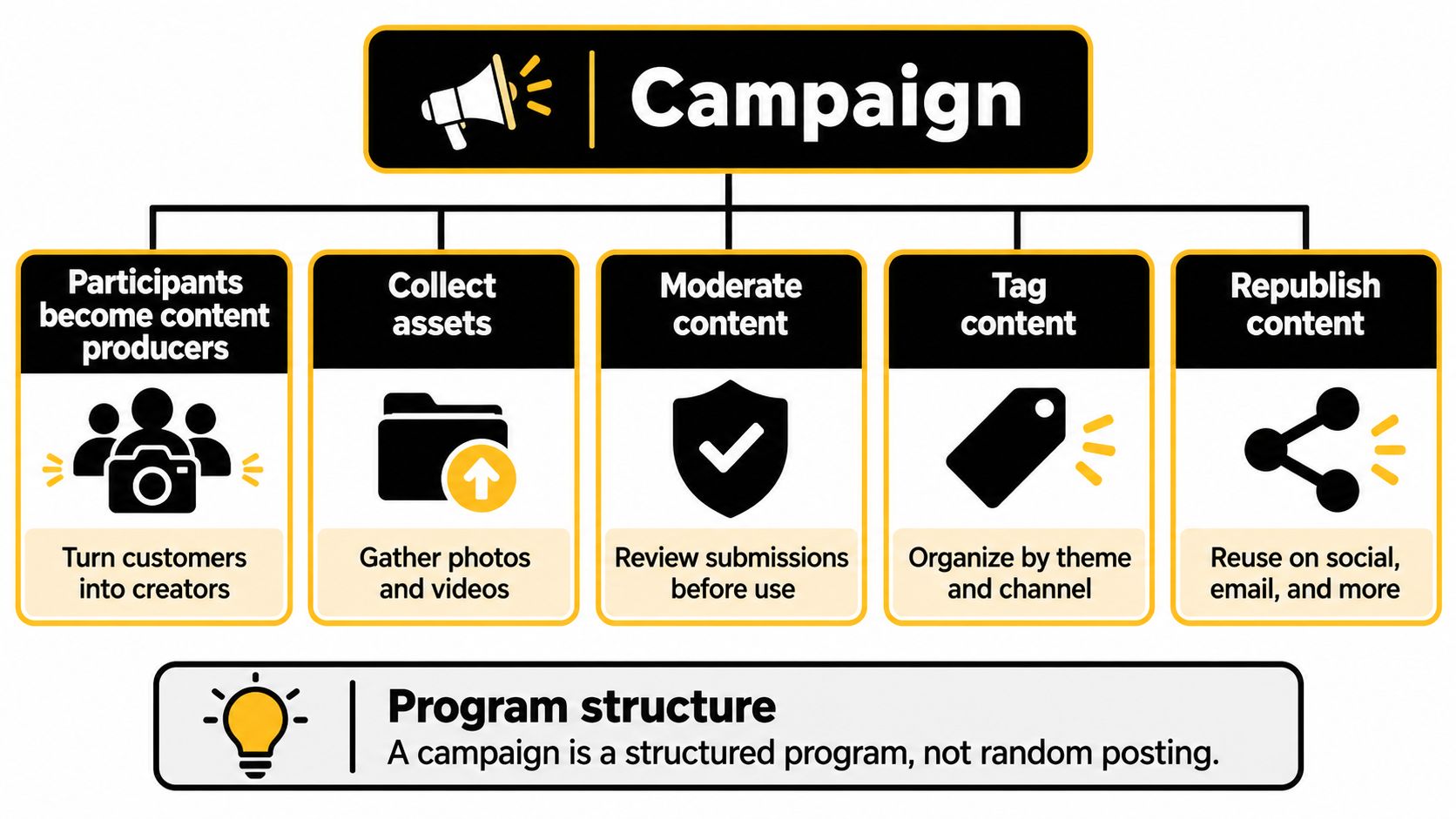
A campaign is a structured program, not a pile of tags. Its value comes from turning participants into distributed content producers, so assets can be collected, moderated, tagged, and republished across social, email, websites, and paid media. An academic review of UGC ties that effect to three mechanisms: perceived authenticity, information reliability, and emotional resonance. Peer content builds trust through empathy and community signals. Brand content leans on professional authority and message consistency.
| Building block | What it defines | Event example |
|---|---|---|
| Participation prompt | What guests are asked to capture or post | Share your best gala moment with the event hashtag |
| Submission route | Where content is found or sent | Shareable link, QR code gallery, or tagged social post |
| Consent terms | Who may appear and where images can be reused | Opt-in step before public posting |
| Moderation rules | Who reviews content and what gets removed | Organizer approves each image before repost |
| Incentive | What participants receive for taking part | Free digital download or featured-photo credit |
| Distribution plan | Where approved assets run after the event | Event website, LinkedIn, sponsor newsletter |
The submission route is the place guests use. A shareable link can go out by email, WhatsApp, or SMS. A QR code can sit on a table card or a registration desk. Guests shouldn't need an app or a new account to find their own moments.
A hashtag-only campaign with no consent terms and no moderation step produces content nobody can safely reuse. If any block is missing, you get content, not usable assets.
Why Peer-Made Photos Persuade Better Than Ads
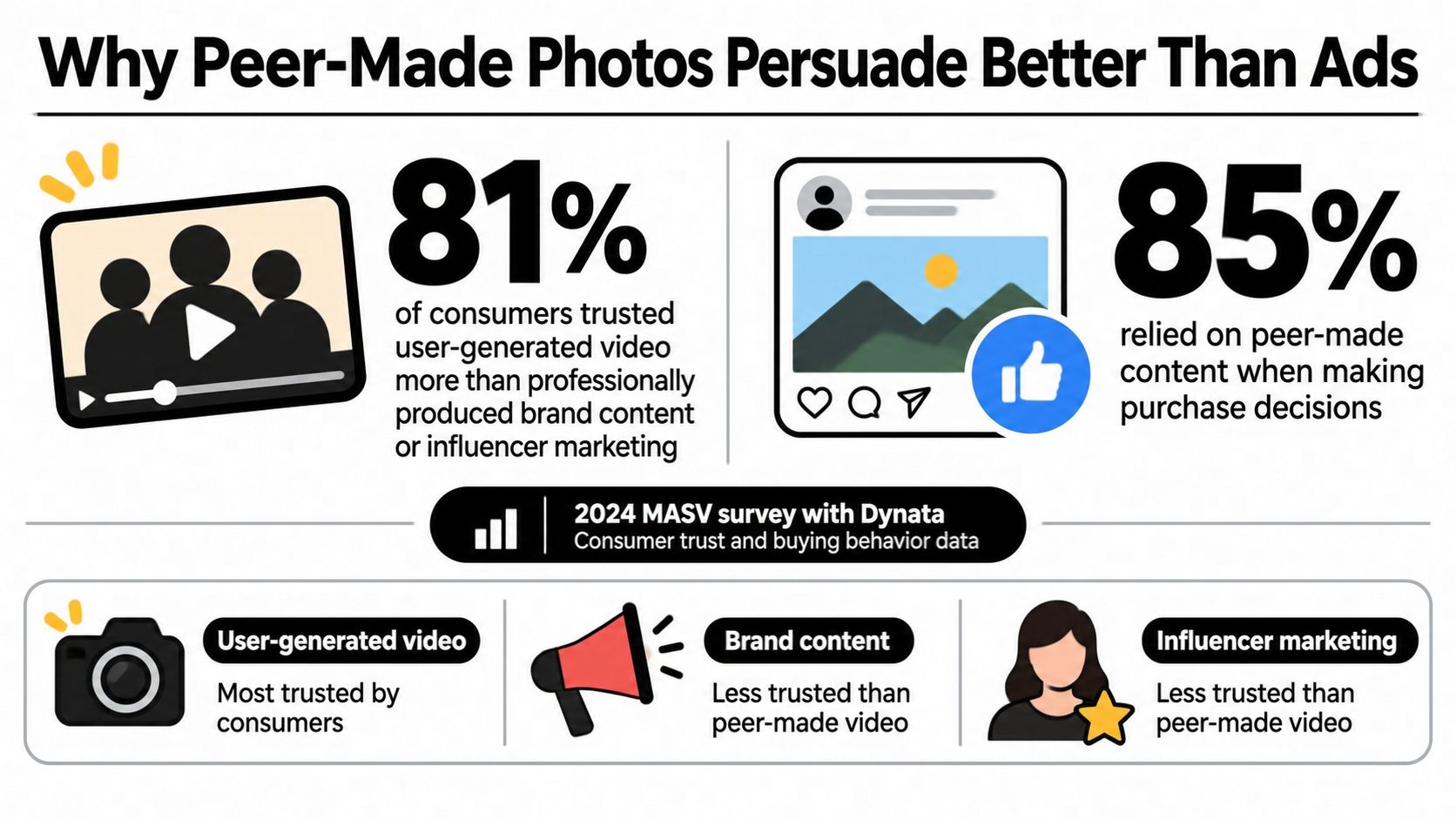
A 2024 MASV survey with Dynata reported that 81% of consumers trusted user-generated video more than professionally produced brand content or influencer marketing, while 85% said they relied on UGC video before making a purchase. Those figures don't mean every submission works. Relevance, quality, consent, context, and moderation still decide whether a clip helps. The same survey found that nearly 100% of brands intended to increase or maintain UGC budgets in 2024, so marketers were treating creator and customer content as an ongoing channel, not a one-off stunt.
A visitor's real photo from a trade show booth, or a participant's tournament highlight, shows atmosphere a formal ad often misses. People recognize a crowded aisle, a muddy jersey, a handshake at a fundraiser table. That recognition is social proof only when the photo is the right one, from the right person, used in the right place.
Peer content helps when attendees can find their own photos without digging through a shared folder. Pair that convenience with explicit release language, privacy controls, an opt-out, and a clear rule on whether photos may be reposted or used in paid media.
Trust in peer video is a reason to build the campaign. It isn't a reason to publish the first photo that arrives.
Privacy Rules for Selfie Matching and Consent
An instant match feels like a favor. Guests like seeing themselves. That enjoyment doesn't replace a plain explanation of collection, purpose, retention, sharing, deletion, and commercial reuse. Biometric and facial data are specially protected in major jurisdictions, which is why a summary of event photography privacy laws treats selfie matching as infrastructure, not a footnote.
| Jurisdiction or rule | Requirement for biometric or facial data | What organizers should do |
|---|---|---|
| EU and UK (GDPR, UK GDPR) | High consent threshold for biometric identification | Offer explicit opt-in and a non-biometric option |
| Illinois (BIPA) | Informed written consent | Record written consent before any matching |
| Texas (CUBI) | Notice and consent | Show clear notice at the selfie-match step |
| California | Biometric information treated as sensitive personal information | Limit use and retention, and state the purpose |
| Quebec (Law 25) | Express consent for biometric systems | Obtain express consent before any matching |
| Children under 13 (FTC COPPA guidance) | Parental permission in relevant circumstances | Avoid matching minors' faces without parental permission |
Design the match so consent is a choice
Build the workflow around six habits.
- Offer a non-biometric alternative: name search or a private link still gets people their photos.
- Use opt-in, not buried consent: the notice sits before matching, in ordinary language.
- Minimize retention and restrict access: keep faces only as long as the stated purpose needs, and limit who can open the set.
- Document approved uses: tie each yes to a specific asset.
- Separate "find my photos" from publishing: private retrieval isn't permission to put someone in marketing.
- Name a takedown path: a participant writes a named contact, you remove the image from the gallery and every approved channel within a stated period, and you update the consent record to show the withdrawal.
An instant match can lift post-event engagement. Unclear consent can undermine trust and expose organizers, photographers, sponsors, and venues. Have counsel confirm the rules for each venue and region before you turn matching on.
How to Run an Event UGC Campaign Step by Step
The strongest campaigns are permissioned content systems, not hashtag requests. FTC guidance on COPPA states that services collecting personal information from children under 13 may need parental permission in relevant circumstances. Schools, universities, and youth sports can't treat that as optional paperwork.
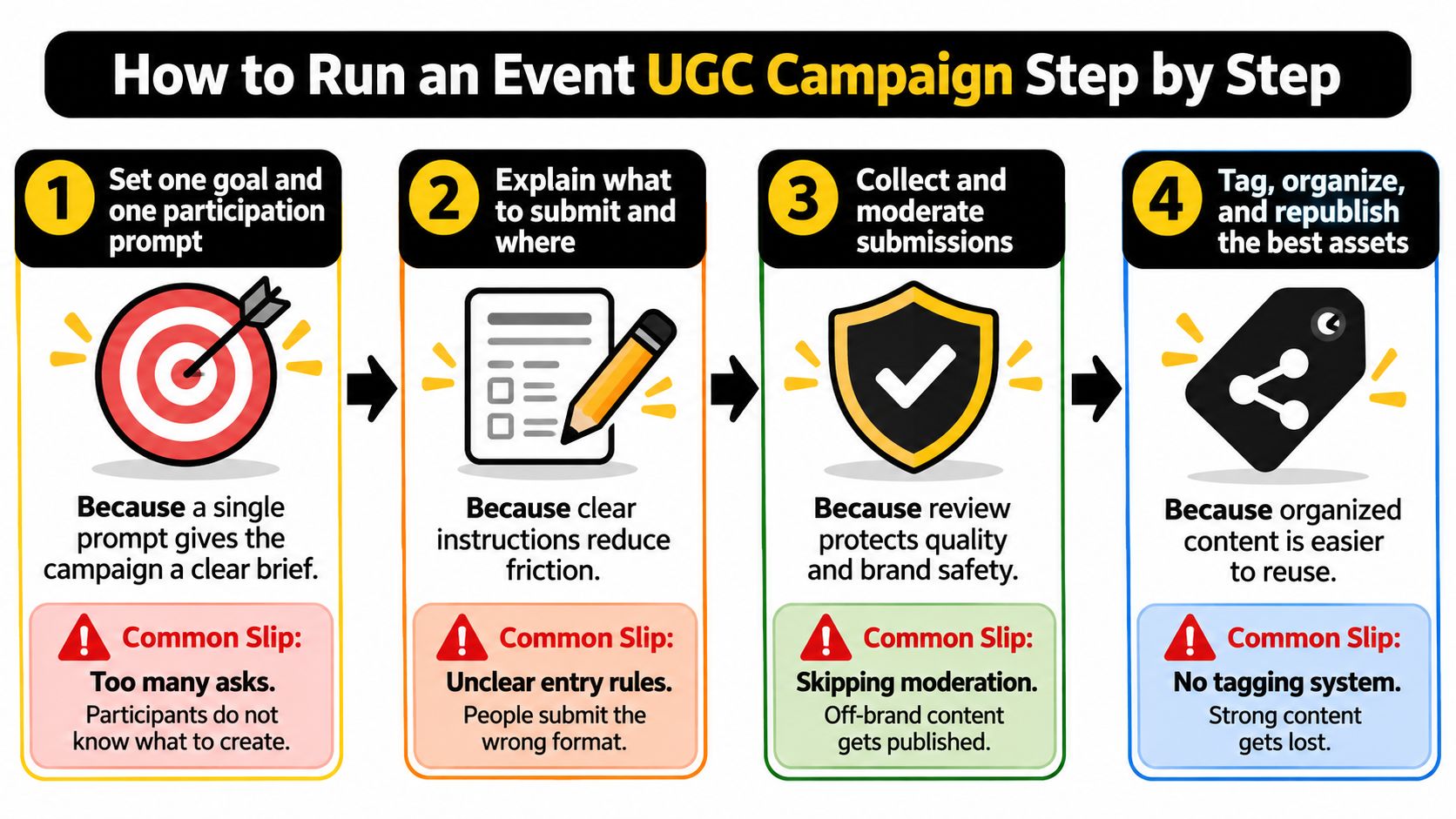
- Set one goal and one participation prompt. A single ask gives the campaign a clear brief. The slip is trying to collect everything at once.
- Publish a permissioned gallery as a shareable link or QR code. Guests need one place to look. The slip is leaving the gallery open with no terms on the page.
- Let guests find their own photos, and keep private retrieval separate from public publishing. A match isn't consent to share. A practical setup is a drag-and-drop upload by the organizer or photographer, background facial processing, instant private retrieval, and organizer-controlled sharing, with the consent notice shown before matching.
- Collect consent for each approved asset. Record who may appear, where it can run, how long reuse lasts, whether paid amplification is allowed, and how someone withdraws. The slip is publishing before that record exists.
- Moderate, then select a smaller approved set. A curated set is safer to reuse and easier to attribute than an open hashtag stream. The slip is reposting first and reviewing later.
- Distribute only approved assets. Use email, WhatsApp, SMS, the event website, and LinkedIn or Instagram, with sponsor credit attached. The slip is sharing files with no usage terms.
- Measure the funnel and keep a takedown ready. The slip is having no way to pull an image after a complaint.
Role-based controls let photographers, sponsors, and marketing teams work without seeing every file. Those controls cut privacy and brand-safety risk while you still track opt-in rate, approved-content rate, share rate, sponsor mentions, photographer upsell conversions, and time saved versus manual photo requests.
Event UGC Campaigns in Practice
Say a gala fundraiser asks guests to share their best moment under a cause hashtag. Consent is collected at selfie matching, before anything goes public. The team tracks gallery visits and donor sign-ups from referral links, not raw post volume.
A sports tournament asks players and families to post highlights. Under-13 players need parental consent before any face match or public use. The scoreboard is share rate and sponsor mentions on approved clips.
At a trade show booth, visitors tag the brand in photos they want shared. Consent language sits on the gallery page, in view before download. Lead inquiries from those gallery links are the outcome that matters to the booth team.
An alumni dinner invites classmates to tag reunion photos. Opt-in happens before public posting, so a private table shot stays private. The office watches re-engagement and sign-ups for the next event.
A brand activation asks attendees to post with a sponsor-approved branded frame, under usage terms stated on the frame page. The team counts frame uses and reach on the approved set only.
Photographers can deliver through the same link and offer prints, digital downloads, or premium edits directly to attendees, instead of answering a week of "can you find me?" messages.
| Event | Participation prompt | Consent route | Tracked outcome |
|---|---|---|---|
| Gala fundraiser | Share best moment under a cause hashtag | Consent collected at selfie matching | Gallery visits and donor sign-ups from referral links |
| Sports tournament | Players and families post highlights | Parental consent for under-13 players | Share rate and sponsor mentions |
| Trade show booth | Visitors tag the brand in photos | Consent shown on the gallery page | Lead inquiries from gallery links |
| Alumni dinner | Classmates tag reunion photos | Opt-in before public posting | Re-engagement and sign-ups for the next event |
| Brand activation | Attendees post with a sponsor-approved branded frame | Stated usage terms on the frame page | Frame uses and reach |
Measuring Results Beyond Content Count
Creator-marketing research from the CreatorIQ State of Creator Marketing 2025 report shows that 94% of organizations believe creator content produces more ROI than traditional digital advertising. ROI is still hard to prove. Judge it across several funnel stages, not one last-click number. A guest sharing a photo still isn't proof you may reuse it in advertising.
| Funnel stage | Metric to track | What it shows |
|---|---|---|
| Reach | Gallery visits from QR code or shareable link | Whether guests found the gallery |
| Retrieval | Selfie searches and matched-photo views | Whether guests found their own moments |
| Activation | Downloads and opt-in rate | Whether interest turned into action and consent |
| Amplification | Approved shares, tagged posts, and reach | Whether peers spread approved content |
| Conversion | Referral traffic, registrations, donations, and photographer upsells | Business outcome linked to the campaign |
Two operational numbers belong next to that funnel. Time saved versus manual photo requests shows whether the gallery replaced inbox searching. Approved-content rate shows what share of gathered files was usable.
More content isn't automatically better. A smaller, permissioned, relevant set can beat a large uncontrolled hashtag stream because it's safer to reuse and easier to attribute.
Connect the photo-sharing link or QR code photo gallery to explicit consent language, organizer-controlled moderation, and campaign tags. Then the visits, shares, referral traffic, registrations, donations, and photographer upsells have a trail you can defend.
Launch a Small Permissioned Pilot at Your Next Event
Pick one event and one prompt. A single hashtag, or one branded frame, is enough. Write the consent language and the usage terms before the first photo is uploaded, and name who moderates.
Run the pilot with one shareable link or QR code at the venue. Send that same link by email, WhatsApp, or SMS afterward. Guests should be able to take a selfie and see only the photos they appear in, typically without an app or a guest account. Organizers or photographers upload the set, and they decide what gets shared.
After the event, check three measures first: gallery visits, selfie searches, and approved shares. If those move, and the consent record is complete, you have a reason to scale. If they don't, you've learned it on a small set instead of a messy archive.
A small pilot with clear consent and a measured funnel tells you whether a full campaign is worth the next event's budget.
Saucial gives organizers and photographers a find-my-photos flow for galas, tournaments, trade shows, and fundraisers, so attendees locate their moments from one event photo sharing link or QR code photo gallery and you keep consent and sharing under organizer control. If you're planning UGC from events and want private selfie photo matching without an app for guests, start with Saucial and run a permissioned pilot at your next event.