Photo Usage Rights: A Practical Guide for Events
You've just received the gallery from a successful event. One image is perfect: a donor laughing with the keynote speaker, the sponsor logo visible behind them, and the room full of energy. Your marketing team wants it on LinkedIn, the sponsor wants it in a presentation, and the photographer has already delivered the file.
Then someone asks a basic question: Are we allowed to use this photo that way?
The answer usually isn't sitting in a single checkbox. Photo usage rights involve the photographer's copyright, the organizer's license, the subject's likeness, the venue or branded property in the frame, and the specific channels where the image will appear. Most rights failures happen after capture, when a team moves a photo from an attendee gallery into advertising, sponsor collateral, or promotional social content without checking whether the permission follows it.
The Moment a Great Photo Becomes a Legal Problem
The problem usually starts with a reasonable assumption. The organizer commissioned the photographer, paid the invoice, received the files, and believes the event photos are available for any useful purpose. The photographer may own the copyright, however, and the contract may grant only defined usage rights. Even if the organizer has a broad license, the recognizable people in the frame can create a separate obstacle.
The gala image illustrates the chain clearly. The photographer may have the right to create and license the image. The organizer may have permission to publish it in an event recap. The donor may still not have granted permission for their face to appear in a sponsor's promotional presentation or paid advertisement. One file can therefore be cleared for one use and blocked for another.
Practical rule: A photo isn't cleared because it was delivered. It's cleared when the planned use, the license, and the people shown in it all line up.
How the failure pattern develops
A typical breakdown follows a predictable sequence:
- Capture: The photographer documents the event, often in a public or semi-public setting.
- Delivery: The organizer receives a gallery or folder and assumes delivery equals permission.
- Selection: Marketing chooses the most compelling images, usually without rights metadata attached.
- Distribution: The image moves into a social post, sponsor deck, newsletter, advertisement, website, or press package.
- Objection: A subject, sponsor, venue, or photographer challenges the use after publication.
The weak point is step four. Teams often plan the capture experience carefully, then treat distribution as an administrative task. That reverses the primary risk. The image is rarely problematic because it exists. It becomes problematic because a new audience, partner, channel, or commercial purpose gets added.
Replace the checkbox with a rights chain
A workable event process asks four questions before publication:
- Who owns the image? This identifies the copyright holder.
- Who has permission to use it? This identifies the licensee and the permitted scope.
- Whose likeness appears? This identifies whether recognizable people need additional consent for the intended use.
- Who else will distribute it? This catches sponsor, venue, media, agency, and partner reuse.
The U.S.-focused guidance on event photography, privacy, and personal rights separates copyright ownership from the right to use a recognizable person's likeness. That distinction should shape your workflow from the beginning, not appear during a last-minute legal review.
The Three Rights That Almost Everyone Confuses
Event teams often reduce three separate permissions to “we own the photos.” That phrase cannot guide a campaign. Copyright, licensing, and publicity rights answer different questions, and one missing answer can block distribution.
These rights are three separate locks on the same door. Copyright controls the photograph as a creative work. A license defines how another party may use that work. Publicity rights govern commercial use of a recognizable person's identity. Each lock needs its own key, and a photographer's invoice does not provide all three.
Copyright belongs to the creator unless the agreement says otherwise
The photographer commonly owns the copyright in each image. That ownership covers the photograph as a creative work, including reproduction, distribution, display, and related uses. Paying for event coverage does not automatically define what the organizer may do with every delivered file.
The photographer-to-organizer contract should state whether the photographer retains copyright and which rights the organizer receives. Specify whether the license is exclusive or non-exclusive, list the permitted channels, and state whether sponsors, venues, agencies, or other partners may receive or reuse the files.
Record those terms before the event. Once images reach a gallery or shared folder, teams routinely assume access means permission.
A license grants use, not necessarily ownership
A license is permission from the copyright holder. It may cover only an event recap on the organizer's website, or it may include advertising, social media, print, internal communications, and partner distribution. The wording controls the result.
An organizer can have permission to publish a photo in a post-event report while lacking permission to give that same image to a sponsor for its own promotional campaign. The organizer's license may cover only the organizer's communications. Third-party reuse needs its own answer.
Set that answer in the delivery workflow. Attendee gallery access is separate from sponsor reuse, and a gallery that lets attendees find or download images does not automatically grant commercial rights to anyone else.
Publicity rights follow the recognizable person
The subject's likeness is separate from the image file. Commercial reuse of an identifiable person's image typically requires a written model release or equivalent consent, even when the photographer owns the copyright and the organizer holds a license.
That distinction matters for attendee faces in advertisements, sponsor collateral, and promotional social posts, as noted in the event photography rights guidance. It also matters when a delivery platform uses face recognition for “find my photos.” Collecting or processing a face to provide access can require permission that differs from consent for event photography or promotional reuse. Define both purposes before collection.
Start each rights review by naming the blocked capability. If the team cannot reproduce the file, check the photographer agreement. If it cannot use the file in a specific channel, check the license. If the recognizable subject has not authorized the intended promotional use, check the release or consent record.
Editorial, Commercial, Promotional, and Social Use Explained
The same image can travel through four different usage lanes. Treating those lanes as interchangeable is how event teams publish a legally acceptable recap and then reuse the same frame in a campaign that needs additional permission.
| Use Lane | Typical Event Example | What's Usually Required |
|---|---|---|
| Editorial | A press article or factual event recap | Copyright clearance, applicable editorial license, and careful documentary context |
| Commercial | A paid advertisement or trade show booth graphic | Copyright license, commercial scope, and consent for recognizable people where required |
| Promotional | A sponsor deck, recap email, or organizer social post | Organizer license, defined promotional scope, and subject consent for identifiable promotional use |
| Social | Attendee sharing, reposting, or tagged content | Clear sharing permissions, platform rules, and limits on organizer or partner reuse |
Editorial use documents what happened
Editorial-style use generally describes an event, person, or public occurrence rather than selling a product or building a brand campaign. A press outlet showing a crowd photo in a factual report is different from an organizer using that same crowd photo to sell tickets, promote a sponsor, or advertise the next event.
Public settings don't create a universal permission slip. The university guidance on photo and copyright law explains that people at public events may be photographed when they aren't the primary focus, while organized celebrations, lectures, and corporate events call for consent planning. Spontaneous images may require consent to be requested afterward.
Commercial use sells, supports, or advances a brand
Paid social ads, landing-page campaigns, booth graphics, sponsor advertisements, and fundraising appeals sit in the commercial lane. The more directly the image helps sell, raise money, recruit, or promote a brand, the less sensible it is to rely on assumptions about general event attendance.
Promotional use still needs a defined scope
Teams often treat an organizer's own social post as casual sharing. That can be a mistake when the post promotes the organizer, a future event, a sponsor, or a commercial relationship. A recap email, annual report, sponsor presentation, and portfolio post may each need separate treatment in the agreement and consent language.
Social sharing needs boundaries
Attendees may receive gallery access and share images with friends without receiving the right to authorize a sponsor's advertising use. Build a decision tree before publishing:
- Is the image documenting the event for factual coverage? Consider the editorial lane.
- Does the image sell, solicit, recruit, or advertise? Treat it as commercial.
- Does the organizer or sponsor use it to build a brand or promote an event? Treat it as promotional.
- Is the attendee sharing it personally? Define personal sharing separately from downstream commercial reuse.
Releases, Permissions, and the Agreements You Actually Need
Three documents do most of the practical work in event photography: the photographer-to-organizer agreement, the model release, and the property release. They solve different problems, so adding more language to the wrong document won't fix the gap.
The photographer agreement controls the image license
This contract should identify the parties, event, deliverables, ownership, permitted channels, duration, territory, exclusivity, attribution, editing rights, sponsor access, and any restrictions on transfer or reuse. It should also state whether the organizer can give files to venues, sponsors, agencies, media outlets, or attendees.
A fundraiser gala creates a common failure point. The organizer may have hired the photographer for event coverage and received permission to publish a recap, while a VIP objects when the sponsor places their image in a presentation. If sponsor reuse matters, name it directly. “Marketing use” isn't precise enough to settle every downstream use.
Model releases protect identifiable subjects
A model release should identify the person, the photographer or rights holder, the organizer or authorized user, the permitted uses, the channels, the duration, the territory, and whether the permission includes partner or sponsor distribution. It should also address edits, withdrawal procedures where applicable, and any special restrictions.
Sports tournaments require stricter coordination when minors appear in podium shots, team portraits, or promotional highlights. Use a parent or guardian consent process where appropriate, tag the record to the participant, and avoid treating a general ticket or registration acknowledgment as a complete commercial release.
Property releases cover spaces and branded elements
A venue, booth, installation, artwork, display, or distinctive branded environment can introduce another rights layer. At a trade show, the contracted photographer may capture booth designs, product displays, or licensed installations. Clarify whether the venue and exhibitors authorize those images, especially when the organizer plans to provide them to sponsors or use them in advertising.
A gallery-access permission is not automatically a sponsor-distribution permission.
Keep the consent record tied to the delivery system and the intended channel. For teams managing sign-ups, waivers, or event assets, the Saucial account access page can be part of an operational setup, but it doesn't replace a properly drafted agreement or legal review. Use counsel for jurisdiction-specific questions, particularly for children, sensitive attendees, biometric discovery, or paid advertising.
Duration, Territory, Exclusivity, and Attribution Demystified
A contract can say “marketing use” and still leave four important decisions unresolved. Duration, territory, exclusivity, and attribution determine how far a delivered image can travel and how long the permission remains useful.
Use a clause like this as a review prompt, not as a universal legal template:
License grant: The photographer grants the organizer a non-exclusive license to use selected event images for the organizer's website, email communications, organic social media, event recap materials, and approved sponsor communications, subject to documented subject permissions. The license applies to the agreed territory and duration. Photographer credit is required where technically practicable.
Duration answers when the permission ends
Ask when the clock starts. Is it the event date, delivery date, first publication, or another agreed trigger? Then ask what happens to evergreen assets, archived pages, printed collateral, and reposts after expiration. If the event becomes part of a long-running campaign, a short license may create an avoidable renewal problem.
Territory determines where the image can appear
A local event may still publish globally through a website, social platform, or international sponsor channel. Don't use “worldwide” casually, but don't assume “local event” limits digital distribution either. Define whether the permission covers a specific market, the organizer's normal operating territory, or global online access.
Exclusivity affects partner and photographer use
An exclusive license can prevent the photographer from licensing or using the image for other parties during the agreed period. A non-exclusive license may let the photographer retain portfolio rights or provide the image to another party. If a sponsor expects exclusive access to an image, specify whether exclusivity applies to the event, the image set, the industry, or a particular campaign.
Attribution should be operational
State whether credit is mandatory, where it must appear, and what happens when a platform doesn't support it. “Credit the photographer” is incomplete if the team doesn't know whether that means a caption, metadata, website credit, or a tagged account.
Redline each clause with four questions:
- Duration: When does use begin, and when must new publication stop?
- Territory: Does the permission cover websites, social platforms, and partner channels?
- Exclusivity: Who else may use the image, including the photographer?
- Attribution: What form of credit is required, and when is it technically possible?
Store the approved version with the event record rather than relying on a message thread. A centralized Saucial settings workspace can support operational organization, but the contract itself should remain the controlling document.
Why Blanket Permissions Are Your Worst Default
A universal media release at check-in looks efficient. It usually isn't. Blanket language asks attendees to authorize a wide range of uses before they know whether their face will appear in a private gallery, an organizer recap, a sponsor advertisement, or a public campaign.
That approach creates two problems. It gives the organizer a permission record that may be too vague to defend, and it makes attendees feel that participation requires surrendering control over every future use. A broad form can be less useful than a narrow one because the team still can't answer what the person agreed to.
Narrow consent is easier to operate
For a gala fundraiser, separate permissions might cover:
- Event documentation: Capture and display images in an attendee gallery.
- Organizer promotion: Use selected images on the organizer's website, email, and organic social accounts.
- Sponsor amplification: Permit named sponsors to reuse approved images in their own channels.
- Advertising: Permit paid campaigns only for people who expressly agree to that use.
An alumni dinner may need an even more conservative design. Some attendees may be comfortable accessing a private gallery but not appearing in a public reunion campaign. Let people choose between gallery access, organizer promotion, and partner or advertising use rather than forcing one decision to cover everything.
Make the language readable at the point of choice
Consent should identify the event, the image uses, the channels, the parties receiving permission, and the process for opting out or requesting removal where applicable. Put the meaningful information near registration and entry, not buried in a general event policy that attendees won't connect to photography.
Trade shows illustrate why partner distribution needs its own field. Exhibitors may want photos of their booth and staff, while the organizer may want event-wide recap content. Those permissions can coexist, but only if the workflow records who may use which images and for what purpose.
Better consent isn't broader consent. It's consent that matches the decision you actually need to make.
The operational win is control. Narrow permissions are easier to explain to attendees, easier to filter during selection, easier to revoke or update where applicable, and easier to defend when a sponsor asks for a new use. If a campaign wasn't included, pause and request the missing permission instead of stretching a universal form beyond its clear meaning.
A Rights-Aware Workflow for Organizers and Photographers
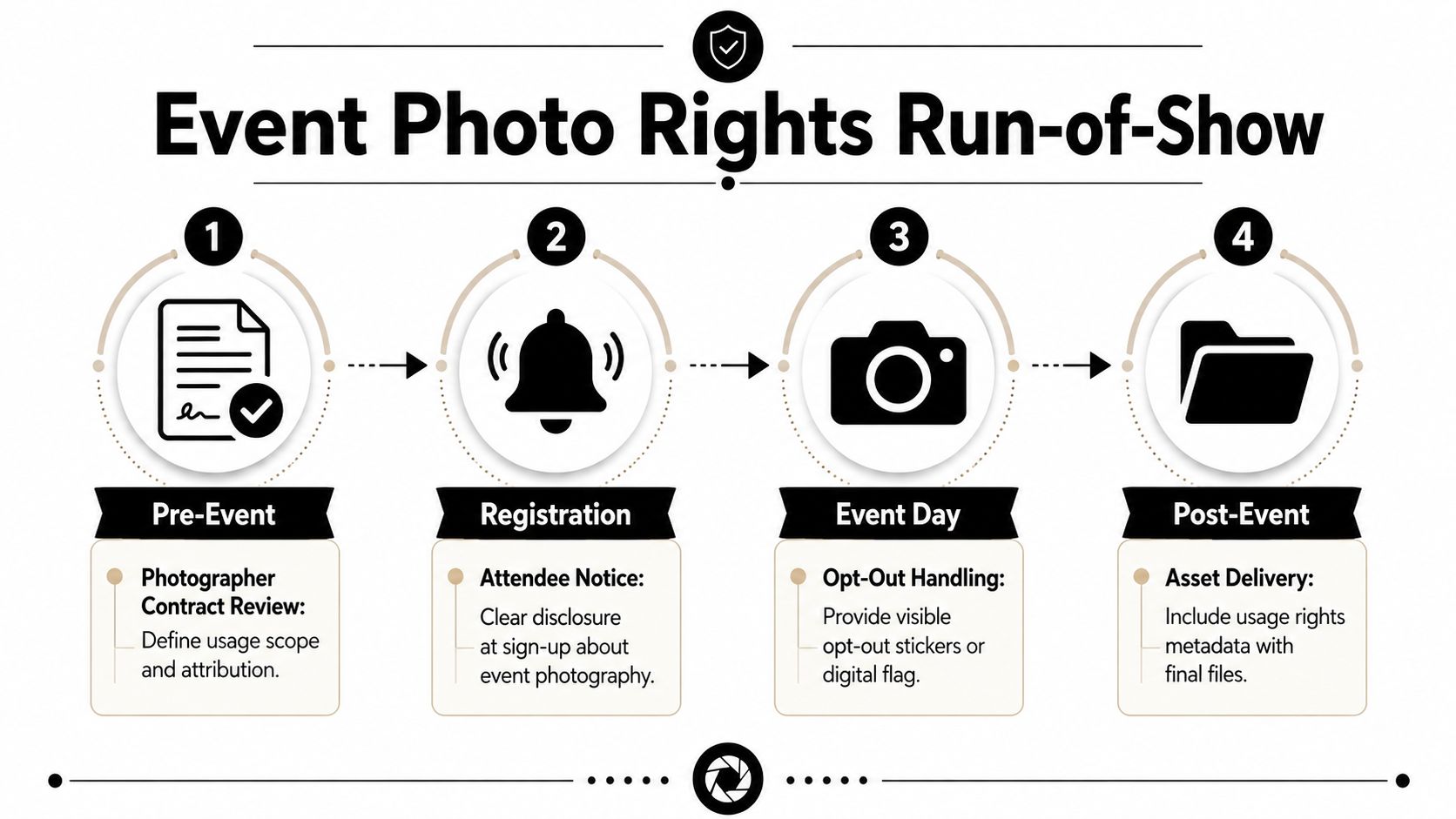
Rights management belongs in the run-of-show, alongside registration, room access, sponsor deliverables, and image turnaround. Assign one owner for consent records and one owner for final publication approval. The photographer should know how the event flags opt-outs, while the marketing team should know which galleries and files are cleared for each channel.
Pre-event preparation
Start with the photographer agreement. List delivery formats, organizer uses, sponsor uses, editorial permissions, attribution, retention, deletion, and the process for pulling an image back. Confirm whether the venue, exhibitors, performers, or other rights holders need separate clearance.
At registration, give attendees a clear photography notice and separate optional consent choices. For sports tournaments, identify how parent or guardian permissions will be recorded for minors. For alumni events, offer a discreet opt-out path for sensitive reunions. For trade shows, ask exhibitors whether booth and staff imagery can be used in organizer and sponsor materials.
Event-day controls
Use visible signage at entrances and registration points. Provide a simple opt-out marker, digital flag, or coordinator-managed list that the photographer can recognize without asking an attendee to explain their situation publicly.
The photographer needs a practical response protocol. If someone asks not to be photographed, stop directing the camera toward them, notify the event lead, and record the request against the relevant delivery workflow. Don't promise a deletion outcome you can't execute, but don't ignore the request either.
Post-event delivery
Separate the attendee gallery from the promotional selects. A person may be allowed to find and view their photos while not being cleared for sponsor advertising. Attach rights notes to folders, filenames, metadata, or the gallery management record so the marketing team doesn't have to reconstruct decisions from email.
Set a deletion schedule for source files, face-search data, opt-out records, and exported assets according to your policy and legal requirements. When someone requests a takedown, pause scheduled posts and sponsor distribution while the team checks where the image has already traveled.
Upload the approved, rights-labeled assets through the Saucial upload workflow or your chosen delivery platform. The tool doesn't make an uncleared image lawful, but a rights-aware upload process makes scope visible before distribution.
Putting It All Together on a Modern Delivery Platform
A modern event gallery has to solve more than file transfer. It has to connect permission, discovery, distribution, and monetization without turning every attendee request into a manual search.
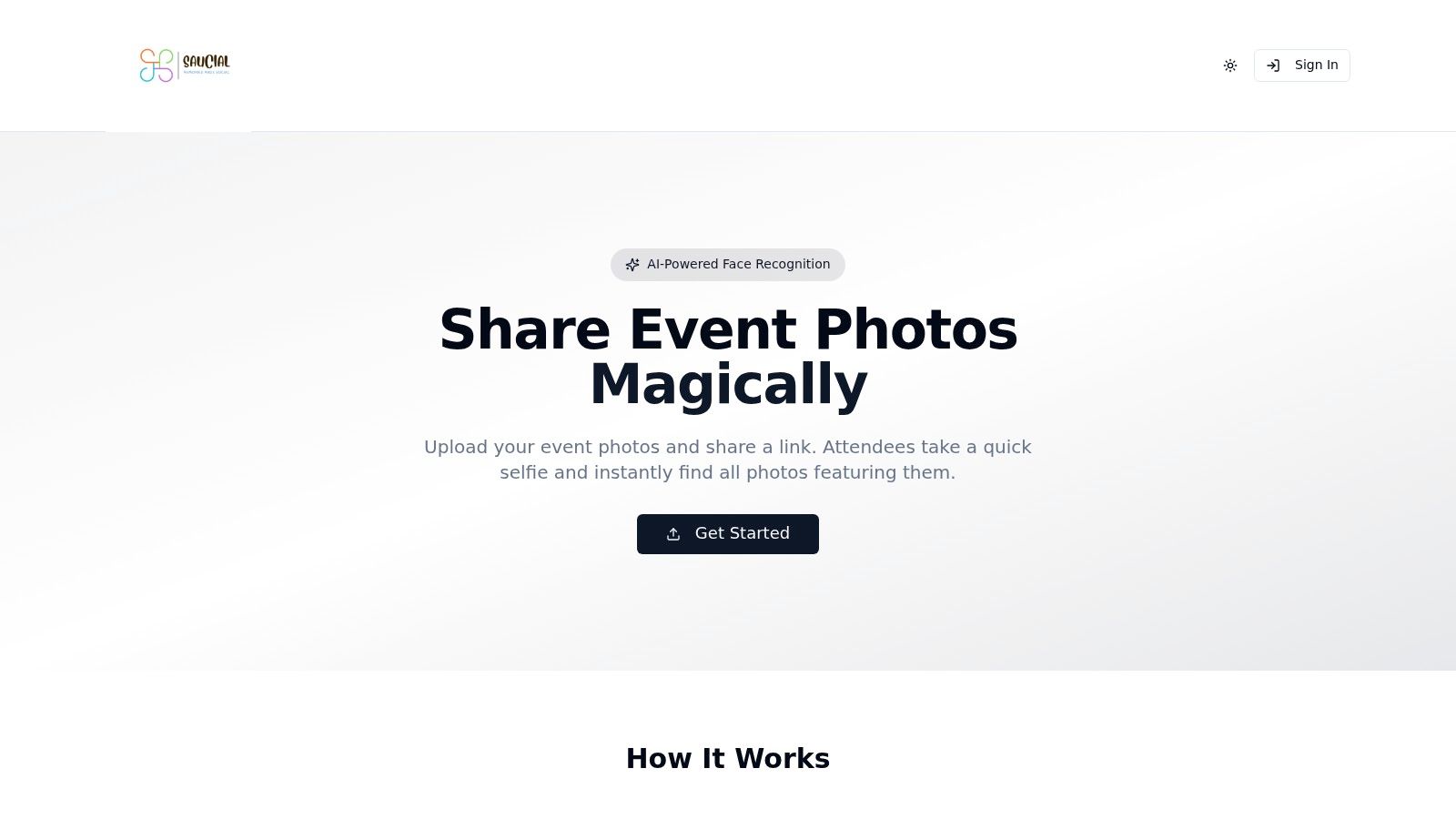
For organizers, the basic delivery layer can include an event photo sharing link, a QR code photo gallery, or a face recognition event gallery. Those options make access convenient, but convenience must remain subordinate to the permission model. Decide which images are available to attendees, which are reserved for approved promotional use, and whether sponsors receive a separate collection rather than the entire event archive.
Attendee discovery needs privacy controls
Selfie photo matching can help guests use a “find my photos” experience instead of scrolling through a crowded gallery. That doesn't remove the need for notice, opt-out handling, selective access, deletion schedules, or special treatment for children and sensitive attendees. Privacy-focused event guidance highlights entry-point notice, opt-out procedures, controlled gallery access, deletion planning, and careful handling of face-recognition systems in event photography usage-rights guidance.
The right design is controlled discovery. Let attendees find approved images without assuming that every discovered image can become public UGC, a sponsor asset, or a paid advertisement. This separation can improve trust because the attendee understands what the system does and what it doesn't authorize.
Monetization follows permission
Photographers can use the same delivery layer to offer optional prints, digital downloads, premium edits, featured sets, or event-approved sponsored frames. Those are not merely storefront features. They introduce new uses, new recipients, and sometimes new branding, so the underlying agreement should authorize the relevant commercial flow.
For a sports tournament, sports tournament photo sales may require a clear distinction between participant access, parent or guardian permissions, team use, and promotional highlights. For a gala fundraiser or trade show, sponsored frames and branded collections need approval from the organizer and any relevant rights holders. A platform can reduce manual tagging and “can you find my photos?” requests, but it can't replace a documented rights decision.
Use a delivery system that keeps the organizer in control of shared galleries, attendee experiences, and approved monetization. A workflow-first platform such as Saucial fits that model by connecting event distribution with permission-aware access rather than treating the final gallery as an unstructured folder.
Saucial gives organizers and photographers a practical way to share event galleries through a link or QR code, support a controlled “find my photos” experience, and offer approved attendee upgrades such as downloads, prints, premium edits, and branded frames. If you're rebuilding your event photo workflow around clear permissions instead of blanket assumptions, visit Saucial and see how the delivery layer can support it.