10 Photo Share Software for Events: Compared by Use Case
A gala ends late. The photographer has delivered hundreds or thousands of images, the organizer sends one shared-folder link, and most guests never open it. Those who do still have to scroll through an entire event gallery to find the few frames they're in. By the next morning, the best moment for sharing has often passed.
The right photo share software changes the job after the shutter stops. This comparison focuses on four practical questions: can attendees find their own faces with a selfie, how effectively does an event photo sharing link or QR code photo gallery reach guests, which privacy controls remain with the organizer, and can the photographer earn from attendee orders?
That distinction matters. Some platforms are excellent client galleries, storefronts, or digital asset libraries, but they rely on browsing and manual curation. Others add selfie photo matching, text delivery, or face-based discovery. The list below ranks tools by what happens after the event, not by how polished the upload screen looks.
1. Saucial
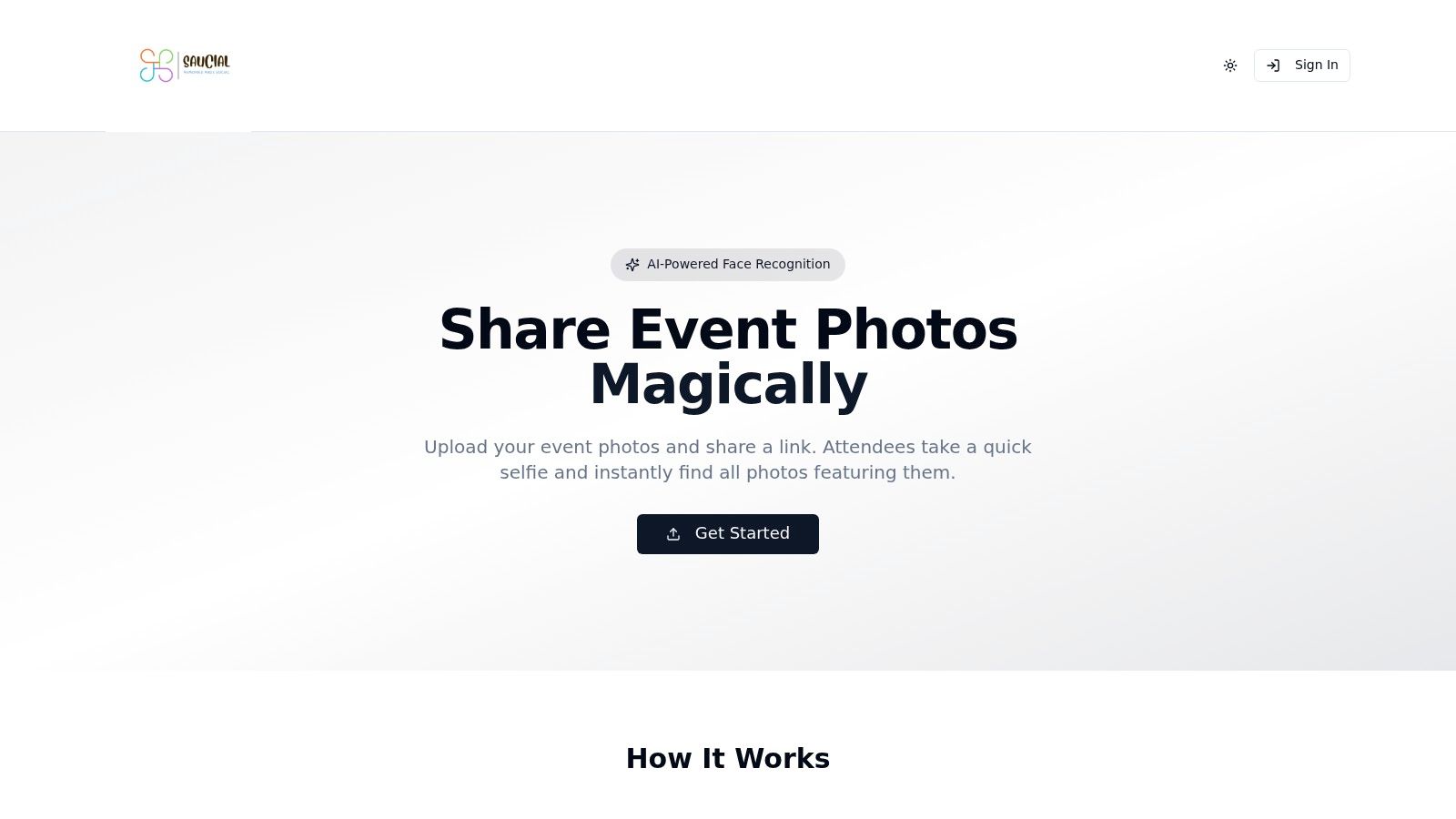
Saucial is built around the moment when guests ask, “Where are my photos?” Instead of handing them a large folder, the photographer or organizer uploads the event images, lets face processing run in the background, and shares one gallery link or venue QR code. Attendees take a quick selfie and see the images they appear in, typically without installing an app or creating a guest account.
That workflow fits high-sharing events such as galas, fundraisers, sports tournaments, trade shows, alumni dinners, schools, and brand activations. It turns delivery into a find my photos experience rather than a file-management exercise. The same link can travel through email, SMS, WhatsApp, an event website, or printed signage.
Saucial's public site explains the product workflow and privacy-oriented use cases, but it doesn't publicly list pricing, customer testimonials, or awards. Contact the company or request a demo before committing to a plan.
Where Saucial earns its place
The strongest advantage is the combination of attendee discovery and organizer control. Teams decide which images are visible, how guests enter the gallery, and whether access is free, paid, or curated. Photographers can also use the gallery as a direct-to-attendee sales channel for prints, digital downloads, premium edits, featured sets, or event-approved sponsored frames.
You can begin with Saucial's upload workflow rather than building a separate folder structure and tagging process. That can reduce repetitive “can you find my photo?” requests, although face matching still depends on image quality, lighting, camera angles, occlusion, and attendee consent.
Practical rule: A frictionless selfie flow still needs a clear notice, an opt-out route, a manual alternative, and a defined deletion policy.
The privacy question deserves more attention than most gallery comparisons give it. Organizers should disclose matching before capture, explain whether a selfie is stored or used to create a biometric template, limit staff access, document vendor processing, and separate photo delivery from marketing consent. A keyboard-accessible gallery, manual search, staff-assisted lookup, and non-smartphone fallback also help guests who can't or don't want to use face-based retrieval.
Pros
- Instant discovery: Guests can search for their own appearances with selfie photo matching, without an app.
- Fast distribution: One event photo sharing link and a QR code photo gallery can reach guests in the room and after the event.
- Organizer control: Teams control shared images, access, curation, and paid or free experiences.
- Photographer revenue: Print sales, downloads, premium edits, and branded frames create possible photographer upsell to attendees.
Cons
- Privacy and accuracy trade-offs: Face recognition can miss people or produce false matches, and organizers must manage consent carefully.
- Limited public pricing information: Plans and customer references aren't listed publicly, so buyers need to request current details.
2. Waldo Photos
Waldo Photos targets the event itself. Guests scan a QR code, take a selfie, and receive the photos they're in through a web and SMS-based experience. That makes it a strong fit when the organizer wants the gallery promoted on-site rather than buried in a post-event email.
The SMS component is useful because it gives the attendee a direct delivery path. A printed sign near registration, a slideshow screen, or a message from the event team can turn the QR code into an immediate call to action. For schools, camps, venues, and one-off activations, that can be easier to explain than a conventional client gallery.
Best fit and limitations
Waldo offers single-event licensing as well as business and professional tiers. A single-event option suits an organizer running an occasional fundraiser or brand activation. A photographer covering frequent events may prefer a recurring business workflow, depending on the current plan and volume.
Its main strength is attendee retrieval through face matching and text delivery. Its limitation is that the experience depends on guests using a phone and SMS or web access, and it isn't a fully white-label app. Photographers should also compare per-event licensing with a broader subscription before pricing a recurring sports or school contract.
Waldo's event photo sharing platform is more purpose-built for attendee discovery than a conventional browse-only gallery. It's less appropriate when the primary requirement is a highly customized storefront or a private internal asset portal.
3. Pic-Time
Pic-Time is a client delivery and e-commerce suite first, but its smart search features make it more capable for events than a basic gallery. Client search can include people, keywords, and selfie search, giving attendees a way to narrow a large collection without manually opening every album.
That distinction matters for weddings, portraits, and multi-day events where the photographer wants both discovery and sales. A guest can locate relevant images, while the photographer can promote prints, digital products, coupons, gift cards, slideshows, or other gallery actions.
Strong sales tools, broader setup
Pic-Time connects galleries with print fulfillment and a network of lab partners. That gives photographers a more developed path from image delivery to order than a simple share link. Visitor chat and marketing automations can also support follow-up after the event, although the breadth of the interface means the photographer needs to configure the experience rather than just upload and send.
Selfie search is useful, but it shouldn't replace clear permission notices or a manual route for attendees who decline face-based discovery. The photographer remains responsible for deciding how public the gallery is, what guests can download, and how the sales experience is presented.
The platform's advanced storage and video allowances sit on higher tiers, so a photographer should review the current plan before moving a large event archive. Pic-Time is a good choice when the brief includes selfie photo matching plus refined sales automation. It's less attractive when the team wants the simplest possible QR-only gallery.
4. PhotoDay
PhotoDay is designed for volume photography, particularly schools, leagues, dance programs, and sports tournaments. Its FaceFind feature supports image discovery, while SMS marketing and lab fulfillment connect retrieval with direct sales to parents and athletes.
The workflow is practical for recurring programs. A photographer can organize images around teams or participants, give families a way to locate their pictures, and offer prints or digital products without manually answering every identification request. QR-friendly gallery entry also helps an organizer distribute access at a tournament or photo day.
A useful model for seasonal sellers
PhotoDay doesn't use a conventional monthly-fee-only structure. Its transaction-based model includes a 10% transaction fee plus processing, so photographers should calculate the effect on their own order economics before choosing it. That fee can be convenient for seasonal businesses that don't want a large standing subscription, but it may be less appealing to sellers with high order values or tight margins.
The platform's FaceFind and SMS tools address the two biggest barriers in volume photography, finding the right images and reminding customers to act. The trade-off is that the photographer is participating in a transaction-revenue model rather than only paying for hosting.
PhotoDay is a strong fit for sports tournament photo sales and organized youth photography. It's less suited to a gala photographer who mainly needs a branded, one-off gallery with flexible attendee access and no transaction dependency.
5. Pixieset
Pixieset is a polished all-in-one platform for client galleries, websites, studio management, and store operations. It works well when the photographer wants to create an event photo sharing link, deliver images, and offer print or digital fulfillment from the same account.
Guests browse galleries, favorite images, and select products through a familiar interface. The store can use automated fulfillment or self-fulfillment, which gives the photographer control over lab production and delivery choices. Paid plans offer commission-free sales, while the free plan applies a store commission.
Where browsing still works
Pixieset doesn't offer attendee selfie or face-match search. That isn't a minor detail for a large gala or tournament. Guests must browse, use available filters, or rely on the photographer's album organization and curation.
For smaller events, portraits, or collections where the photographer has already separated images into clear sets, browsing may be enough. It can also be the better choice when the primary objective is a clean storefront rather than automated find my photos retrieval.
Email campaign tools can help drive post-event engagement, but they still require the organizer or photographer to promote the gallery. A QR code can point to the gallery, yet the QR code doesn't identify the attendee's images. Pixieset is therefore a dependable browse-first choice, not a face recognition event gallery.
6. ShootProof
ShootProof combines client galleries with contracts, invoices, booking, slideshows, video, and sales tools. For a working photographer, that business-tool coverage can matter more than a single discovery feature. One platform can handle delivery and payment without forcing the studio to stitch together separate systems.
Paid plans support commission-free print and digital sales, along with multiple price sheets. That's helpful for photographers who sell differently across weddings, corporate events, and private clients. Storage tiers extend to unlimited photos on Premium plans, giving larger event libraries room to stay accessible.
Delivery and administration in one place
ShootProof doesn't provide selfie or face-match attendee search. Guests browse by album or filters, so the photographer needs a sensible folder structure and descriptive gallery organization. For a curated wedding gallery, that may be perfectly workable. For a large conference where attendees expect to locate themselves quickly, it creates more work on the guest side.
Archiving beyond active storage can also incur fees except on the highest tier, so photographers should understand how long event galleries need to remain online. This is less of a concern for a short delivery window and more important for schools, alumni groups, and annual events that refer back to older collections.
ShootProof suits photographers who want a business-management layer alongside client delivery and sales. It doesn't suit teams that consider selfie search a required part of the attendee experience.
7. PASS Gallery
PASS Gallery focuses on polished gallery delivery and print commerce. Its mobile-friendly galleries, product catalogs, packages, albums, and price lists are designed to help photographers move from presentation to order without creating every product configuration from scratch.
The platform also supports gallery pre-registration and testimonial collection. Pre-registration can help a photographer collect contact details before or during delivery, while presets and onboarding support are aimed at making the store easier to launch.
A sales-first browse experience
PASS Gallery doesn't offer attendee selfie or face-match discovery. The photographer needs to curate albums and guide guests toward the right collection. That approach can work for weddings, portraits, and events where the gallery is intentionally edited. It's weaker for a crowded trade show or tournament where one guest may appear in scattered images across a large batch.
Lower tiers carry commission and payment-handling costs, so the photographer should compare those charges with the expected order value and desired margin. The platform's strength is not automated identity-based retrieval. It's the speed and polish of a sales-ready gallery.
PASS Gallery is a sensible option when the photographer's priority is print presentation and automated selling. Choose something else if guests must take a selfie and immediately isolate their own photos.
8. Zenfolio
Zenfolio combines a website, gallery system, commerce, and pricing automation. Studios that manage several event types can use packages, coupons, albums, digital downloads, and bulk price-list tools across galleries rather than rebuilding each offer from the beginning.
Smart Pricing and price-list formulas can help a photographer set products consistently across a larger catalog. Bulk updates are useful when a lab changes a product, a package needs revision, or multiple event galleries share the same commercial structure.
Efficient commerce, manual discovery
Zenfolio doesn't provide attendee selfie or face-match search. Guests still browse albums or use the structure the photographer provides. That makes the platform more suitable for a studio with repeatable gallery organization than for an open-ended public event collection.
A commerce fee of around 7% on many plans applies, so verify the current terms before making a margin decision. The fee may be acceptable in exchange for integrated hosting, sales, and website tools, but it needs to be included in the photographer's pricing model.
There can also be differences in archiving and user experience across platforms and plan versions. Test the actual gallery as a guest rather than evaluating only the administration screen. Zenfolio works best for studios that want one vendor for web presence, delivery, and sales, not for public-event face matching.
9. SmugMug
SmugMug is a mature hosting, portfolio, delivery, and print-sales platform. Its plans provide unlimited full-resolution JPEG storage, and photographers can add RAW storage through SmugMug Source. That makes it practical for large event libraries where predictable hosting matters.
Portfolio and Pro plans support print and digital sales, fulfillment, coupons, and package options. The photographer can keep a large archive online while presenting selected galleries to clients or attendees. For teams that already know how to organize folders and albums, the system is straightforward.
Reliable storage without identity search
SmugMug doesn't offer attendee selfie or face-match discovery. A guest opening a gala fundraiser photo gallery will browse the collection rather than take a selfie to filter it. The photographer can reduce friction with albums, filenames, and curated sets, but those measures still rely on manual navigation.
Deeper brand customization and multi-price-list capabilities require higher-tier plans. That may be worthwhile for an established studio, while a one-off event photographer may prefer a simpler gallery product or a dedicated event-discovery platform.
SmugMug is a strong hosting choice for photographers who need room for large collections and a dependable storefront. It's not the right tool if the central promise is “take a selfie and see only your photos.”
10. PhotoShelter for Brands
PhotoShelter for Brands is built for organizations that need governed asset management rather than casual attendee sharing. Its branded portals, permissions, SSO, password protection, link sharing, download controls, and Smart Galleries support distribution across departments, sponsors, schools, sports properties, and partner teams.
That makes it particularly useful after an event when the audience is made up of internal stakeholders. A marketing department can give sponsors a controlled portal, a university can manage access for communications teams, and a sports organization can reduce ad hoc requests with self-service galleries.
Enterprise control over public-event convenience
PhotoShelter isn't designed for attendee selfie or face-match discovery at a public event. It can make approved assets easy to find and download, but it doesn't replace a find my photos workflow for every guest in a room.
The trade-off is administration. Enterprise permissions, SSO, and branded portals require onboarding and ongoing stewardship. Pricing is also enterprise-oriented, so smaller photographers should compare the operational value with their actual distribution needs.
PhotoShelter for Brands is the strongest fit here when governance, stakeholder access, and brand control matter more than attendee self-discovery. It's a digital asset management solution, not an event selfie gallery.
Top 10 Photo Sharing Platforms, Feature Comparison
| Product | Core features | UX & quality | Price & value | Target audience | Unique selling points |
|---|---|---|---|---|---|
| 🏆 Saucial | AI face recognition; selfie photo matching; event photo sharing link + QR code; drag‑and‑drop upload | ★★★★★ • instant find‑by‑face, no app, privacy controls | 💰 Contact for plans; organizer‑controlled + photographer monetization | 👥 Event organizers, pro photographers, venues, schools, marketers | ✨ "find my photos" selfie matching; QR code photo gallery; photographer upsell; fast turnaround |
| Waldo Photos | Selfie matching; SMS delivery; QR join; single‑event & Pro tiers | ★★★★☆ • SMS boosts conversion; QR on‑site flow | 💰 Clear single‑event pricing; Business tiers available | 👥 Organizers, venues, schools, camps, pro photographers | ✨ SMS auto‑delivery; printable QR signage; one‑off licenses |
| Pic‑Time (Client Delivery) | Smart Image/Search (people, selfie); premium galleries; integrated print store; automations | ★★★★☆ • strong e‑commerce; requires onboarding | 💰 Tiered plans; powerful revenue tooling (coupons, promos) | 👥 Wedding/portrait pros; multi‑day events; studios | ✨ Smart search + 30+ lab partners; sales automations |
| PhotoDay | FaceFind clustering; SMS opt‑in & reminders; e‑commerce + fulfillment | ★★★★☆ • mobile‑first; high conversion via SMS | 💰 Transaction model (no monthly); ~10% + processing | 👥 Schools, leagues, sports tournaments, parents | ✨ FaceFind clustering; drop‑ship fulfillment; SMS marketing |
| Pixieset | Client galleries; integrated store; website builder; studio manager | ★★★★☆ • clean guest UX; fast gallery creation | 💰 Storage‑based plans; commission‑free sales on paid tiers | 👥 Photographers wanting all‑in‑one site + delivery | ✨ All‑in‑one site + store; predictable storage pricing |
| ShootProof | Galleries + contracts, invoices, selling, slideshows; storage tiers | ★★★★☆ • business tools bundled; easy price sheets | 💰 Tiered plans; commission‑free on paid plans | 👥 Photographers who need delivery + payments | ✨ Contracts & invoicing integrated; event price‑sheet management |
| PASS Gallery | Print store; marketing automations; packages & price lists; testimonials | ★★★★☆ • polished mobile galleries; sales presets | 💰 Lower tiers carry commissions; onboarding support | 👥 Photographers focused on quick store setup & sales | ✨ Store presets + onboarding to raise AOV; fast setup |
| Zenfolio (NextZen) | Website + galleries + commerce; Smart Pricing; bulk price lists | ★★★★☆ • efficient bulk tools; active updates | 💰 Plan/commerce fees (≈7% on many plans) | 👥 Studios, multi‑event sellers | ✨ Smart Pricing & bulk updates across galleries |
| SmugMug | Unlimited JPEG storage; storefront/fulfillment; optional RAW storage | ★★★★☆ • predictable hosting; robust store | 💰 Plan‑based unlimited storage; Pro store options | 👥 Photographers with large libraries; portfolio owners | ✨ Unlimited storage; RAW add‑on; simple store setup |
| PhotoShelter for Brands | Enterprise DAM; branded portals; SSO & permissions; Smart Galleries | ★★★★☆ • enterprise governance; secure sharing | 💰 Enterprise pricing; onboarding & admin required | 👥 Brands, teams, schools, sports properties | ✨ SSO/permissions, branded portals, scale & governance |
Choosing the Right Tool Before Your Next Event
Match the platform to what guests need to do after the event. Choose face matching when attendees must find themselves quickly. Waldo Photos, Saucial, Pic-Time, and PhotoDay support that kind of discovery, though their delivery methods, sales models, and configuration depth differ. Choose a browse-only gallery when the event is curated and the main goal is print or digital sales. Pixieset, ShootProof, PASS Gallery, Zenfolio, and SmugMug are better examples of that model.
Choose an enterprise portal when the photos mainly go to internal stakeholders, sponsors, departments, or approved partners. PhotoShelter for Brands offers stronger permission and distribution controls than a public event gallery, but it isn't intended to solve the attendee question, “Which photos include me?”
The difference between these categories is easy to miss during a product demo. A gallery can look excellent and still make guests scroll through an entire collection. A platform can advertise AI features and still require substantial setup before the QR code, consent notice, search experience, and sales path work together.
Before the event, test the complete guest journey with your own images.
- Scan the QR code: Use the same signage or screen guests will see and confirm that the link opens cleanly on a phone.
- Run a selfie search: Test different lighting, angles, glasses, partial occlusion, and group photos. Record what happens when the system can't find a match.
- Check the fallback: Confirm that guests can use manual search, a curated album, staff assistance, or another non-biometric route.
- Review privacy controls: Ask what the platform stores, whether selfies create biometric templates, who can access the data, how deletion works, and how opt-outs are handled.
- Test the sales path: Place a test order for a digital download and a print if relevant. Check fulfillment, taxes, payment handling, branding, and customer support.
- Calculate the commercial model: Compare subscription costs, single-event licenses, transaction fees, payment processing, storage, and archiving against the sales you realistically expect.
- Measure the outcome: Track upload-to-gallery time, successful retrieval, non-selfie access, support requests, deletion requests, sharing activity, and revenue per event.
The historical case for low-friction photo distribution is strong. Instagram launched publicly in Apple's App Store on October 6, 2010, attracted approximately 25,000 users on its first day, and surpassed 1 million users in less than three months, according to Reuters' account of the platform's early growth. That doesn't mean an event gallery will reach social-network scale. It does show why immediate, mobile-friendly access changes how people participate in visual sharing.
Photo sharing was already a broad behavior before automated event galleries became common. In a nationally representative Pew Research Center survey conducted in 2013, 54% of U.S. adult internet users said they posted original photos or videos online, while 47% said they reposted visual content they found online. The distinction between creators and curators still applies to events. The photographer publishes, and attendees select, download, and share the moments that matter to them, as documented by the Pew Research Center's photo and video sharing report.
Commercially, the category is moving toward cloud workflows and event-specific software. A commercial market analysis estimates the global photography software market at $4.31 billion in 2025, with a projection of $9.51 billion by 2034 and a 9.2% compound annual growth rate. The same source identifies cloud deployment as the fastest-growing model, with a projected 13.1% CAGR, and estimates that individual photographers, enthusiasts, and hobbyists represent approximately 64.3% of market share. Treat those estimates as directional rather than independently audited, as explained in the photography software market analysis.
Event photographers also have a clear reason to compare specialized workflows. Wedding and event photographers represented 41.28% of photography-studio-software spending in 2025, while the broader photography studio software market is projected to grow from $0.72 billion in 2025 to $1.54 billion by 2031, according to Mordor Intelligence's studio software report. Those figures are projections and market estimates, not a guarantee of demand for any individual photographer.
Privacy and accessibility should sit beside speed and sales in the decision. Organizers should explain face matching before guests use it, offer a non-biometric alternative, define retention and deletion, and avoid treating “no account required” as proof that processing is risk-free. They should also provide accessible digital materials, screen-reader-compatible forms, descriptive text where feasible, strong contrast, keyboard access, staff assistance, and an offline or SMS fallback, consistent with the event accessibility guidance and the privacy considerations summarized by the Congressional Research Service.
The best photo share software is the one that matches the post-event job. If the promise is fast personal discovery, use face matching with consent and a fallback. If the promise is a beautiful store, choose a browse-first client gallery. If the promise is controlled distribution across an organization, use an enterprise asset portal. Test the experience as a guest before you trust it with a full event.
Saucial gives organizers and photographers a low-friction find my photos experience with selfie photo matching, an event photo sharing link, and QR code gallery distribution. If you need to turn delivery into post-event engagement and a possible photographer upsell to attendees, visit Saucial to review the workflow and request current plan details.