How to Get Into Events Organising: A Practical Guide
You're sitting in a venue café with a notebook full of ideas, wondering whether the next move is another event-planning course or getting inside a real event. You may already have useful experience in hospitality, sales, fundraising, education, community work, marketing, or project coordination, but a CV rarely proves that you can keep suppliers, schedules, guests, budgets, and last-minute problems moving together.
The practical answer to how to get into events organising is to build evidence before you chase status. Run or support a manageable event, document the decisions and artefacts, measure what happened, and turn the result into a case study someone can trust. Event organising is a recognised professional field. In the United States, the Bureau of Labor Statistics describes approximately 172,100 meeting, convention, and event-planning jobs in 2025, with a median annual pay of $61,160 and projected employment growth of 6% between 2025 and 2035.
Why a Portfolio Programme Beats Another Certificate
A new organiser can spend months collecting certificates while avoiding the harder test: asking a venue manager for a real opportunity. A course may teach useful terminology and process, but it cannot show whether you can write a supplier brief, resolve a registration problem, or explain why catering exceeded the approved budget.
A documented small event provides that evidence. Give a prospective client the original brief, your responsibilities, the run-of-show, key contingency decisions, budget outcome, and selected post-event results, such as attendance conversion or photo engagement. The case study should make your judgement visible, including what changed and why.
That is what separates a certificate from a portfolio. A credential signals preparation. A case study shows how you operate when suppliers, guests, timings, and costs collide.
Practical rule: Treat every early event as a controlled portfolio project, not as unpaid labour that disappears when the guests leave.
The strongest route is a 6–12 month portfolio programme. Choose one event type, assist someone already delivering it, shadow the planning process, lead a contained production, and publish a concise case study. A gala fundraiser, alumni dinner, sports tournament, trade show, or community festival can work when the scope is clear enough to measure.
Corporate, civic, nonprofit, hospitality, education, and association events all hire organisers, so a well-documented small event can transfer across settings. The BLS occupational profile describes the occupation, but your own evidence must show how you perform it.
Credentials still have a place. They can help with a screening filter, introduce a shared professional standard, or signal commitment when industry contacts are limited. They should support operating experience rather than replace it.
Ask of every course, tool, and networking opportunity: will this create evidence that a venue, client, supplier, or employer can evaluate? If not, it may still be useful, but it should rarely be your first investment.
Designing Your 6–12 Month Portfolio Programme
Start with a narrow niche. A person who says they organise everything sounds inexperienced, even when they have strong general skills. Someone who says they want to support community festivals or sports tournaments gives a venue manager a clear reason to respond.
Months one and two
Choose the environment where you can access real work. Read event listings, contact local venues, and ask organisers what assistance they need. Your first role might involve registration, volunteer coordination, venue setup, supplier calls, guest communications, or photographer access.
Don't ask only to “get experience.” Offer a useful task. You could prepare the registration desk plan, reconcile attendee names, create a supplier contact sheet, or manage the event photo-sharing link after the programme ends.
Months three through seven
Shadow a planner through a site inspection, procurement conversation, schedule review, risk discussion, and closeout. Then produce your own versions of the core documents, even if a senior organiser checks them.
Lead a small event with a documented budget, staffing plan, contingency matrix, feedback process, and permission record. The event doesn't need a large audience to demonstrate competence. It needs a clear brief and an honest account of what you controlled, what changed, and what you learned.
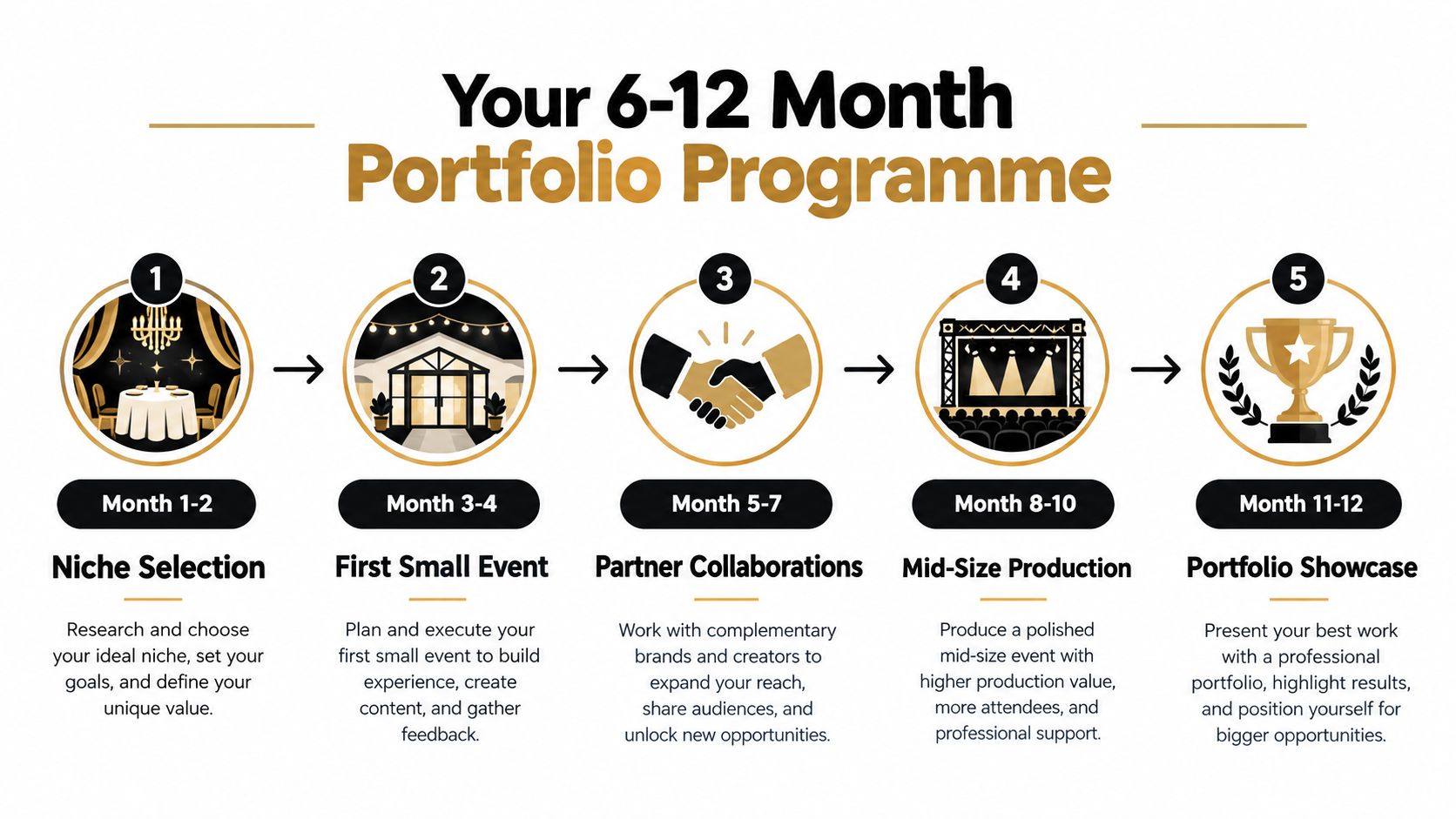
Months eight through twelve
Take on a more involved production or a defined workstream in a larger event. You might own guest communications, sponsor deliverables, venue logistics, or media distribution rather than pretending to run the entire event alone.
Build the final portfolio around two or three strong examples, not a crowded gallery of shallow tasks. A useful event photo workflow can sit inside one case study. Document where the QR code photo gallery appeared, who approved access, how photographers uploaded images, and how quickly attendees found and shared their photos. A tool such as Saucial may be relevant to that workflow, but the portfolio value comes from your planning and measurement, not from naming a platform.
Common mistakes are predictable:
- Treating logistics as the whole job: Guest experience, permissions, communication, budget control, accessibility, and reporting matter as much as loading equipment.
- Ignoring permissions: Record who approved photography, where images could be shared, and how attendees could ask questions or opt out.
- Reporting only attendance: Headcount is context, not a complete result. Track conversion, satisfaction, budget performance, sponsor delivery, and post-event engagement.
- Leading too soon: A small event with a reliable contingency plan is better evidence than a complex event where you can't explain the decisions.
Operational Skills Worth Practising Early
A credible assistant produces useful artefacts before anyone gives them a manager title. Start with a work-breakdown structure. Every task needs an owner, deadline, dependency, and acceptance criterion. “Confirm catering” is weak. “Jordan confirms final menu, dietary labels, service timing, and invoice terms with the caterer by Thursday” is operational.
Keep a live budget with three views: approved amount, committed cost, and forecast final cost. If a supplier changes scope, record the change immediately. Waiting until closeout makes it impossible to distinguish a genuine overrun from a tracking failure.
The documents that reveal readiness
Your run-of-show should show the event in sequence, including doors, cues, speaker movements, breaks, photography moments, meal service, announcements, and close. A show caller needs a minute-by-minute version, while department leads may need a shorter operational view.
A supplier brief should state the deliverable, arrival point, access window, equipment or staffing requirement, contact person, acceptance standard, and fallback. For photography, add upload ownership, processing deadline, QR distribution locations, consent language, moderation responsibility, deletion rules, and the backup plan if connectivity fails.
A venue risk assessment should address crowd movement, entrances, exits, weather exposure, accessibility, power, medical escalation, lost children or belongings, and supplier access. Pair it with an incident-escalation tree so staff know who receives the first call and who has authority to pause or change the programme.
A document is only useful if another person can act from it without calling you for every detail.
By month six, you should be able to create these documents from a blank page, then improve them after mentor review. For media delivery, test photographer upload throughput and network capacity before promising instant access. An attendee who scans a QR code and finds an empty gallery experiences a planning failure, not a minor technical inconvenience.
If you need a practical upload workflow to study, review how an event photo upload process can fit into the production brief. Keep the emphasis on ownership, timing, consent, and fallback delivery. The technology supports the operation. It doesn't replace it.
Credentials That Help and When to Skip Them
A credential earns its place when it solves a specific access problem. It should help you pass an employer filter, enter a specialist niche, or demonstrate a recognised level of competence. A professional-sounding title alone is not a reason to enrol.
The Certified Meeting Professional designation, established in 1985, can matter when an employer or association recognises it as a competency signal. It carries more weight after you have handled real event work and understand the practices it is intended to validate. Taking it before dealing with a registration desk, supplier change, or incident escalation may give you useful terminology, but it will not replace evidence of judgement under pressure.
A Certified Meeting Manager path may suit someone moving toward strategic meeting management or corporate programmes. A specialist certificate can also help when it matches a target niche, such as fundraising events, venue operations, accessibility, production, or digital events. Start with the roles you want, then identify the qualification those employers or clients value. Check whether the course includes assessed work, practical placements, or access to experienced practitioners.
Degree route versus no-degree route
The degree question needs a direct answer. U.S. occupational data shows that a bachelor's degree was required for 53.9% of meeting, convention, and event-planner roles, while prior work experience was required for 80.7%, according to the BLS Occupational Requirements Survey fact sheet. A separate career analysis reports that approximately 47% of U.S. event-planner job postings list a bachelor's degree requirement in its discussion of entry routes, as outlined by Les Roches.
A degree can therefore help you pass screening filters, particularly at larger organisations and structured hospitality or communications teams. Candidates without one can still build credible evidence. Sales, hospitality, fundraising, education, community management, marketing, and project coordination all provide experience that can be translated into event work.
Use this decision test:
| Your situation | The credential question |
|---|---|
| You need to pass degree filters for a target employer | Is a degree required for the roles you're applying to? |
| You already have adjacent work experience | Can you convert that experience into an event case study first? |
| You're targeting a specialist or leadership path | Does the credential reflect a recognised competency standard? |
| You have limited event access | Will the course include supervised practical work or only theory? |
A certificate rarely wins a first paid brief on its own. A clear case study can show how you work, what you controlled, and what changed because of your decisions.
The one-page case study format
Write the case study while the details are fresh. Keep it factual, and separate measured results from observations or planned improvements.
- The brief: State the event purpose, audience, format, constraints, and success criteria.
- Your role: Define exactly what you owned, supported, or approved.
- Your artefacts: Attach or summarise the run-of-show, supplier brief, budget tracker, risk assessment, contingency matrix, or communications plan.
- The outcomes: Report attendance conversion, budget variance, schedule adherence, incident count, sponsor deliverables, attendee satisfaction, and post-event engagement where those measures exist.
- The lesson: Explain one decision that changed your standard operating procedure.
A volunteer at a community event might document the registration flow, identify a queue problem, revise the arrival process, and report the effect on check-in time if that data was captured. They could also show how photography permissions were communicated, how photo delivery was handled, and how attendees accessed the event gallery.
Do not present a small supporting role as full event ownership. Clear boundaries build trust. A client can hire an assistant who understands their limits. They cannot safely hire someone whose portfolio exaggerates their responsibility.
Measuring What Planners Usually Skip
New organisers often lead with attendance because it's easy to count. A stronger portfolio shows what happened before, during, and after arrival.
Industry KPI usage still leaves room for differentiation. Cvent's event statistics report cites attendee engagement and event feedback or satisfaction as commonly used success KPIs by 34% of planners each, while attendance is cited by 31%. The same source reports that only 36% use data and ROI-measurement tools to prove event success.
That gap gives a new organiser a practical advantage. You don't need an elaborate dashboard. You need definitions, consistent collection, and a report that connects activity to the event's purpose.
A compact measurement sheet
Track the measures that fit the brief:
- Registration conversion: attendees divided by registrants.
- Budget variance: actual cost minus approved budget, divided by approved budget.
- Schedule adherence: planned milestones compared with actual completion.
- Feedback: response count, satisfaction result, and recurring issues.
- Photo engagement: gallery views, QR code scans, selfie photo matching searches, shares, and qualified leads captured through the gallery.
- Sponsor action: delivered placements, scans, conversations, or calls-to-action completed.
For a photo-heavy event, report the journey rather than merely saying “photos were uploaded.” State how the link was distributed, where the QR code appeared, when the gallery became available, how attendees retrieved images, and what they shared afterwards. If selfie matching was used, separate searches from successful retrievals and record the permission process.
A client-facing summary might say: registrations produced a defined attendance conversion, spending finished above or below the approved budget by a recorded amount, feedback identified a specific improvement, and the gallery generated measurable retrieval and sharing activity. That is more persuasive than “everyone loved the photos.”
Use organizer settings for event photo access as a prompt to think about controls, not as a replacement for your own reporting. The organiser should know who can access the gallery, what is public, what requires permission, and how long the content remains available.
Using Photo Technology Without a Privacy Failure
Fast photo retrieval can improve the attendee experience, but speed doesn't excuse unclear consent. A standard photo gallery and a system that attempts to identify a person through their face create different operational and legal questions.
The Orrick overview of facial-recognition technology in stadiums explains that Illinois requires informed written consent for biometric collection, Colorado requires controls including notice, affirmative consent, retention, and deletion policies, and GDPR treats biometric data as special-category data in relevant circumstances.
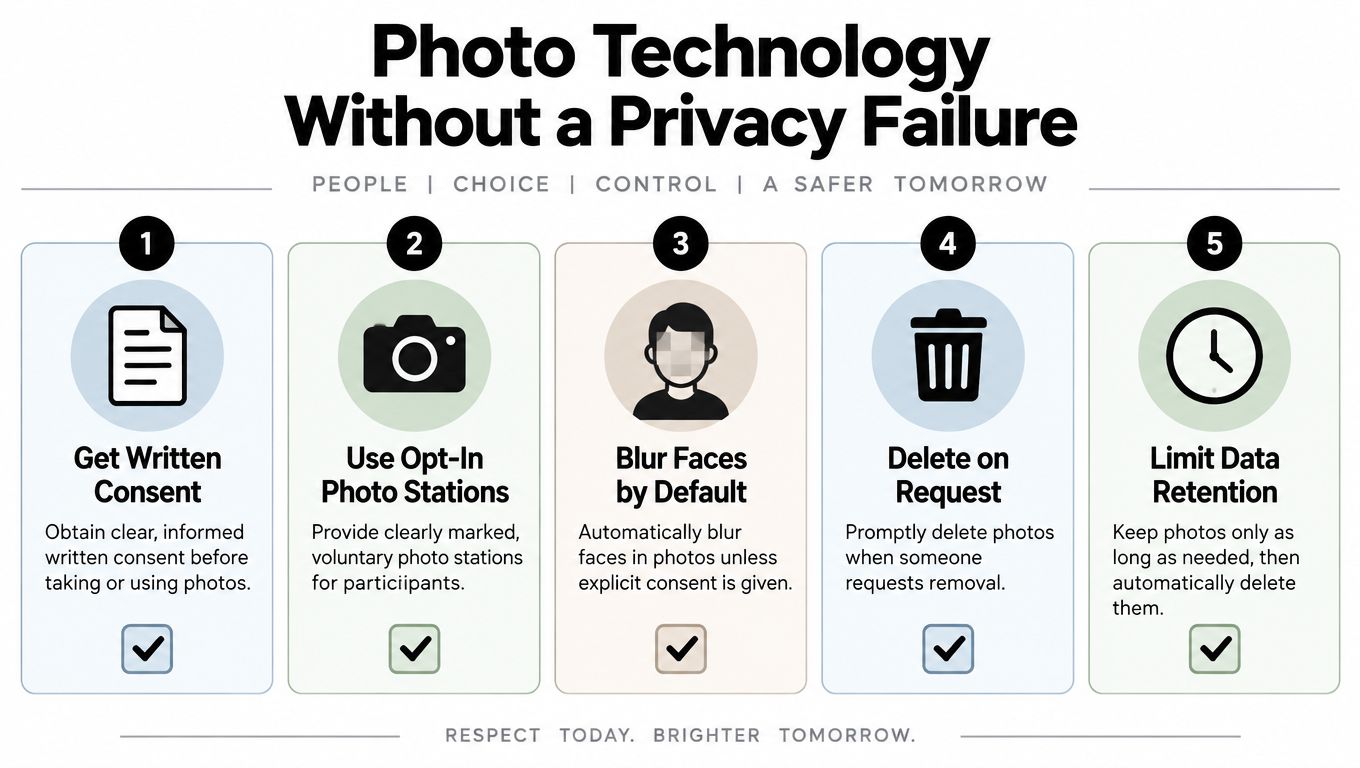
A permission-first workflow
Before photography starts, disclose what the feature does, what data it processes, who controls it, and how attendees can choose not to use it. Offer a non-biometric route, such as browsing a restricted gallery by event, time, category, or photographer.
Keep access limited. Define retention and deletion periods before uploading images, document how deletion requests are verified, and brief photographers, volunteers, venue staff, and customer-service contacts on the answers they should give.
Ask every vendor:
- Processing: Where are images and matching data processed?
- Control: Who is the data controller, and who can export or access it?
- Opt-out: How does an attendee avoid matching or request removal?
- Retention: When are images, templates, and logs deleted?
- Minors: What safeguards apply to children and youth events?
- Training: Are images or biometric representations used to train a model?
- Transfers: Do images cross borders or move between subprocessors?
Trust is part of the attendee experience. A frictionless gallery with unexplained identification can damage the event it was meant to enhance.
An event photo access workflow should therefore support organiser controls and clear attendee choices. Don't describe face recognition as a default feature. Treat it as a decision that requires a lawful basis, documented permission, a fallback, and a way to answer questions before anyone scans a gallery.
A 30-Day Networking and Pitch Plan
Your first month of outreach should be small enough to finish and specific enough to generate replies. Instead of sending a generic CV to every local venue, choose one mentor, one venue coordinator, one supplier, and one peer working in your target niche.
During the first week, prepare a one-page case study and a short service offer. Ask a venue coordinator whether you can support registration or logistics during a shift. Ask a supplier if you may observe the pre-event briefing. Ask a peer whether they need help with guest communication, schedules, or post-event reporting. Each request should define the work and the time involved.
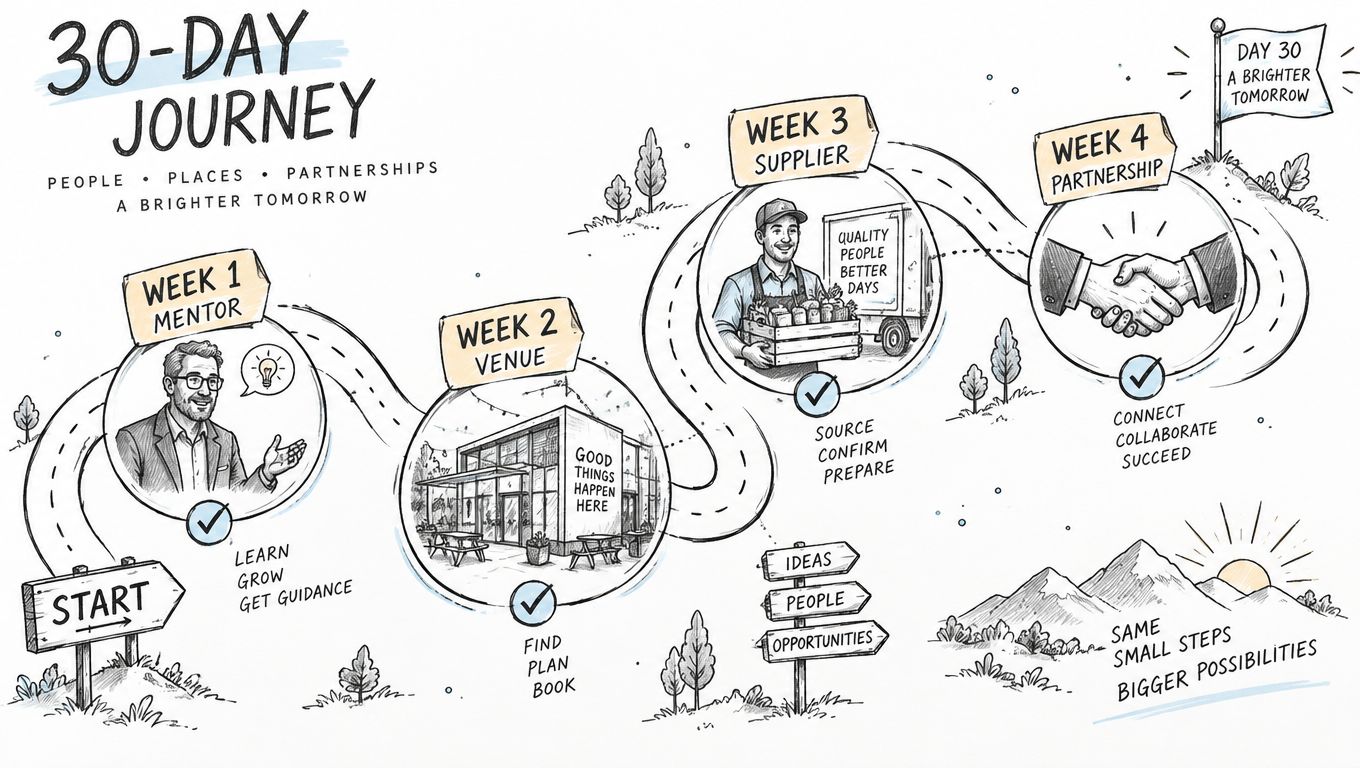
A workable calendar
Days one through seven: Choose the niche, revise your case study, list the documents you can produce, and contact four relevant people. Request a defined shadowing or assistant opportunity, not an open-ended favour.
Days eight through fourteen: Attend or support an event. Record details about the brief, site access, supplier handoffs, guest flow, risk controls, and closeout. Ask permission before adding documents or photographs to your portfolio.
Days fifteen through twenty-one: Turn the event into a concise debrief. Calculate the measures you captured, identify one operational failure or improvement, and convert that lesson into a standard operating procedure.
Days twenty-two through thirty: Pitch a contained service to a venue, organiser, photographer, or community group. Offer a defined outcome, such as a registration plan, supplier coordination, guest communications, or post-event photo distribution. Do not promise to “handle everything.”
A short pitch should show the case study, explain your role, and name the measures you will report. If photography is involved, specify who uploads files, when processing is complete, where the QR code appears, what consent language attendees see, who moderates the gallery, and what happens if the network fails. Those details show that you understand delivery, not only promotion.
Use the following video as a prompt for your event-planning review, then compare its ideas with the documents you are building:
Keep the first paid brief simple. Confirm the objective, scope, budget authority, supplier responsibilities, permissions, escalation path, and acceptance criteria in writing. Run a post-mortem within 72 hours, record the variance and feedback, and update the relevant procedure before sending the next proposal.
Saucial helps event teams create a controlled find my photos experience through an event photo sharing link, QR code photo gallery, and attendee retrieval workflow designed for post-event engagement. Visit Saucial to see how a privacy-conscious photo delivery process can become a measurable part of your next event case study.