The Best Way to Share Photo for Any Event in 2026

You've delivered a full event gallery, sent the link, and still receive messages asking, “Can you find my photos?” Attendees may have to scroll through hundreds of images, create an account, download an app, or search a folder that wasn't designed for mobile use. By the time they find a good image, the moment for sharing may have passed.
The best way to share photo depends on the event, audience size, device mix, privacy expectations, delivery speed, browsing needs, and the photographer's commercial goals. A gala fundraiser may need a branded gallery and approved social sharing, while a sports tournament benefits from private retrieval and print sales. A conference may need fast access without overwhelming attendees, and a wedding may prioritize a polished gallery for guests and family.
This guide compares Saucial, Google Photos, Apple Photos Shared Albums, Dropbox, Pixieset, Pic-Time, and Waldo Photos. The strongest workflow often combines a delivery platform with email, SMS, WhatsApp, social channels, or an on-site QR code photo gallery instead of relying on one channel alone.
1. Saucial
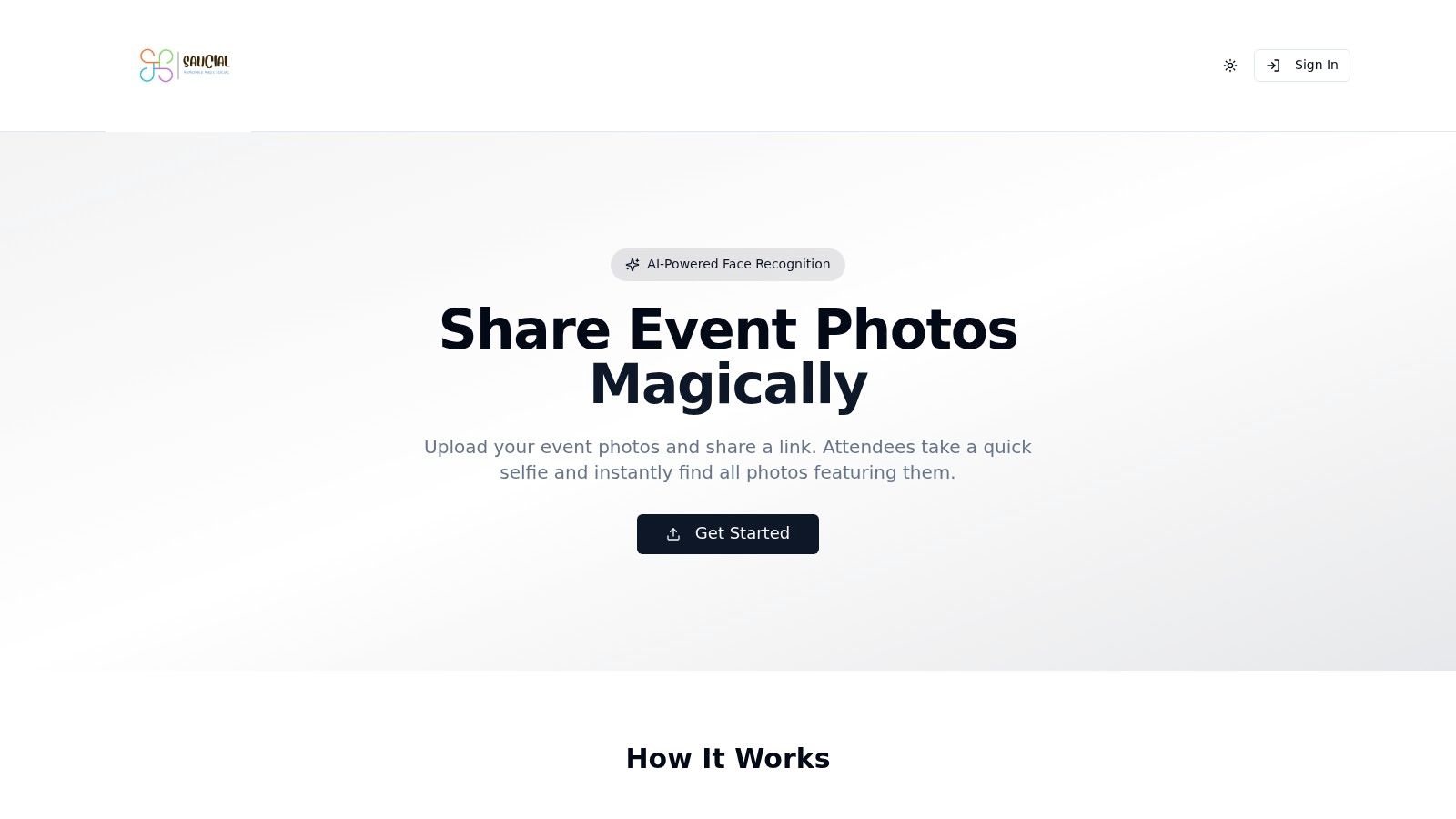
Saucial is built around the question attendees ask after an event, “Where are my photos?” Instead of handing guests a crowded Drive folder, the organizer or photographer uploads the event images, shares one event photo sharing link, and lets each attendee use selfie photo matching to find the images they appear in.
The workflow is particularly effective for galas, alumni dinners, fundraisers, festivals, sports tournaments, trade shows, and brand activations. Guests typically don't need an app, complex setup, or an account. They open the link, take a quick selfie, and receive a private view of relevant images. That makes the experience more useful than a generic album when attendees care about their own moments rather than browsing every image.
Saucial supports drag-and-drop upload, background facial processing, and optional QR distribution. An organizer can place the QR code on registration desks, table cards, lanyards, venue screens, or sponsor signage. That approach fits current mobile behavior. Pew Research documented the earlier shift toward mobile and social photo sharing, including the finding that 54% of internet users had posted original photos or videos online in 2013, while 47% had shared photos or videos found elsewhere in the same period in its analysis of online photo and video sharing.
Best fit for event teams and photographers
Saucial gives organizers control over what gets published, who can view it, and whether access is free, curated, or connected to approved paid upgrades. Photographers can use the delivery experience to offer prints, digital downloads, premium edits, featured sets, or sponsored and branded frames, subject to organizer approval.
Practical rule: Make the attendee's first action “find my photos,” not “learn how this gallery is organized.”
The main trade-off is procurement. Pricing and detailed plan features aren't listed publicly, so teams may need to contact Saucial or request a demo before approving a project. Face-recognition performance can also vary with low light, masks, extreme angles, obstructions, and very large galleries. Event teams should test representative images and publish clear consent and privacy language before launch.
For a gala fundraiser, Saucial can combine a branded gallery with sponsor-approved frames and controlled sharing. For a sports tournament, private selfie retrieval can reduce browsing and support sports tournament photo sales. For a conference or trade show, QR access and a single link can turn scattered event images into a practical post-event engagement channel.
2. Google Photos
Google Photos is a strong general-purpose choice when the organizer needs to distribute one album quickly to a mixed-device audience. A photographer can create a shared album, copy the link, and distribute it by email, SMS, WhatsApp, or an event website. Guests can usually view a shared link without installing the app or creating an account, which keeps the initial step simple.
The platform also supports invited contributors, so it works when attendees are expected to add their own images. That makes it suitable for a wedding where guests contribute candid moments, a small team gathering, or a community event collecting user-generated content. Partner sharing can also automate sharing for a defined person, although that workflow is more appropriate for ongoing personal libraries than a public event.
Where Google Photos works well
The biggest advantage is familiarity. Guests can browse on mobile or the web, videos play within the same environment, and organizers can distribute one album rather than many individual files. A conference team can publish a recap album through a post-event email, while a wedding couple can keep a collaborative album open for family contributions.
Google Photos also provides useful access controls, including the ability to reset a link and remove participants. But a link-based share is still broadly accessible to anyone who receives or forwards it. It doesn't provide the same attendee-specific discovery as a face recognition event gallery, and it offers little professional branding or built-in commerce for photographers.
A shared album is convenient for browsing. It isn't the same as a personalized “find my photos” workflow.
Storage deserves attention, especially when the photographer wants to preserve original-size files. Google Photos storage is pooled with Google One, and original-size storage may require a paid Google One plan. Before uploading, decide whether guests need high-resolution downloads or only convenient viewing.
For a gala fundraiser, Google Photos can work as a simple approved gallery, but it may not give sponsors or photographers enough presentation control. For a conference, it offers fast link delivery with low technical friction. If you want to direct guests toward a more personalized event experience, you can also send them through a Saucial attendee access page rather than asking them to browse a large album.
3. Apple Photos Shared Albums
Apple Photos Shared Albums are a natural fit for a private group that already uses iPhones, iPads, and Macs. The organizer creates a Shared Album, invites participants, and can allow them to view or contribute. Notifications, comments, and interactions feel familiar because they sit inside the Apple ecosystem.
That low friction can be valuable for a wedding family album, a private alumni dinner, or a small team gathering. Guests who already use Apple Photos won't need to learn a new gallery interface. Shared Albums also don't count against iCloud storage in the same way as a standard iCloud library, which can make them attractive for ongoing group sharing.
The limitations become clear at larger or more public events. Mixed-device audiences may have a less smooth experience, particularly when Android or Windows users are among the guests. Shared Albums also have item and invitation constraints, including a stated limit of up to 5,000 items per shared album, so organizers should confirm that the event volume fits the format before relying on it.
A private album, not a sales platform
Apple Photos doesn't provide meaningful branding, photographer analytics, attendee selfie matching, or a print storefront. A wedding photographer can deliver a private album through it, but selling prints or premium edits requires a separate process. That adds manual follow-up and makes it harder to measure which images attract attention.
Privacy still requires active management. Invitations should go only to approved recipients, and the organizer should decide whether contributors can add media. If the event has a broader audience, a browser-based event photo sharing link may be more accessible than an Apple-specific invitation flow.
For an iPhone-heavy wedding, Shared Albums are convenient for family contributions after the ceremony. For a sports tournament, conference, or trade show, the device and scale limitations make them less suitable. An organizer wanting controlled access can review Saucial's event settings before selecting a distribution method.
4. Dropbox and Dropbox Transfer
A gala organizer may need approved images for sponsors, while a wedding couple may want a final archive. Dropbox fits both cases when the deliverable is a file set rather than an interactive gallery. Photographers can sort folders by event, date, camera, or deliverable, then share a viewing or download link. Dropbox Transfer works well for a fixed package of originals, edited files, ZIP archives, or large video assets, without adding recipients to a shared workspace.
Its access controls support more deliberate distribution than a casual social album. Depending on the plan and feature, organizers can set view-only permissions, passwords, expiration dates, download restrictions, and link revocation. Viewer activity indicators can help a photographer or event team confirm whether a client accessed the delivery.
Strong for originals, weak for discovery
Dropbox suits high-resolution wedding delivery, campaign assets for a brand, and approved conference images for a sponsor's channels. At a sports tournament, it can also receive a structured package from the photographer for the organizer to distribute, rather than asking attendees to search through every image.
Attendee findability is the main weakness. A folder does not identify which photos feature a guest. People must browse filenames, thumbnails, and subfolders, which becomes frustrating on mobile when an event produces a large gallery. Download restrictions also cannot fully prevent screenshots or resharing, so organizers still need clear permission rules and distribution copy.
Use Dropbox for file handoff. Use a photo-specific experience for attendee discovery.
Dropbox offers less branding and commerce than Pixieset or Pic-Time. A photographer selling prints, digital downloads, premium retouching, or branded frames needs another storefront or a manual sales process. The workflow can combine Dropbox Transfer for client originals with Saucial's upload workflow for attendee-facing retrieval and easier sharing.
For a conference, keep Dropbox focused on internal delivery to the event team. For a wedding, use it for final archives. At a gala or sports tournament, pair it with a public-facing gallery when browsing, privacy controls, personal findability, or photographer revenue options matter more than straightforward file access.
5. Pixieset
Pixieset is designed for photographers who want a polished client gallery connected to sales. Its galleries support downloads, favorites, and proofing, while the integrated store can connect print products and digital downloads with partner-lab fulfillment. Optional website and Studio Manager tools extend the platform into contracts, invoicing, and client administration.
That makes Pixieset particularly suitable for weddings, portraits, and event photography where the client expects a professional presentation. A couple can review favorites, download approved images, and purchase prints without moving between unrelated services. A photographer can also use the gallery as a branded extension of their business rather than sending guests to a generic storage folder.
The commercial advantage
Pixieset is strongest when the photographer controls the client relationship and wants a conventional gallery-plus-store workflow. The plan notes also identify 0% commission on sales with paid Client Gallery plans, which should be checked against the current plan terms before purchase. The storefront gives photographers a clear route to sell prints and downloads after delivery.
The trade-off is discovery. Pixieset doesn't include face-recognition attendee matching, so guests generally browse categories or the full gallery. That can work beautifully for a wedding where people enjoy looking through the entire collection, but it becomes less efficient at a large sports tournament or high-volume brand activation.
Storage-based plans require housekeeping when a photographer hosts many large events. Marketing automation is also more limited than on some competitors, so the photographer may need to write and schedule the follow-up campaign independently.
For a wedding, Pixieset is one of the strongest choices for a browsable client gallery and print sales. For a gala fundraiser, it can support a branded gallery if the audience is willing to browse. For a trade show, combine it with an event photo sharing link or QR code rather than expecting every attendee to search manually. A photographer can also use Saucial's main event-sharing entry point when personal retrieval matters more than traditional proofing.
6. Pic-Time
Pic-Time suits photographers who treat gallery delivery as part of an ongoing sales and marketing workflow. It combines branded galleries, an integrated store, automated campaigns, slideshows, add-ons, and AI tools for album drafts and gallery layouts. Compared with a basic folder or shared album, it gives the event a more deliberate commercial presentation.
The workflow is particularly useful for wedding and event photographers who want to sell after delivery. Print products, albums, digital downloads, and approved add-ons can appear inside the gallery, so clients do not need a separate storefront. Automated follow-up keeps the gallery active after the event, provided the photographer has configured the campaigns carefully.
Strong sales tools require preparation
Pic-Time's commercial features can add work before launch. Marketing and store functions may depend on higher-tier plans, while automated campaigns require defined products, pricing, delivery rules, brand assets, and audience segments. Storage and plan selection also matter when several event galleries stay active at once.
For a wedding, that preparation can support a polished viewing and purchasing journey. At a gala fundraiser, the photographer and organizer can offer approved prints or special collections, but they should settle image permissions, revenue ownership, and fulfillment responsibilities first. A conference may not justify extensive sales automation unless sponsor content or attendee purchases are part of the event plan.
Sports tournaments present a different trade-off. Large galleries can be branded and distributed through event emails, QR codes, or social posts, yet attendees may still need to browse, choose images, and identify themselves manually. Pic-Time does not provide the same direct selfie-matching workflow as Saucial or Waldo Photos, so attendee findability depends more on gallery organization and distribution copy.
Use Pic-Time when premium gallery presentation and automated commerce are central. For fast, private first delivery, a photographer can use the Saucial upload workflow, then direct clients to a sales gallery when permissions and purchase options are ready.
7. Waldo Photos
Waldo Photos focuses on the same central event problem as Saucial, attendees want their own images without searching a giant gallery. Guests scan a QR code or open a link, submit a selfie, and receive the photos they appear in through a private delivery flow. That makes it a natural fit for camps, schools, sports, and large events where the photo volume can overwhelm a standard album.
The experience is designed for quick onboarding. The organizer can place QR codes around the venue, send the link through event communications, and configure attendee notifications. Monetization options may include prints and digital products, depending on the package and event setup.
Evaluate privacy before adoption
Face recognition requires more than a technical decision. The organizer should explain how attendee images and selfies are handled, define retention and access rules, and obtain any required permissions. Privacy concerns are substantial. One privacy survey reported that 80% of users were uncomfortable with facial recognition in photos, while 56% were uncomfortable with automatic sharing of photos containing people in its discussion of photo privacy controls.
Waldo's pricing may be quote-based or tiered, and detailed features can vary by package. Branding and storefront capabilities should be confirmed during procurement rather than assumed. Photographers should also establish who owns the attendee relationship, who approves sales, and how any print or download revenue is handled.
For a sports tournament, Waldo can reduce the burden of browsing and support direct sales. For a school or camp, organizers should be especially careful with parental permissions and child privacy. For a conference or gala, it can work when personal findability is more important than a large public gallery. The trade-off is that teams must be comfortable with facial matching and the associated consent language.
Top 7 Photo-Sharing Services Comparison
| Solution | Implementation Complexity 🔄 | Resource Requirements ⚡ | Expected Outcomes 📊 | Ideal Use Cases 💡 | Key Advantages ⭐ |
|---|---|---|---|---|---|
| Saucial | 🔄 Low for attendees; moderate for organizers (workflow & face‑processing setup) | ⚡ Cloud face-recognition, paid plan/quote, QR/selfie-ready attendees | 📊 Fast delivery, higher shares, measurable engagement & revenue lift | 💡 Galas, festivals, sports, brand activations, large social events | ⭐ Selfie matching, no-app access, monetization paths, granular privacy |
| Google Photos | 🔄 Very low (create album/link) | ⚡ Free tier; Google One for original-size storage; web/mobile access | 📊 Frictionless viewing and wide distribution at scale | 💡 Casual events, mixed audiences, quick link sharing | ⭐ Familiar UX, easy sharing, scalable links |
| Apple Photos (iCloud Shared) | 🔄 Very low for Apple users; invites only | ⚡ iCloud accounts; shared albums exempt from storage quota | 📊 Simple private co-collection for Apple-centric groups | 💡 Families, weddings, iPhone-heavy teams | ⭐ Native integration, notifications, low friction on Apple devices |
| Dropbox / Transfer | 🔄 Low to moderate (upload + link/transfer configuration) | ⚡ Paid plans for large files; desktop/web upload; transfer feature | 📊 Secure delivery of originals; not optimized for guest browsing | 💡 Delivering RAWs/originals, client handoffs, large file exchange | ⭐ Granular link controls (passwords/expiry), reliable large-file delivery |
| Pixieset | 🔄 Moderate (gallery & store setup) | ⚡ Paid storage plans, integrated lab fulfillment options | 📊 Professional presentation and straightforward client sales | 💡 Wedding, portrait, event photographers needing storefronts | ⭐ Branded client galleries, integrated print store, studio tools |
| Pic-Time | 🔄 Moderate–high (brand galleries + marketing automations) | ⚡ Paid plans for advanced commerce/automation; initial setup time | 📊 Increased post-event sales via automations and AI tools | 💡 Photographers focused on upsells, automated campaigns | ⭐ Strong e‑commerce, AI curation, marketing automations |
| Waldo Photos | 🔄 Low for attendees; moderate for organizers (consent & face setup) | ⚡ Cloud face-recognition, QR workflows, paid/quoted pricing | 📊 High immediate engagement; private delivery per attendee | 💡 Camps, schools, sports, large public events with many attendees | ⭐ QR + selfie matching, high engagement, reduces support requests |
Choose the Workflow That Matches the Moment
No platform wins every event. The right decision depends on whether guests need a fast link, a private find my photos experience, a conventional gallery, original files, or a sales path.
For a gala fundraiser, choose Saucial when rapid attendee retrieval, sponsor branding, controlled sharing, and approved monetization matter. Pixieset or Pic-Time can work when the audience is expected to browse a polished gallery and purchase products. Google Photos is adequate for a simple recap, but it offers less control over branding and personal discovery.
For a sports tournament, prioritize private selfie photo matching and sports tournament photo sales. Saucial and Waldo Photos are the most directly aligned with that workflow. Dropbox is better for delivering the full set to the organizer, not for helping each player find their own images.
For a conference or trade show, speed and low friction usually beat elaborate browsing. Use a QR code at registration, sponsor areas, and high-traffic locations, then send the same event photo sharing link through email, SMS, WhatsApp, and approved social channels. This fits the scale of modern image sharing. Industry reporting estimates that about 14 billion images are shared daily across social networks, including roughly 6.9 billion on WhatsApp, 3.8 billion on Snapchat, 2.1 billion on Facebook, and 1.3 billion on Instagram in its summary of photo-sharing statistics. Those figures support a messaging-first distribution plan, not a gallery-only strategy.
For a wedding, choose Pixieset or Pic-Time when the couple wants a premium client gallery, proofing, albums, and print sales. Choose Apple Shared Albums for a private, iPhone-heavy family collection, or Google Photos when guests use mixed devices. Saucial becomes stronger when the couple wants every guest to locate their own images quickly without browsing the complete gallery.
Roll out the gallery without creating support work
Before the event, confirm photo permissions, face-recognition consent language where relevant, retention expectations, and whether children appear in the images. Define who can view, download, share, and purchase photos. Decide whether the photographer can offer a photographer upsell to attendees, and get organizer approval for every product, price, and branded frame.
Upload the gallery, test it on iPhone and Android devices, and verify that the landing page loads quickly on mobile. Place the QR code at registration, tables, lanyards, screens, and other high-traffic areas. Send the event photo sharing link by email and SMS, publish it through approved social channels, and include concise copy that tells guests exactly what to do.
Timing matters. One event-photography analysis reports that 69% of guests share event photos on social media within 24 hours, while delayed delivery of two to three days can push that figure below 30% in its event photography benchmarks. Uploading on the same day, or as soon as the approved set is ready, helps organizers reach guests while the event is still fresh.
Saucial is the strongest fit when attendees need a fast find my photos experience and the event team wants controlled distribution plus photographer monetization. Google Photos and Apple Shared Albums win on familiarity, Dropbox wins on file delivery, Pixieset and Pic-Time win on conventional gallery commerce, and Waldo Photos offers another event-focused matching option. Choose the workflow that matches the moment, then distribute it through the channels your attendees already use.
Saucial turns event delivery into a private, mobile-first find my photos experience with selfie photo matching, an event photo sharing link, and an optional QR code photo gallery. Visit Saucial to explore a faster way to share event photos with attendees while keeping organizer controls and approved photographer upsells in the workflow.