What is photo proofing? A Quick Guide for Photographers
Think of photo proofing as the bridge between a photographer's camera and the client's final selections. It's the critical step where a client gets to review a set of images and pick their absolute favorites before any final edits or prints are made.
What Is Photo Proofing in Event Photography
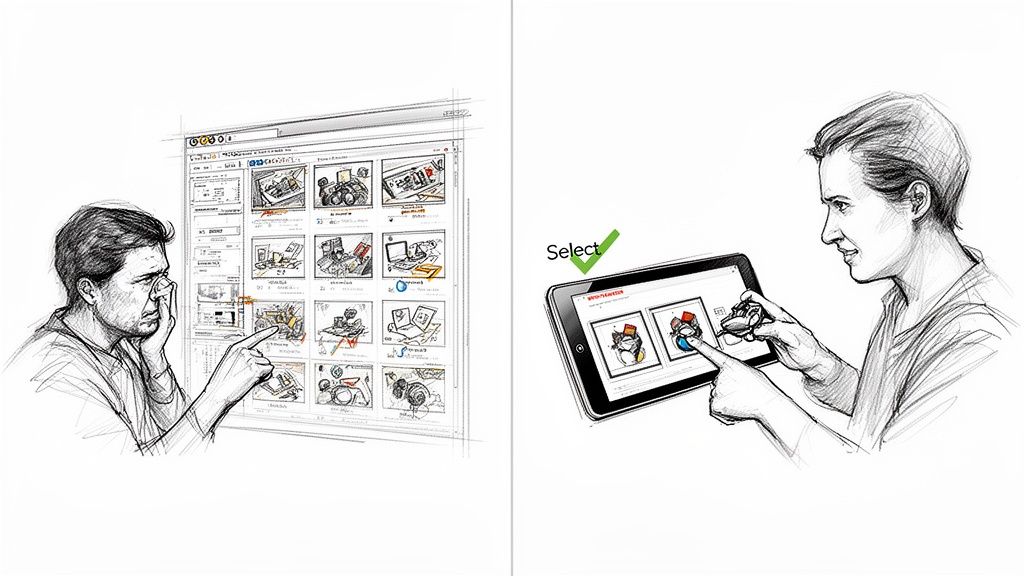
At its heart, photo proofing is a collaborative process. It's designed to make sure clients walk away with the images they truly love. But for event photography, this process has traditionally been a massive headache for everyone involved.
For years, attendees have been forced to scroll endlessly through huge, disorganized online folders. Imagine searching through hundreds, sometimes thousands, of watermarked photos just to find a single shot of yourself. It's a real chore.
This old-school approach creates a ton of friction. It's overwhelming for guests and a colossal time-sink for photographers, who end up playing tech support instead of focusing on their art. The whole thing feels clunky and outdated, leading to low engagement and lost opportunities for everyone.
The Shift to Smarter Solutions
Thankfully, modern solutions are flipping the script by getting rid of the manual search altogether. Instead of dumping everyone into one giant gallery, new platforms deliver a personalized "find my photos" experience. It’s a necessary change, as the old way of doing things is quickly becoming irrelevant.
In fact, the 2025 State of the Photography Industry report noted that traditional proofing services saw a jaw-dropping 40% decline in the event photography space. This signals a massive industry pivot toward smarter, more efficient tools. You can find more on this trend in the full Zenfolio report.
Photo proofing isn't just about showing pictures; it's about delivering a seamless, high-value experience that respects an attendee's time and makes them feel seen. The goal is to make finding and loving their photos effortless.
Why a Better Proofing Process Matters
The payoff for a smoother proofing workflow goes way beyond convenience. A great system can directly influence an event's success and a photographer's profitability.
For event organizers, a better process means:
- Increased Post-Event Engagement: When guests can easily find and share their photos, they become brand ambassadors, keeping the event's buzz going on social media for weeks.
- Improved Attendee Experience: A frustrating photo hunt can leave a bad taste, even after a fantastic event. Instant, easy access leaves a lasting positive impression.
- Valuable User-Generated Content (UGC): Making it simple to get professional photos encourages guests to post them, generating authentic marketing content for your next event.
For photographers, modern platforms like Saucial use selfie photo matching to create a face recognition event gallery. This turns what used to be a tedious administrative task into a powerful business tool, saving hours of work and creating new ways to sell directly to attendees.
Traditional vs Modern Photo Proofing at a Glance
The evolution from clunky galleries to intelligent systems has been a game-changer for event photography. This table breaks down the key differences between the old way of doing things and the modern approach.
| Feature | Traditional Proofing (e.g., Drive Folders) | Modern Proofing (e.g., Saucial) |
|---|---|---|
| Search Method | Manual scrolling through hundreds or thousands of photos. | Instant, AI-powered selfie search; attendees find their photos in seconds. |
| Attendee Experience | Frustrating, time-consuming, and often leads to giving up. | Fast, fun, and personalized, creating a 'wow' moment. |
| Privacy | All photos are public to anyone with the link, raising privacy concerns. | Photos are private by default; attendees only see their own images. |
| Engagement | Very low; most attendees don't bother searching. | Extremely high, leading to more social shares and user-generated content. |
| Monetization | Cumbersome and indirect, often requiring manual follow-up. | Built-in e-commerce allows for direct-to-attendee sales of prints and digital downloads. |
| Photographer Workflow | Requires hours of uploading, organizing, and managing links. | Automated and efficient; photographers just upload photos and let the system handle the rest. |
It's clear that while traditional methods got the job done, they left much to be desired. Modern systems are not just an upgrade; they represent a fundamental shift in how we handle event photos, focusing on creating a better experience for everyone.
From Manual Proofing to AI-Powered Galleries
Photo proofing has come a long way, and its story is really about technology finally catching up to our frustrations. If you've been around a while, you might remember the old days of purely physical proofing. Photographers would lay out contact sheets—big pages crammed with tiny thumbnail versions of every single shot from a roll of film—and clients would squint through a magnifying glass to pick their favorites.
When photography went digital, the process moved online, but it was still a mess. The first digital methods were basically just a digital version of the old way: photographers would email huge ZIP files or send a link to a clunky, password-protected website. It was a step up from paper, but for anyone at a big event, it was a digital nightmare. Imagine trying to find your face in a sea of thousands of photos. It was exhausting.
That friction had a real cost. Engagement was terrible, with selection rates often stuck between a measly 15-25%. It wasn't that the photos were bad; the process was just too much work. People would give up, and those great memories—and potential sales for photographers—were left to die in a forgotten online folder.
The Rise of Intelligent Curation
It was obvious something had to change, and that need drove some incredible innovation. The evolution of photo proofing for events has shifted from those painful manual reviews to smart, AI-driven personalization. This isn't just a gimmick; it's a change that's directly boosting sales in the photo printing market, which was valued at USD 25.16 billion in 2025 and is expected to reach USD 40.1 billion by 2035. You can find more details on this incredible growth at futuremarketinsights.com. A big reason for this boom is simply that it's getting easier for people to find and buy their photos.
The core problem was never the photos themselves; it was the delivery. The challenge was to close the gap between taking a great picture and getting it into the hands of the person who would cherish it most.
Modern platforms are tackling this problem by automating the most tedious part of the whole experience: the search. New tools like selfie photo matching and the face recognition event gallery aren't just buzzwords; they’re the common-sense solution everyone was waiting for.
From Manual Search to Instant Discovery
Picture this: you're at a big corporate gala. Instead of getting an email with a link to 1,200 photos you have to sift through, you see a sign with a QR code.
- You scan the QR code photo gallery link with your phone.
- A simple prompt asks you to snap a quick selfie.
- In seconds, the system scans the entire event gallery and pulls up just the 15 photos you're in.
That's the magic of a modern find my photos system. It turns photo proofing from a chore into a genuinely fun moment of discovery. For photographers, it gets rid of the headache of manual tagging and answering endless "where are my pictures?" emails. For guests, it provides instant gratification, making them far more likely to look at, share, and buy their photos. This isn't just a small improvement—it's a total reinvention of the event photography experience.
How Modern Proofing Drives Post-Event Engagement
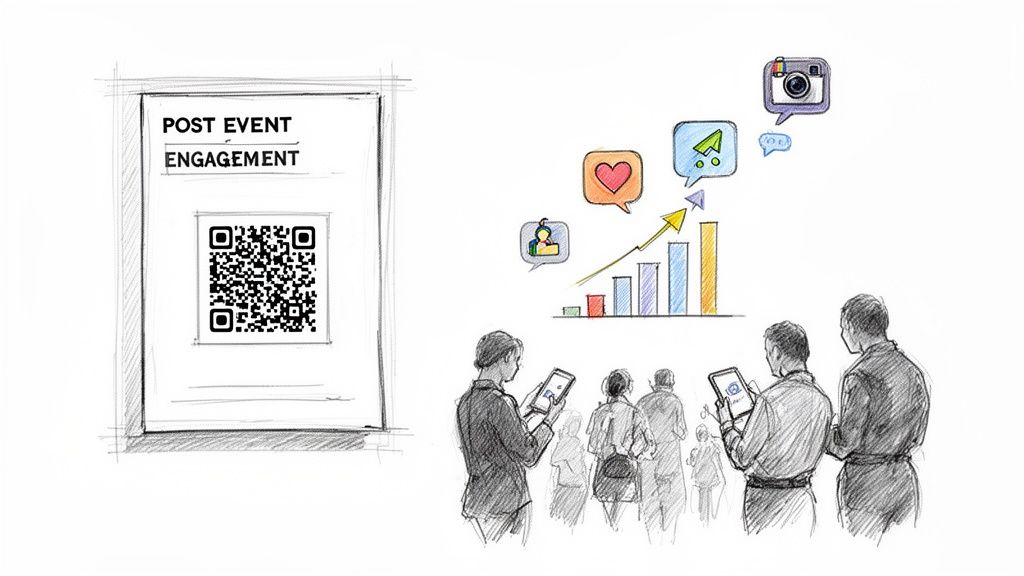
For any event organizer, the work doesn't stop when the last guest leaves. That post-event buzz is a golden opportunity to cement your brand message and keep the excitement going. But let's be honest—old-school photo delivery methods can kill that vibe in an instant. Nothing deflates enthusiasm faster than making people hunt through a massive, disorganized folder for their one good shot.
Modern photo proofing flips the script entirely. It turns what was once a point of frustration into a powerful tool for engagement, giving your event a much longer shelf life. The secret is simple: get people their photos immediately, without the headache.
Instead of sending out a generic link to a sea of images, picture a follow-up email with one clear, irresistible call to action: "Find your photos instantly." That small change makes all the difference.
Turning Photos Into Authentic Marketing
When people can find their professional photos in seconds, what do they do? They share them. Everywhere. This easy access is the fuel for a wildfire of authentic user-generated content (UGC). Each shared photo acts as a personal stamp of approval for your event, spreading across social media with genuine excitement.
This is more than just racking up likes and comments; it’s about organically expanding your brand's reach. We know that content shared by real people gets far more engagement than posts from a brand's own account. By making photo sharing a breeze, you're essentially turning your attendees into your most passionate and effective marketers.
The real value of event photography isn't just capturing moments—it's about making those moments shareable. An intelligent photo proofing system turns every attendee with a smartphone into a potential brand ambassador.
This approach neatly solves a huge headache for organizers: how to get high-quality, authentic content without a ton of manual work. It creates a natural, self-perpetuating cycle of engagement that keeps working for you long after the event is over.
The Power of a Single Link
The real beauty of a modern system lies in its simplicity. Organizers get a single event photo sharing link and a matching QR code photo gallery. This one asset is a Swiss Army knife for all your post-event marketing.
You can weave this link into all your follow-up communications:
- "Thank You" Emails: Drop in a big, bold button that takes attendees right to their photos.
- Social Media Posts: Share the link across Instagram, LinkedIn, and Facebook to pull your audience back in.
- Post-Event Surveys: Offer instant photo access as a little thank-you for filling out a feedback form.
This strategy does two things at once. It delights your attendees by giving them instant access to great memories, which reinforces the positive experience they had. It also gives them a compelling reason to open your emails and engage with your brand one more time.
What used to be a logistical nightmare—distributing thousands of individual photos—is now a single, high-impact touchpoint that requires almost no effort from your team. That’s the power modern photo proofing brings to the table.
A New Way to Earn: More Than Just a Time-Saver
For any working photographer, switching from manual photo sorting to an AI-powered delivery system is more than just a workflow tweak—it's a fundamental shift in how you can run your business. The most immediate win is getting your time back. All those hours spent manually tagging photos or answering a flood of "Can you find my picture?" emails are suddenly gone, freeing you up to focus on what actually makes you money: shooting, editing, and landing the next gig.
But the real game-changer isn't just the time you save; it's the entirely new income streams that open up. These modern platforms turn a simple photo gallery into a live marketplace where you sell directly to the event attendees. Instead of your only paycheck coming from the event organizer, you now have a direct line to the people who value the photos most—the ones in them.
This is a massive shift. The professional photography world is projected to hit USD 60 billion in services by 2026, but the old ways of doing things are fading fast. Traditional photo proofing has already dropped by 40% in major event categories, largely because it was so clunky. In the past, maybe 10-20% of attendees would actually sift through a massive, disorganized gallery. Now, with a face recognition event gallery that lets people find their shots with a quick selfie or a simple event photo sharing link, engagement skyrockets, and the door to direct sales swings wide open. You can dig into more of these photography industry statistics at behindmud.com.
From Delivering Files to Making Sales
This new approach makes it easy to offer upsells that were once a logistical nightmare. Photographers can now build a range of premium products right into the viewing experience, all on autopilot.
Here are a few ways photographers are cashing in:
- Selling Prints: Attendees can order high-quality prints of their favorite shots with a couple of clicks. This taps into the booming photo printing market, which is on track to grow from USD 26.4 billion in 2026 to USD 42.1 billion by 2036.
- High-Res Downloads: Give away web-sized, watermarked images for social media, but charge a fee for the full-resolution, print-ready files.
- Premium Retouching: Offer professional editing services as an add-on for attendees who want their best photos to look absolutely perfect.
- Branded Overlays: Team up with event sponsors to offer custom-branded photo frames, creating a new revenue stream for you and added value for them.
The old model was about delivering a service to one client—the organizer. The new model is about opening a storefront for hundreds, or even thousands, of potential new customers at every single event.
How It Works in the Real World
Picture a huge youth sports tournament. A photographer might shoot thousands of action shots over a weekend. Instead of just selling a single package to the league for a flat fee, they can use a platform like Saucial that lets every parent instantly find photos of their kid and buy prints or digital packages. The earning potential just multiplied.
The same goes for a black-tie gala. Guests can find their red-carpet photos on their phones before the night is even over and buy them right then and there. This kind of system finally lets photographers capture the true value of their work by connecting it directly with the people who will treasure it for years to come.
A Step-By-Step Guide to Using Modern Photo Proofing
Today’s photo proofing tools have turned a once-dreaded chore into a surprisingly simple process. The real magic is how effortless it is for both the person running the event and the guests who just want to see their pictures.
Let’s walk through how it works from both sides of the camera.
For the Photographer or Event Organizer
Your goal is to get photos into the hands of your clients or guests without spending hours glued to a computer. This is where modern systems really shine.
- Upload Your Photos: After the event, you just drag and drop all your photos into the platform. You don't need to sort them or tag anyone beforehand—the system is built to handle that for you. Our guide on how to easily upload your event photos breaks down just how quick this is.
- Let the AI Work: The second your photos are uploaded, an AI gets to work scanning every image and identifying the faces. This all happens behind the scenes, so you can grab a coffee or start on your next project while the private galleries build themselves.
- Share a Single Link: The platform gives you one single link and a matching QR code for the entire event. That's it. This is the only thing you need to share with everyone, whether you're sending it in an email, putting it on a screen at the venue, or posting it online.
This simple, three-step workflow completely gets rid of the hassle of creating, sending, and managing countless individual photo galleries.
For the Event Attendee
From the guest's perspective, the experience is all about instant gratification. It’s private, fast, and honestly, a little bit fun. No apps, no sign-ups, no friction.
The core idea is to remove every possible barrier between attendees and their photos. A quick selfie is all it takes to unlock their personalized memories, making the experience feel magical, not manual.
An attendee just scans the event’s QR code with their phone. They’re prompted to take a quick selfie, which is used only for that one-time search. In a matter of seconds, the system matches their face to the photos from the event and presents them with a private gallery of just their pictures.
This infographic shows how this streamlined process unlocks new value for photographers by saving time and enabling direct sales.
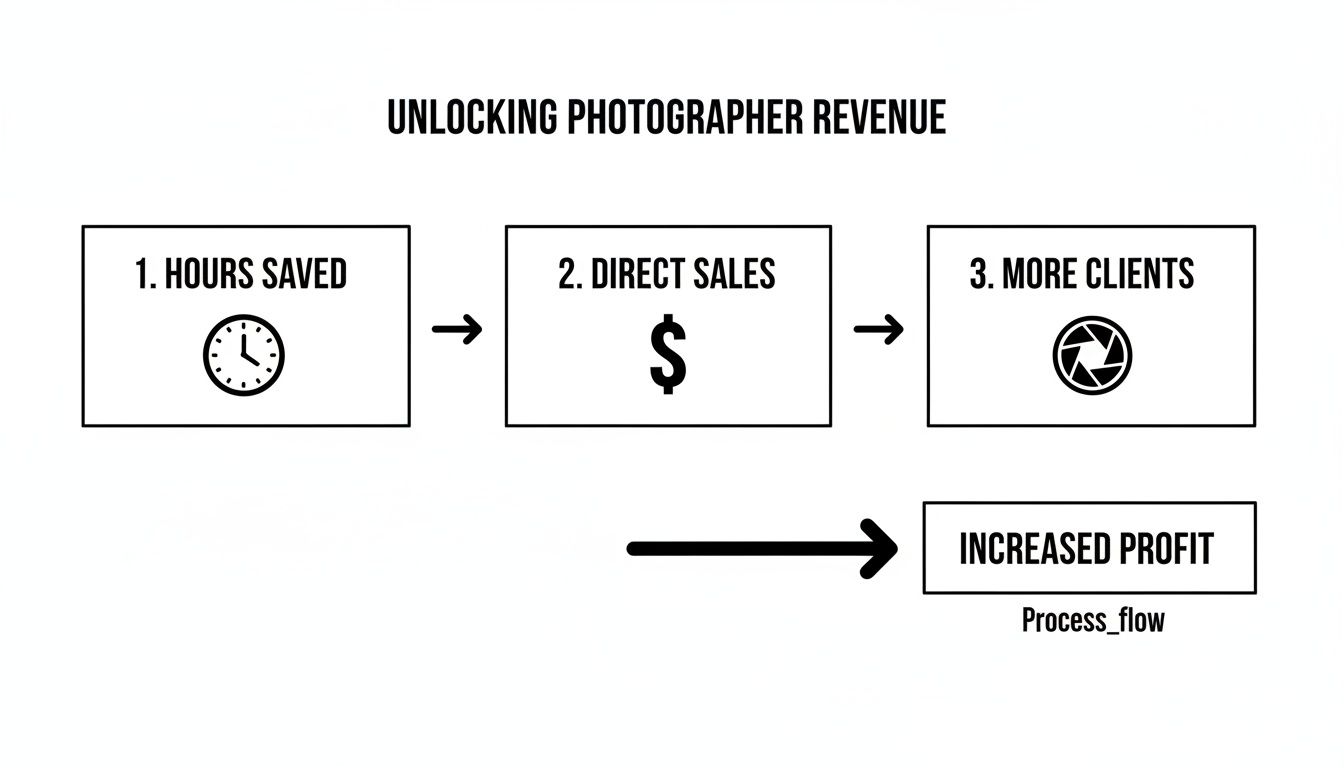
This workflow isn't just about convenience; it's a powerful model for turning photo delivery into a business-building tool. When you save hours on tedious manual work, you free up that time for finding new clients and generating more revenue.
A Practical Guide to Privacy and Photo Sharing
Let's be honest: the moment you bring up AI and personal photos, alarm bells about privacy start ringing. It's a valid concern, and any modern photo platform worth its salt is built with privacy at its core. The whole system is designed around a permission-first model, giving both you and your guests the final say.
This is a world away from the old, risky methods. Think about it: sending out a single link to a public cloud folder is a privacy nightmare. Anyone who gets their hands on that link can browse—and usually download—every photo from your event. Suddenly, your guests have zero control over who sees their pictures.
AI-powered galleries flip that script entirely. They act as a secure gateway, requiring each person to verify who they are with a quick selfie before they can see their photos. No more scrolling through hundreds of pictures of strangers.
How to Build Trust with Your Guests
For this to work smoothly, you have to be crystal clear with your attendees. People are much more comfortable when they understand exactly what's happening with their images.
Here are a few simple ways to be transparent:
- Put Up Clear Signage: Place QR codes around your event with simple, friendly instructions explaining the “Find My Photos” feature.
- Give a Heads-Up: Mention how photo access will work in your pre-event emails or on your event website.
- Use Reassuring Language: Make it clear that their selfie is only for a one-time search. Emphasize that it isn't stored or used for anything else.
When you're proactive like this, you're not just sharing photos; you're showing that you respect your guests' data.
The key is to treat privacy as a feature, not a footnote. You're giving attendees direct, secure access to their own memories, which creates a far better experience while respecting their personal information from the get-go.
At the end of the day, a modern photo proofing system is simply a safer, more considerate way to share memories. You, the organizer, keep complete control over the master gallery, while your guests get a private, personalized album of their best moments. To see how these controls work, you can dive into your event settings.
Got Questions? Here Are Some Straight Answers
Jumping into new tech always brings up a few questions. Let's tackle some of the most common ones we hear from event organizers and photographers about modern, AI-powered photo proofing.
How Does This "Selfie Matching" Thing Actually Find My Photos?
It’s actually pretty clever and simpler than it sounds. Think of it like a digital coat check for your face.
When a guest snaps a selfie, the system creates a temporary, unique map of their facial features—almost like a fingerprint, but for faces. It then scans the entire event photo library, looking for other images that match that specific map.
Once it finds a match, it pulls all of those photos into a private, personal gallery just for that guest. The selfie itself is only used for that one search and isn't kept, which keeps the whole process private and secure from the start.
Is a Gallery That Uses Face Recognition Really Secure?
Yes, and it's a massive security upgrade from the old way of doing things.
Remember those days of sending out a single link to a Google Drive or Dropbox folder? Anyone with that link could see and download every single photo. That’s a huge privacy risk.
Modern platforms flip that model on its head. Photos aren't just sitting in an open folder. Instead, each guest has to prove who they are (usually with that quick selfie) to see only their own images.
The power shifts from one public link to thousands of private, individual keyholes. It's a system built on controlled, permission-based access, which means guest privacy is the default setting, not an afterthought.
This design completely eliminates the problem of unauthorized people browsing through everyone's pictures. If you want to see exactly how these permissions work, you can create a free account and explore the platform's security features yourself.
Can I Give Away Some Photos for Free but Sell Others?
You bet. This is actually one of the smartest ways to use these platforms.
A really popular approach is to offer free, web-sized, or watermarked photos to every single attendee. This gets people excited and encourages them to share their memories all over social media, which is fantastic free marketing for your event.
At the same time, you can offer premium options right in the same gallery. Think high-resolution digital downloads, professional prints, or custom-edited images. This hybrid model is the best of both worlds—it keeps every guest happy while opening up a new revenue stream from those who want a little something extra.


