Photography Pricing Guidelines That Win More Clients
Setting your photography prices can feel like a shot in the dark, but it doesn't have to be. The most common mistake I see photographers make is plucking a number out of thin air or, even worse, copying a competitor's rates. That's a surefire way to burn out and struggle financially.
A truly sustainable photography business is built on a solid financial foundation. Before you ever think about what to charge for a wedding, a corporate event, or a portrait session, you need to know your numbers—cold. This means moving past guesswork and getting real about what it costs to run your business and live your life.
Build Your Pricing from the Ground Up
The secret to confident, profitable pricing isn't about what others are charging; it's about what you need to earn. It all starts with a simple but crucial calculation: your Cost of Doing Business (CODB). This is the baseline figure it takes to keep your business running for a full year, even if you didn't book a single client.
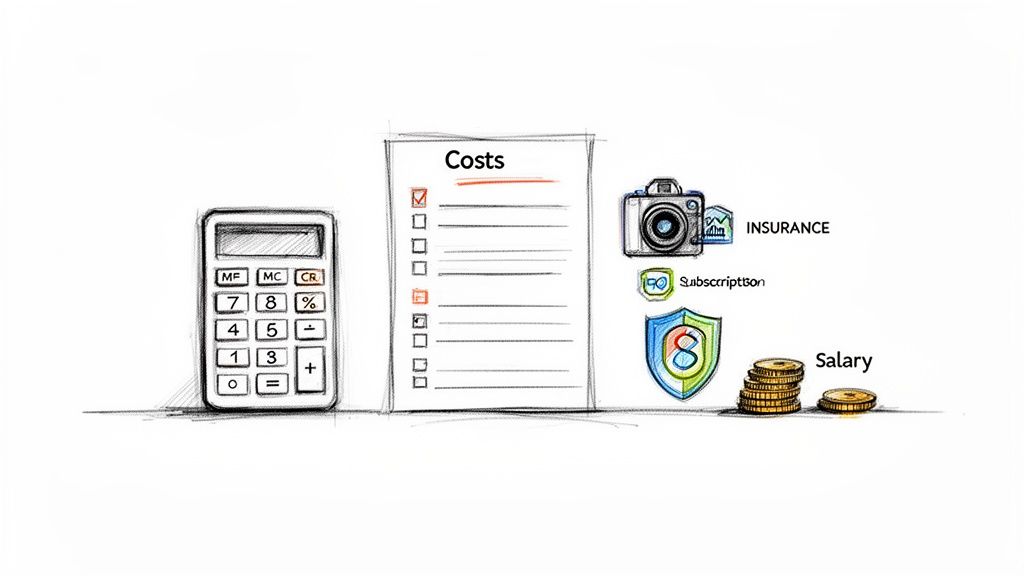
Tally Every Single Business Expense
Think of your CODB as the engine of your business—it needs fuel to run. To figure it out, you have to track every single expense, no matter how small. It’s easy to remember the big stuff, like a new camera or lens, but it’s the dozens of smaller, recurring costs that can quietly sink your budget.
Your expenses generally fall into two buckets:
- Fixed Costs: These are the predictable bills you pay every month, rain or shine. Think insurance, software subscriptions like Adobe Creative Cloud, gallery delivery services, and website hosting.
- Variable Costs: These expenses pop up depending on how much you're working. This includes things like gas for driving to a shoot, client gifts, paying a second shooter, or running a targeted ad campaign.
Don't forget the "invisible" costs, either—things like depreciation on your gear, office supplies, online courses to sharpen your skills, and, of course, taxes. Getting all of this down on paper ensures you aren't accidentally paying for business expenses out of your own pocket.
To make this tangible, let's look at a simplified annual breakdown for a freelance event photographer.
Sample Cost of Doing Business (CODB) Annual Breakdown
| Expense Category | Example Items | Estimated Annual Cost |
|---|---|---|
| Gear & Equipment | Camera bodies, lenses, lighting, bags, memory cards | $3,500 |
| Software Subscriptions | Adobe Creative Cloud, gallery platform (Saucial), CRM | $1,200 |
| Marketing & Website | Hosting, domain, ads, bridal show fees | $2,000 |
| Insurance & Legal | Liability insurance, equipment insurance, contracts | $1,500 |
| Office & Admin | Phone bill, internet, office supplies | $1,800 |
| Professional Development | Workshops, courses, memberships | $1,000 |
| Taxes & Fees | Self-employment tax, business license | $5,000 |
| Total Annual CODB | $16,000 |
This is just a starting point, but seeing the numbers laid out like this makes it clear just how much it costs to simply open for business.
Determine Your Personal Salary
Once you know what your business needs to survive, it's time to pay yourself. Your salary is not a bonus or a luxury; it's a legitimate and critical business expense. You need to decide on a realistic annual salary that covers your personal life—rent, groceries, bills, and maybe even a little for savings.
This number should be treated as a non-negotiable line item. By baking your salary into your business costs from the start, you guarantee that every single job you book is contributing to your personal financial health.
So many photographers fall into the trap of paying themselves with whatever is "left over" at the end of the month. This treats your own income as an afterthought. Flip the script: build your salary directly into your pricing to create a career that actually sustains you.
This three-step process—calculating costs, setting a salary, and adding profit—is the bedrock of any smart pricing strategy.
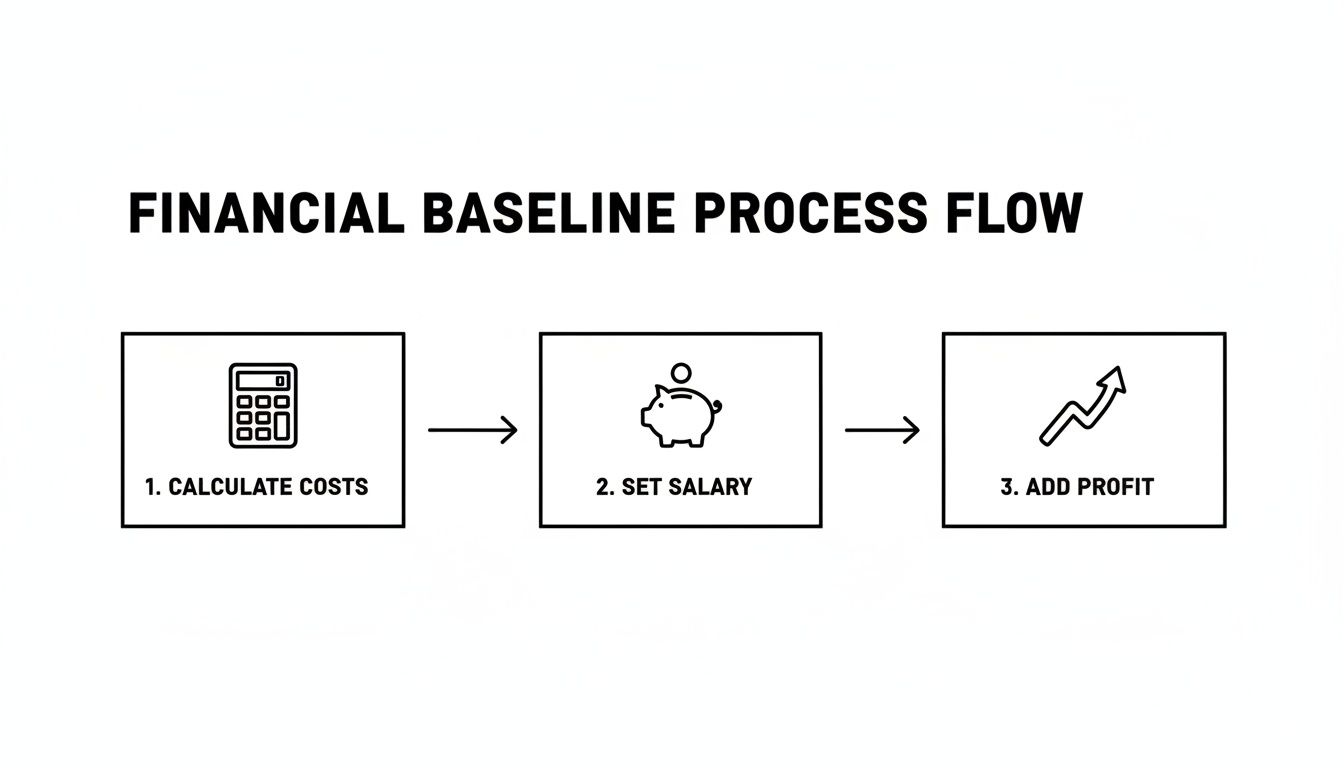
As you can see, profitability isn't an accident. It's a deliberate calculation that supports both your business operations and your life outside of work.
Add a Healthy Profit Margin
Here's something a lot of people miss: profit is not the same as your salary. Your salary pays you for the work you're doing right now. Profit is the money that fuels your business's future. A healthy profit margin—I recommend 15-30% on top of your CODB and salary—is absolutely essential for growth.
This extra cushion is what lets you:
- Invest in new gear without taking on debt.
- Breathe easier during slow seasons.
- Expand your marketing to land bigger clients.
- Build a cash reserve for emergencies or unexpected opportunities.
Without profit, your business is just surviving. With it, your business can truly thrive.
The global photography market was valued at a massive USD 35.78 billion in 2024, which shows just how much opportunity is out there. In the US, for example, experienced event photographers can command daily rates anywhere from USD 1,000 to 4,000. They can do this because they've structured their pricing correctly and deliver incredible value. This is where a tool that creates a seamless "find my photos" experience can be a game-changer, helping photographers manage huge events and generate an extra 15-30% in upsell revenue. If you want to dive deeper into the numbers, you can find more detailed photography industry statistics on Behind The Mud to see how this all breaks down.
Selecting a Pricing Model That Fits Your Work
Alright, you've crunched the numbers on your business costs and know what you need to make. Now for the fun part: figuring out how you’ll actually charge for your work. There’s no single right answer here. The best pricing model really depends on what you're shooting, who you're shooting for, and the nature of the job itself.
Think of these different models as tools in your professional toolkit. You wouldn't use a hammer to turn a screw, and you wouldn't charge by the image for an eight-hour wedding. Picking the right approach makes your value crystal clear to the client and guarantees you’re paid fairly for your time, talent, and all the work that happens behind the scenes.
Pricing by the Hour
Charging by the hour is as straightforward as it gets. It’s perfect for shorter, well-defined jobs where clients can easily understand what they're paying for. This model shines when the scope is contained and the deliverables are simple.
I find myself falling back on hourly rates for gigs like:
- Corporate Headshots: A company books you for a two-hour block at their office to get updated shots for 10 employees.
- Small Events: You're hired to cover the first hour of a child's birthday party or a quick ribbon-cutting ceremony.
- Extra Coverage: A wedding client who already booked a package realizes they want you at the rehearsal dinner for an extra hour.
Here’s a pro tip: always set a minimum booking time, usually two or three hours. This makes sure even the smallest jobs are worth your while after factoring in prep, travel, and client communication. It prevents you from getting stuck with a one-hour gig that costs you more in overhead than you actually make.
Pricing Per Image
The per-image model, sometimes called à la carte, is a staple in the commercial, product, and real estate photography worlds. With this setup, the client pays a set fee for each final, edited image they choose. This is great because it separates your shooting time from the final product, giving the client total control over their final spend.
Imagine a restaurant hires you to photograph their new menu. You might spend three hours at the location, capturing 50 different dishes. Afterward, you send them the proofs, and they decide to purchase the rights to 15 specific images for their website. Your invoice is based on those 15 photos, not the three hours you were on-site.
The per-image model is powerful. It ties your income directly to the tangible value you deliver, pushing you to create amazing work in every single frame because each selected photo adds to your bottom line.
This approach doesn’t really work for dynamic events like weddings or festivals. For those, the goal is to tell a complete story, not just deliver a specific number of standalone shots.
Project-Based Flat Fees and Packages
For bigger, more involved events, project-based pricing—which you'll usually present as packages—is the industry gold standard. This model bundles all your services (shooting time, deliverables, and any extras) into one flat fee. This gives clients peace of mind with a predictable cost and lets you price based on the total value and complexity of the event, not just the hours you're holding a camera.
A wedding is the classic example. A standard package might look something like this:
- 8 hours of continuous coverage
- A second photographer
- An online gallery with 500+ edited images
- A complimentary engagement session
This is my go-to for any event with a lot of moving parts, like a multi-day conference, a music festival, or a big corporate gala. A flat fee covers all the pre-event consultations, the team you might need, the tricky logistics, and the thousands of photos you'll spend hours culling and editing later. It’s a foundational part of any smart photographer’s pricing strategy because it protects your time while giving the client exactly what they expect.
Choosing the Right Model for the Job
So, which model is best? The one that makes sense for the client’s needs and the reality of the event. A local 5K race, for example, probably can't afford a huge flat fee. A great alternative is to offer to shoot the event for a smaller base fee and then make additional income by selling photos directly to attendees through a QR code photo gallery. It's a win-win.
On the flip side, a major brand activation needs a predictable budget. A comprehensive flat-fee package that includes instant delivery for their social media team is a much better fit than a confusing hourly rate that could spiral. Once you get comfortable with these different models, you can put together proposals that are both profitable for you and a perfect fit for any client who walks through your door.
How to Structure Packages That Actually Sell
Let's be honest, creating photography packages feels less like a science and more like an art form. A great package structure doesn't just list what you do; it tells a story. It guides your client to the perfect solution for their event, making them feel understood and confident in their decision. When you get this right, your average booking value goes up without you ever having to do a hard sell.
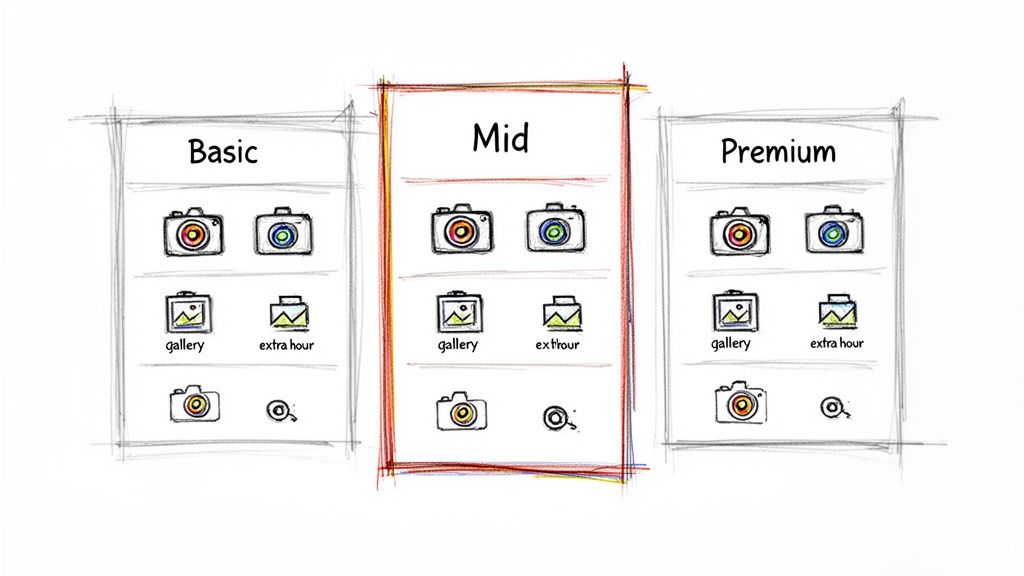
The secret? A tiered approach, usually with three distinct options. This isn't just about giving people choices; it's about framing the value. By presenting a basic, a standard, and a premium package, you're using a psychological principle called "choice architecture." It naturally positions your middle option as the most reasonable, popular choice, preventing the all-too-common race to the bottom on price.
Building Your Three Tiers
So, how do you actually build these tiers? The trick is to create a logical flow of value from one package to the next. You want each step up to feel like a smart, justifiable upgrade, not just a random price jump. Think of each package as solving a specific problem for a specific type of client.
The Basic Package (The Essentials): This is your foot in the door. It needs to cover the absolute bare-bones necessities for a client with a strict budget or very simple needs. It's designed to be a starting point, but it should intentionally leave out a few of the features you know most clients really want.
The Standard Package (The Sweet Spot): This is your money-maker. You want 70-80% of your clients to land right here. It should include everything from the basic tier, plus the high-impact services clients are looking for—things like more hours, a second photographer, or a quick-turnaround digital gallery. Price this to be the absolute best bang for their buck.
The Premium Package (The All-Inclusive Experience): This one is for the client who wants it all and doesn't want to think about the details. It bundles everything from the lower tiers with luxury add-ons like a fine art album, extended coverage, or exclusive post-event services. Even if only a handful of clients book it, its higher price point makes your standard package look like an even better deal.
A key takeaway here is making the jump in value from Basic to Standard really significant. It should be a no-brainer to upgrade. This isn't about upselling; it's about helping the client see that the middle package is clearly the smartest investment.
Bringing It to Life: Real-World Package Examples
Theory is great, but let's see how this plays out in the real world.
Scenario A: A Corporate Awards Night
The client needs polished photos of the award winners, candid networking shots, and great branding content for their social media and marketing teams.
- Bronze Package: 3 hours of coverage with one photographer. You'll get candid shots of guests mingling and crisp photos of the award presentations on stage. A digital gallery is delivered within a week.
- Silver Package: 5 hours of coverage with one photographer. This includes everything from the Bronze package, but adds posed group photos and a curated set of images perfectly optimized for social media sharing.
- Gold Package: 8 hours of coverage with a second photographer to ensure no moment is missed. You get everything from Silver, plus a branded online gallery with instant photo access for guests to download and share.
Scenario B: A Community Music Festival
Here, the organizer needs to capture the energy. They need dynamic coverage of multiple stages, the crowd, sponsor activations, and an easy way for attendees to find and share their photos.
- Headliner Package: 4 hours of single-photographer coverage, focused entirely on the main stage and the crowd. An online gallery is delivered after the festival.
- VIP Access Package: 8 hours of coverage with a second shooter, allowing you to capture multiple stages and sponsor areas simultaneously. It also includes an instant, shareable gallery link for the social media team to post in real-time. You can make this happen smoothly when you upload event photos to a central gallery that handles all the heavy lifting for you.
- All-Access Pass Package: Full-day coverage with two photographers and a dedicated editor on-site for real-time delivery to social channels. We're talking photos ready in minutes, not days. This also includes a QR code photo gallery for attendees, letting them find their pictures instantly with cool tech like selfie-based photo matching.
Notice how in both scenarios, the middle package hits that sweet spot. For the corporate client, the social media assets are a must-have. For the festival, a second shooter and an instant gallery are game-changers. By bundling these high-value services, you make the standard package the most logical and irresistible choice.
Here's a quick look at how those corporate packages compare side-by-side.
Example Tiered Packages for a Corporate Event
This table breaks down how features and value scale across the three tiers for a typical corporate event. It's a great visual tool to help clients quickly understand the benefits of each package and see why the standard option is often the best investment.
| Feature | Basic Package (The Essentials) | Standard Package (Most Popular) | Premium Package (All-Inclusive) |
|---|---|---|---|
| Coverage Time | 3 Hours | 5 Hours | 8 Hours |
| Photographers | 1 | 1 | 2 |
| Deliverables | Stage & Candid Shots | All Basic Features + Social Media Images | All Standard Features + Instant Gallery |
| Gallery Type | Standard Digital Gallery | Standard Digital Gallery | Branded, Instant Access Gallery |
| Post-Event Analytics | No | No | Yes |
| Price | $1,200 | $2,000 | $3,500 |
Presenting your options this way makes the decision-making process clear and stress-free for your client, empowering them to choose the package that truly fits their vision and budget.
Turning One Gig Into Many: How to Boost Your Profit with Upsells and Smart Tech
The fee your client agrees to in the contract? That’s just where your income starts. The real magic—and what separates a decent year from a fantastic one—happens when you strategically introduce add-ons and modern tools.
This isn't about nickel-and-diming anyone. It’s about offering more value that genuinely improves your client's experience. By thinking beyond just showing up and shooting, you’ll build a far more profitable and resilient photography business.
The Classic Upsells That Never Fail
Some add-ons are classics for a reason: clients want them, understand them, and are happy to pay for them. These should be a standard part of your offerings, presented as easy upgrades to your main packages.
Here are a few tried-and-true options you should have in your back pocket:
- Extra Hours of Coverage: This is the easiest upsell in the book. Events almost always run late. Having a set hourly rate for overtime makes it a simple decision for the client.
- A Second Photographer: For big events, a second shooter is a game-changer. You can’t be in two places at once, and framing this as a way to guarantee comprehensive coverage makes it an easy sell.
- Gorgeous Albums and Prints: Digital files are expected, but a high-quality, tangible album is a family heirloom. Offering beautifully designed albums, canvas prints, or custom framing is a high-margin service that clients truly cherish.
- Engagement or Pre-Event Shoots: Perfect for weddings, this session does more than just generate extra income. It’s your chance to build a real connection with the couple before the big day, which always leads to better, more relaxed photos.
Present these as optional add-ons. It keeps your base packages looking affordable and empowers clients to build the exact experience they want, which almost always means a higher total invoice for you.
Using Tech to Open Up New Revenue Streams
Traditional upsells are your bread and butter, but technology is where you’ll find the real growth opportunities. The old way of just sending a gallery link and calling it a day is officially dead. Today's tools can turn the photo delivery process itself into an automated profit machine that works for you long after the event is over.
The biggest shift I've seen in event photography is the move from a one-to-one transaction (you and the organizer) to a one-to-many model where you're selling to every single attendee. It completely changes the financial potential of a single event.
This is where platforms built for the modern photographer come into play. Think about a large corporate conference or a weekend-long sports tournament. Instead of just delivering a massive folder of images to the organizer, what if you could empower every single person there to find and buy their own photos?
It’s possible with tools that offer a "find my photos" experience. A platform like Saucial and its AI-powered features can completely transform your workflow. Here's a quick look at how it works:
- You upload your entire photo gallery from the event.
- The platform uses selfie photo matching to figure out who is in each picture.
- You share one simple QR code photo gallery link with all the attendees.
- Guests snap a selfie on their phone and instantly get a private gallery of just their photos.
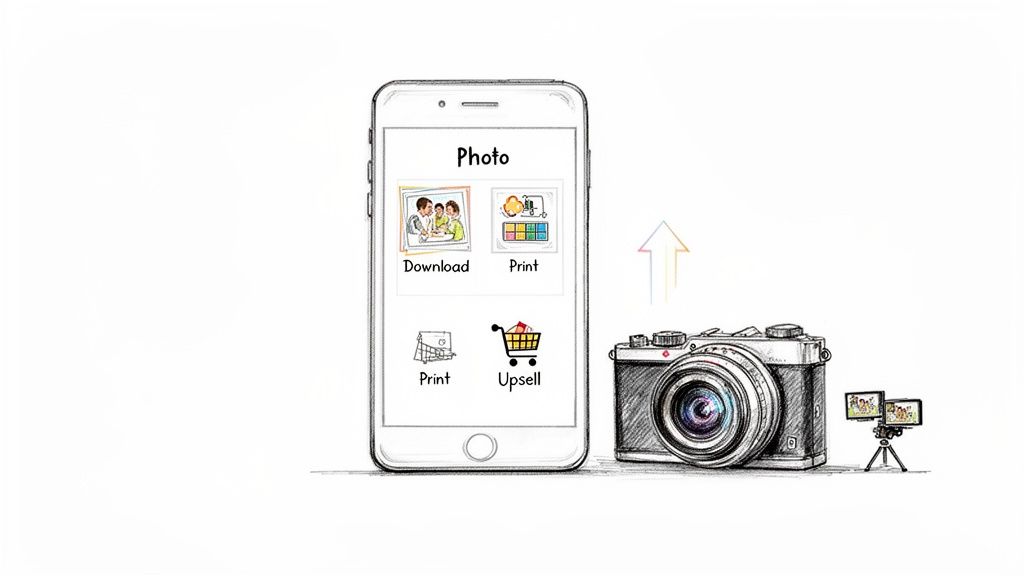
This is where the magic really begins. From that personal gallery, you can offer all sorts of paid options, creating a sales funnel that's completely frictionless for the user. It delivers an incredible experience for guests and automates what used to be a mountain of manual work for you.
Your Post-Event Sales Strategy
With the right setup, you can create a menu of products that attendees can buy directly from their phones, often boosting your total revenue by 15-30% or more per event.
Here are a few ideas for what you can sell directly to attendees:
- High-Resolution Digital Downloads: Let them buy individual photos or offer a discount on a bundle of their favorites.
- Prints and Merch: By integrating with a print-on-demand lab, you can sell everything from 8x10 prints to coffee mugs and phone cases without ever touching the inventory.
- Premium Edits: Offer special edits as an upgrade, like black-and-white conversions or advanced blemish removal.
- Sponsored Digital Frames: For corporate gigs, team up with event sponsors. You can offer attendees a free branded digital frame for their photos, paid for by the sponsor—a new income stream for you and great exposure for them.
This strategy completely flips the script. You’re no longer just a contractor for the event host; you become a direct-to-consumer vendor for every person in the room, dramatically expanding your market with every single event you shoot.
Fine-Tuning Your Rates and Securing the Deal
You've built out your packages, and you’re ready to start landing clients. But here’s something a lot of new photographers miss: your pricing doesn’t exist in a bubble. The final, most critical steps are tweaking your rates to fit your local market and then locking in every single agreement with a solid contract. This is where you go from having a plan to running a professional, secure business.
Pricing is a living thing. What a client in New York City is willing to pay for event coverage is a world away from what someone in a small Midwestern town might budget. To avoid either pricing yourself out of your own backyard or leaving a ton of money on the table, you have to do a little local recon.
Ground Your Prices in Local Reality
First thing's first: see what everyone else is charging. Find five to ten photographers in your area who are shooting for a similar type of client and are at a skill level you respect. Don't just glance at their "starting at" prices on their homepage—that number can be misleading. You need to dig into their actual packages to see what clients get for that price. How many hours? Are they including a second shooter? What are the final deliverables?
This research gives you a realistic benchmark. If you find your calculated rates are 20-30% higher than the local average, you’d better have a really good reason—maybe you offer a unique service like an instant QR code photo gallery or your portfolio is in a league of its own. On the flip side, if your rates are way lower, it's a huge red flag that you’re undervaluing your work and it’s time to raise them.
Don't copy your competitors, but be aware of them. The goal is to position yourself competitively, justifying every dollar with the unique value you bring, not just matching a price you saw online.
Once your rates are dialed in, you need to be able to talk about them with confidence, especially when a potential client pushes back.
Handling Price Negotiations with Confidence
Sooner or later, you'll hear it: "You're a bit more expensive than we budgeted for." Resist every instinct to immediately offer a discount. A knee-jerk price drop cheapens your work and signals that your initial numbers were inflated. Instead, see this as your opening to explain the value you deliver.
Stay calm and walk them through what's included in your fee. Gently remind them about your years of experience, the professional-grade gear you’ve invested in, your liability insurance, and the countless hours of meticulous editing that happen long after the event is over.
If the budget is a genuine roadblock, you can still find a way to work with them by creating a custom package. The key is to adjust the scope, not the price.
- Offer a solution: "I completely understand working within a budget. While I can't change my package pricing, we could adjust the coverage from eight hours down to six to better align with what you're looking to spend. How does that sound?"
This simple shift keeps your core pricing intact but still provides a flexible solution for the client. It reframes the conversation around deliverables and value, not just a race to the bottom on cost.
Your Contract Is Your Most Important Tool
Let me be clear: a verbal agreement is worthless. A professional, detailed contract is non-negotiable for every single job. It protects you just as much as it protects your client by laying out all the expectations in black and white, preventing miscommunications, and giving you legal footing if things go sideways.
This contract is the final piece of the puzzle. Within Saucial, you can manage your client agreements and permissions directly from your event dashboard, which helps keep everything in one place. You can find options to customize these features in your Saucial account settings.
At a bare minimum, your photography contract must nail down these key points:
- Scope of Services: Be painstakingly specific. Detail the date, time, and location of the event, the exact hours of coverage, the number of photographers, and what they’ll receive (e.g., "an online gallery of approximately 500 high-resolution, edited images").
- Payment Schedule: Leave no room for confusion. State the total fee, the non-refundable retainer needed to book their date, and the due date for the final balance. A 50% retainer to reserve the date with the final 50% due two weeks before the event is a very common and effective structure.
- Image Usage and Licensing: Define how the client can use their photos (personal use only, sharing on social media) and make it clear that you, the photographer, retain the copyright. For commercial jobs, this section is even more critical and must detail the licensing terms, like duration and media.
- Cancellation and Rescheduling Policy: What happens if they cancel? Or need to move the date? Spell it out. Specify which payments are non-refundable and what your process is for rescheduling.
- Failure to Perform Clause: This is your safety net. In case of a true emergency on your end (sudden illness, catastrophic equipment failure), this clause states that your liability is limited to a full refund of all money paid by the client.
By tuning your rates to your market and securing every booking with a rock-solid contract, you’re not just a person with a camera—you’re a business owner. This professional framework builds client trust and protects your business for the long haul.
Common Questions About Photography Pricing
Even with a perfect strategy on paper, pricing can feel like a moving target in the real world. Let's dig into some of the most common questions and tricky situations that pop up for photographers. Think of this as a field guide for navigating those conversations with confidence.
How Often Should I Update My Photography Prices?
I recommend taking a hard look at your pricing at least once a year. It’s the perfect time to factor in inflation, new software subscriptions, and the simple fact that you're a better photographer than you were last year.
But don't be afraid to adjust sooner if the situation calls for it. Did you just drop $5,000 on a new lens and lighting kit? Or maybe you've just come back from a workshop that leveled up your skills. The biggest sign, though, is a constantly full calendar. If you're turning away work because you're booked solid for months, that’s your market screaming that your prices are too low for the demand you’ve built.
What Should I Do When a Client Says I Am Too Expensive?
First, take a breath. It's easy to get defensive, but resist the urge to immediately slash your price. This is actually a great opening to talk about the value you bring to the table.
Calmly and confidently explain what's included beyond just clicking a button. You can say something like, "I understand it's an investment, and my fee reflects my years of experience, professional-grade equipment, insurance, and the many hours I'll spend carefully editing your photos to get them just right."
If they truly have a fixed budget, see if you can tailor a package to fit it. Maybe that means reducing the number of hours of coverage or removing an add-on like a print album. This way, you’re not devaluing your work; you're simply adjusting the scope to meet their needs.
Should I List My Prices on My Website?
This is a hot topic, and there's no single right answer. But from my experience, listing a "starting at" price is a huge time-saver. It acts as an instant filter, weeding out inquiries from people whose budgets just don't align with your costs. The leads you get are already pre-qualified, which means you spend less time on calls that go nowhere.
Of course, this doesn't work for everything. For highly custom work—think multi-day commercial shoots or big corporate events—it’s better to use "Custom quotes available upon request." This prompts a conversation where you can learn the full scope of their project and build a proposal that makes sense for everyone.
How Do I Price for Image Licensing and Usage Rights?
This is where many photographers leave money on the table. The key is to separate the service of taking the photo from the product—the right to use it.
Personal use, like a family sharing photos on their private social media, is usually baked into your package price. But the moment a business wants to use your photo for commercial purposes—on their website, in an ad, on a billboard—that requires a separate licensing fee.
The price of that license should depend on a few things:
- Duration of Use: Are they using it for one year or forever?
- Media: Is it for web-only, print, or a national TV campaign?
- Exclusivity: Are they the only company allowed to use this image?
Always, always get this in writing. Your contract is your best friend here. Clearly defining usage rights protects you from future headaches and legal trouble. Managing these permissions is crucial, and you can explore how to handle these settings when you create a Saucial photographer account to organize your event workflows.
Remember, licensing isn't an add-on; it's a distinct product. Pricing it correctly creates a vital revenue stream and protects the commercial value of your craft.
Ready to transform your event photo delivery into a seamless, profitable experience? With Saucial, you can offer attendees an instant "find my photos" experience using AI-powered selfie matching, create new revenue streams with direct-to-attendee sales, and save hours on post-event admin. Get started with Saucial today and see how top photographers are boosting engagement and profit.


