Photo software with facial recognition: Boost Event Engagement
Ever spent what feels like an eternity scrolling through a massive, disorganized online photo gallery, desperately trying to find that one decent picture of yourself from an event? It’s a frustrating digital scavenger hunt. For your guests, it’s a chore. For you, the organizer or photographer, it’s a logistical nightmare that kills engagement.
The old way of sharing event photos—just dumping hundreds of images into a generic cloud folder—is fundamentally broken. It creates a barrier between your guests and their memories. People give up, those great moments get lost in the noise, and all that potential for social sharing just evaporates.
It’s like being handed the keys to a warehouse full of unmarked boxes and being told your stuff is "in there somewhere." Good luck.
A Modern, Smarter Way to Share Photos
This is exactly where photo software with facial recognition changes the game. Think of it as a personal concierge for your event photos. Instead of forcing guests to sift through a messy digital pile, the software instantly finds every photo they appear in and hands them a beautifully curated, personal collection.
This isn't just about making things easier; it’s a strategic shift. The global market for this technology was valued at over $9.30 billion in 2025 and is on a steep upward climb, which tells you something big is happening. Event management is getting smarter and more automated. You can dig into the market trends over at datainsightsmarket.com.
By automating the tedious job of sorting photos, you get your time back and deliver a standout experience that people will actually want to share. This boosts your brand's reach and creates lasting, positive memories for every single person who attended.
Platforms like Saucial were designed to solve this exact problem. We turn the entire photo-sharing workflow on its head, simplifying it to a quick photo upload for organizers and an instant selfie search for guests. The result? Sky-high engagement, happier attendees, and a real, measurable return on your event photography investment.
See just how simple it is with Saucial's drag-and-drop photo upload process here.
How AI-Powered Photo Matching Actually Works
So, what’s the secret sauce behind facial recognition photo software? It’s not some cryptic tech wizardry—it’s a smart, methodical process that acts like a digital valet for your event photos. Instead of leaving guests to endlessly scroll through a massive, jumbled online album, the system does all the heavy lifting behind the scenes.
Think of it this way: it turns a firehose of hundreds or even thousands of images into a perfectly organized, personal photo album for every single attendee. And it does it in seconds. Let's pull back the curtain and see exactly how it connects a face in the crowd to their specific digital memories.
The Four-Step Photo Retrieval Process
At its heart, the entire system boils down to four simple steps. Each one flows logically into the next, creating a "find my photos" experience that feels completely effortless to your guests.
Photographer Uploads and AI Gets to Work: First things first, the event photographer or host uploads the entire batch of photos to a platform like Saucial. The moment those files land on the server, our AI kicks into gear. It scans every single image, identifying the unique facial features of each person and creating an anonymous biometric map—think of it as a digital fingerprint for each face. It’s secure, private, and fast.
The Guest Scans a QR Code and Snaps a Selfie: Now for the guest's part. They see a QR code at the event—on a sign, a screen, or a handout—and scan it with their phone. This opens a simple webpage where they're prompted to take a quick selfie. That’s it. No apps to download, no accounts to create, no friction whatsoever. This selfie is their key.
The Magic of the Instant Match: The software instantly analyzes that new selfie, creating its own unique biometric map. It then compares this map against the thousands it already indexed from the main event gallery. Because all the initial analysis was done upfront, the matching process is incredibly fast. We're talking a few seconds to search through an entire event's worth of photos.
A Personalized Gallery Appears: The second a match is found, the system filters the entire photo collection and delivers a personalized gallery right to the guest's phone. This gallery contains only the photos they appear in, ready for them to view, download, and share on social media right away.
This flow completely eliminates the frustrating, time-consuming manual search that everyone dreads.
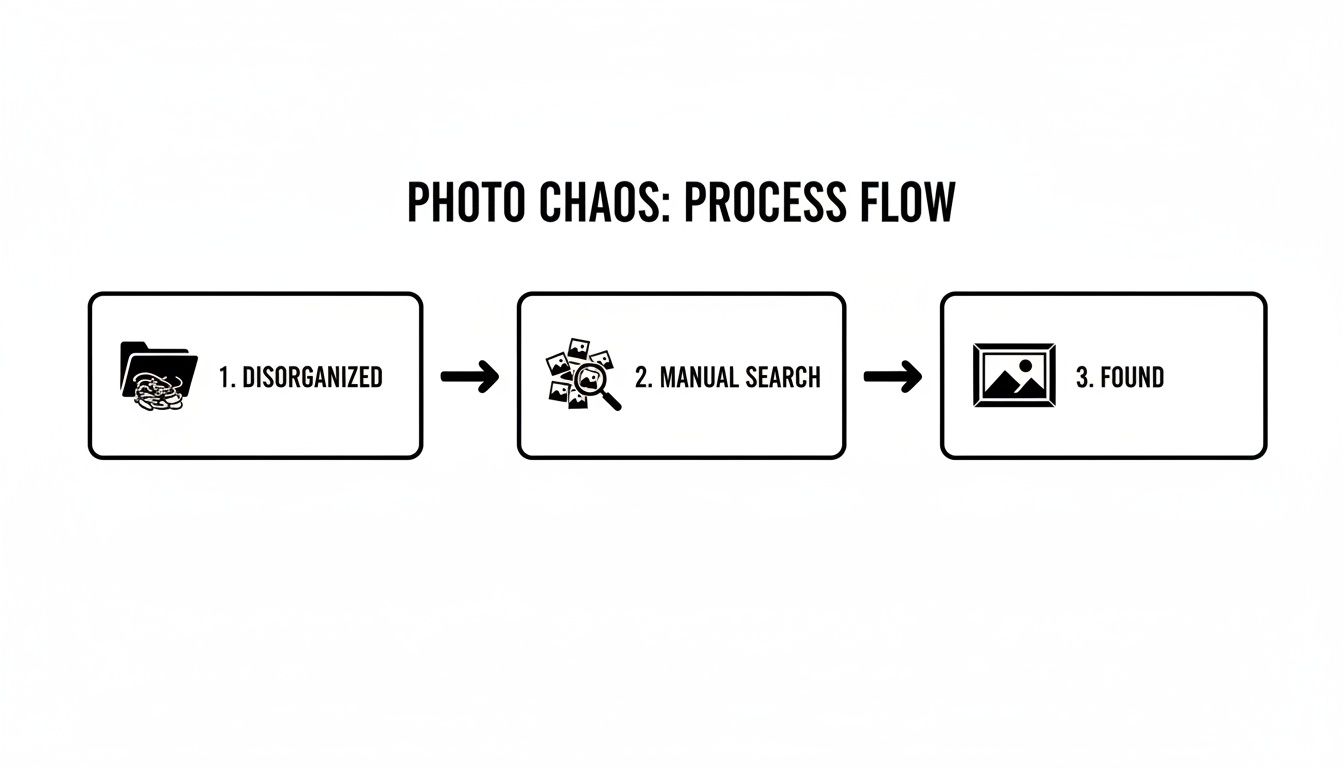
As you can see, we’re moving from total chaos to a clean, targeted solution. The difference is night and day, saving everyone time and making the experience so much better.
Traditional vs AI-Powered Event Photo Delivery
To really grasp how much of a game-changer this is, it helps to put the old and new methods side-by-side. The difference in the workflow, the time involved, and the final results for both attendees and organizers is pretty stark.
Here’s a direct comparison of the typical cloud folder dump versus a modern AI-powered approach.
| Stage | Traditional Method (Cloud Folder) | AI-Powered Method (Saucial) |
|---|---|---|
| Finding Photos | Attendees manually scroll through hundreds or thousands of unsorted images. | Attendees take a selfie; the AI finds all their photos in seconds. |
| Time Spent | Minutes to hours of frustrating searching, often with no success. | Less than 30 seconds from QR scan to viewing the personal gallery. |
| Engagement | Low. Most attendees give up, resulting in minimal shares and lost value. | High. Instant gratification leads to 80% or higher view rates and social sharing. |
| Organizer Effort | Requires manual sorting or responding to endless "find my photo" requests. | Zero manual sorting. The system is fully automated after the initial upload. |
The table makes it clear: one method creates work and frustration, while the other delivers instant delight and tangible results. It’s about working smarter, not harder, to give your attendees an experience they'll remember and share.
Building Trust with a Privacy-First Approach
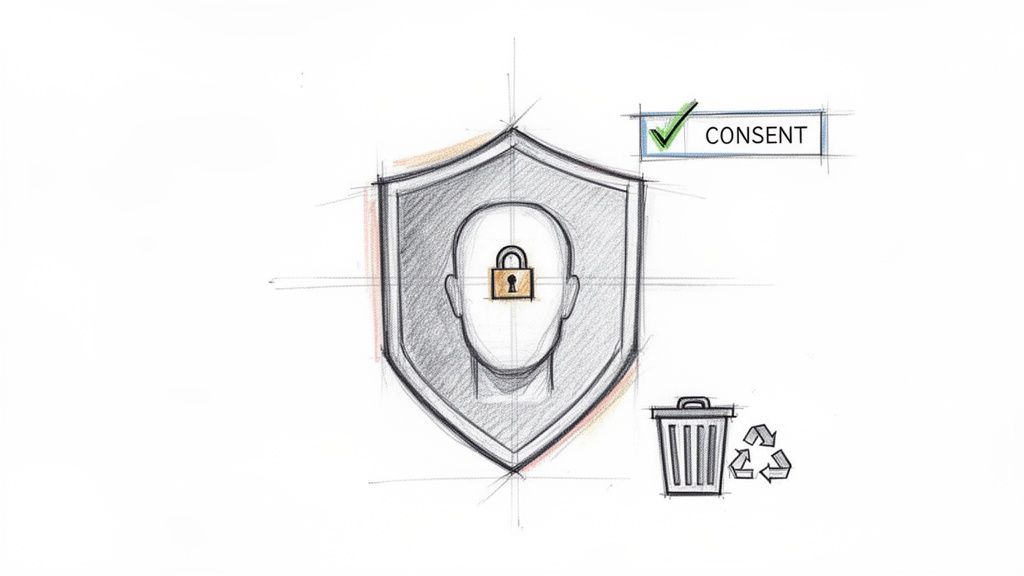
Let's be honest: the phrase "facial recognition" can make people a little uneasy, and for good reason. It’s important to immediately separate the idea of public surveillance from the kind of permission-based photo software with facial recognition we’re talking about for private events. One often works without you knowing, while the other is built from the ground up on your explicit consent.
Event-focused platforms operate on a simple, transparent agreement. An attendee willingly snaps a selfie for one single purpose: to find their photos from that specific event. That's it. It’s not about tracking them later or identifying them elsewhere. It’s purely a tool for convenience that only works when the user decides to turn the key.
Making that distinction crystal clear is the foundation of trust. When your guests understand their data is being used for them—not on them—and handled responsibly, the technology stops feeling invasive and starts feeling incredibly helpful.
The Core Pillars of Ethical Photo Matching
To earn that trust, a photo platform can't just bolt on privacy features as an afterthought; it has to be engineered into its very DNA. This commitment shows up in a few key practices that protect everyone involved, from the attendees to the event organizers.
One-Time Use Only: The selfie an attendee submits is used for one thing and one thing only—to create a temporary mathematical model of their face to match against the event gallery. It’s never stored long-term or used for anything else.
Secure and Temporary Data: As soon as the photo matching is done and the personalized gallery is delivered, that initial selfie data is securely and permanently deleted. Think of it as a "use-and-forget" model that prevents data from ever being repurposed.
Complete Organizer Control: The event host or photographer always holds the reins to the photo gallery. They are the ones who decide which images get uploaded, ensuring only the best and most appropriate moments are shared.
“Building a privacy-first platform means every feature must answer a critical question: Does this empower the user and protect their data? If the answer is no, it doesn’t get built. Attendee trust is the most valuable asset an event can have.”
This privacy-centric design is what makes the whole experience feel safe. And of course, it helps that the technology just plain works. Modern facial recognition has hit accuracy rates of at least 99.5%, giving guests confidence they’ll actually find their pictures.
Plus, with over 176 million Americans already using this kind of tech on their phones every day, most people are already comfortable with the concept. You can dive deeper into these facial recognition statistics and user adoption trends to see just how common it has become.
At the end of the day, a well-designed system gives attendees a powerful tool without asking them to compromise their privacy. It turns a potential concern into a genuine "wow" moment.
Ready to see how these principles work in the real world? You can get started with Saucial's secure platform and experience it firsthand.
Making Facial Recognition Work at Your Next Event
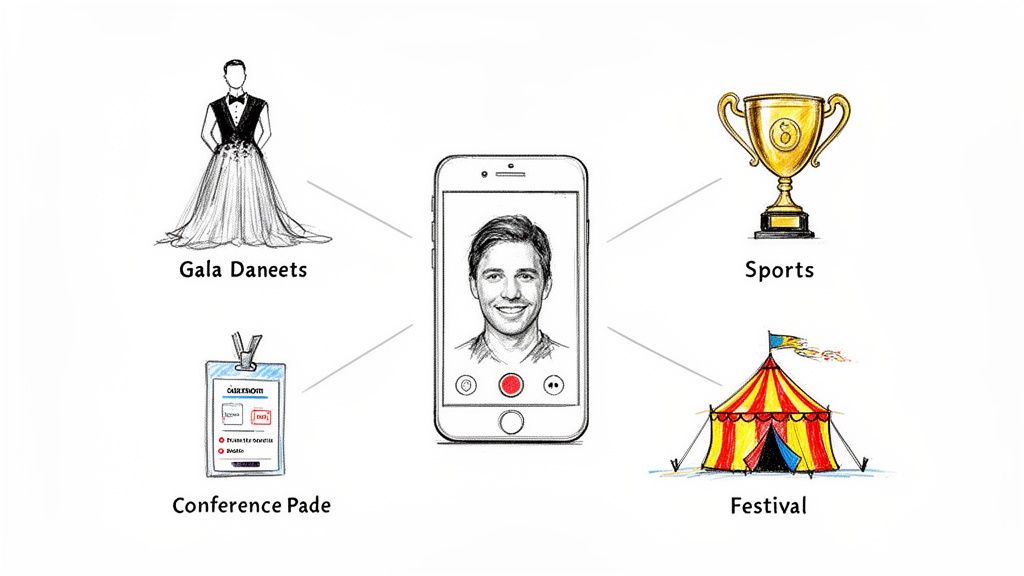
Understanding the theory is one thing, but seeing photo software with facial recognition solve real-world problems is where it all clicks. This isn't just a neat party trick; it's a seriously practical tool that smooths out frustrating parts of the event experience for everyone involved.
Let's dive into a few common scenarios where this technology is already making a huge difference. Each one highlights a familiar challenge and shows how an automated "find my photos" system turns a potential headache into a moment of pure magic for guests.
Galas and Fundraisers
At a high-end charity ball, the atmosphere is everything. You've worked hard to create an evening that feels special and inspires people to give. The last thing you want is for that feeling to evaporate once the night is over because donors can't find their photos.
Instead of forcing them to sift through hundreds of images, a simple selfie search delivers their best moments—a handshake with the guest of honor, a shared laugh at their table—right to their phone. That instant connection reinforces the positive memory and keeps the cause they supported fresh in their minds.
Sports Tournaments and Competitions
The photo volume at a weekend sports tournament can be staggering. Parents and athletes are desperate for that perfect action shot—the game-winning goal, the triumphant finish—but finding it in a sea of thousands of images is a nightmare.
This is where facial recognition is a total game-changer. A quick selfie scan is all it takes to pull up every single photo of a specific player. This saves families hours of scrolling and makes it easy for photographers to sell more prints and digital downloads directly to the people who want them most.
By turning a needle-in-a-haystack search into an instant, personal experience, you give attendees the power to find, keep, and share the moments that truly matter.
Corporate Conferences and Trade Shows
Networking is the name of the game at professional conferences. People want high-quality shots of themselves speaking on a panel or connecting with industry leaders to post on their LinkedIn profiles. But those valuable images often get buried in generic event galleries, where they're never seen again.
With a QR code that leads to a selfie-searchable gallery, attendees can find their photos in seconds. They can then share them on social media while the event is still happening, amplifying your brand's reach and giving every participant a tangible career-building takeaway. You can explore how to set up these seamless experiences with a platform like Saucial.
Community Festivals and Public Gatherings
For a large public festival, the goal is often to create as much social buzz as possible. The biggest obstacle? Friction. If people can't easily find a photo of themselves having a great time, they're not going to post about it.
A selfie search completely removes that barrier. When guests can find and post their pictures in just a few taps, they become your best marketers. That immediate social proof shows everyone what a great time they missed, driving excitement for your next event without any extra work from your team.
Measuring Your Event Photo Strategy ROI
Bringing new tech into your event workflow isn't just about a slicker guest experience; it has to deliver a real return on investment (ROI). For event planners and photographers, photo software with facial recognition isn't some novelty feature. It’s a workhorse tool that produces results you can actually measure, proving its worth by driving up engagement and making your operations run smoother.
You really see the value when you stop relying on gut feelings and start looking at the numbers. Instead of just hoping your guests liked their pictures, you can see exactly how they found and used them. This data-first mindset turns your event photography from a simple expense into a marketing and revenue-generating powerhouse.
Tracking Attendee Engagement
The most obvious win is in attendee engagement. Let’s be honest, old-school cloud folders get terrible traffic because nobody wants to spend an hour scrolling through hundreds of photos. When you let people find their photos with a selfie, you can track metrics that prove the system is working.
- Gallery View Rates: This tells you what percentage of your attendees actually opened their personal galleries. Hitting view rates of 80% or more is common, and it’s a clear sign that the system is both effective and dead simple to use.
- Social Share Counts: A good platform will show you how many times photos were shared straight from the gallery to social media. Every single share is a piece of authentic, user-generated content that organically boosts your event’s visibility.
- Download Metrics: Seeing how many photos were downloaded tells you people valued the images enough to save them for good. High download counts equal happy attendees.
Calculating Operational and Financial Returns
Beyond the engagement stats, the operational ROI is just as powerful. For event organizers, think of all the hours you'll get back when you no longer have to manually sort photos or answer endless "can you find my picture?" emails. That’s time your team can spend on things that actually matter, which directly cuts down on administrative drag.
For photographers, this technology is a game-changer for earning more from your work. By putting the right photos directly in front of the right people, you’ve instantly created a sales channel for high-margin products like prints and digital downloads.
By turning the delivery process into a direct-to-attendee marketing channel, photographers can effectively monetize their work through print sales and digital downloads without any extra administrative effort.
This isn't just a niche idea; the market is exploding. By 2026, the United States alone is expected to account for $2.7 billion of the global facial recognition market. What's really telling is that ready-made software makes up 78.31% of that spending. This shows a massive shift toward plug-and-play systems that are easy to implement and even easier to measure. This trend makes it simpler than ever to bring these tools into your workflow and prove their value. If you want to dive deeper into the numbers, you can explore these facial recognition insights from Fortune Business Insights.
Answering Your Questions About Facial Recognition Photo Software
Bringing any new tech into your event workflow is going to come with questions. That's a good thing—it means you're thinking critically. When it comes to facial recognition for event photos, people usually zero in on a few key areas: how it actually works for a real person, what happens to their data, and if it can handle the chaos of their specific event.
Let's cut right to the chase and tackle these questions head-on. My goal is to give you the confidence that this isn't just another complicated piece of tech, but a real solution designed to make everyone's life easier.
Is This a Pain for Attendees to Use?
Not in the slightest. We designed the entire experience to be incredibly simple and fast because we know the last thing a guest wants is to download an app or sign up for yet another account.
The whole process takes less than a minute on their own phone:
- They spot a QR code at your event and give it a quick scan.
- A simple webpage pops up asking for a selfie.
- Seconds later, their personal photo gallery appears. That's it.
It’s about as easy as sending a text, which is exactly why people actually use it. No friction, no frustration—just instant gratification.
What Happens to the Selfies They Take?
This is probably the most important question, and we built our entire system around a privacy-first answer. The selfie a guest takes serves a single, temporary purpose: it creates a unique mathematical map of their face to find matches within that specific event gallery.
The selfie data is never stored long-term, shared with anyone, or used for any other reason. Once the search is done, the biometric data created from that selfie is securely and permanently deleted.
Think of it like a disposable keycard for a hotel room. It gets you into your gallery for that one event, and once you're in, the key is gone for good. This approach is non-negotiable for building trust with your attendees. You can dig deeper into your gallery and privacy controls in our guide to Saucial settings.
Do I Have Control Over Which Photos Are Shown?
Absolutely. You are always in the driver's seat. Whether you're the event host or the photographer, you have complete control over the gallery. You decide what gets uploaded and what your guests see.
Before you share the gallery link, you can easily go through and remove any shots that don't meet your standards—blurry photos, awkward expressions, you name it. This ensures that only the best, brand-safe images that capture the spirit of your event are the ones people find.
Will This Work for My Huge (or Tiny) Event?
Yes. The software is built to scale, whether you're hosting an intimate 50-person gala or a massive festival with tens of thousands of attendees. It works just as well for both.
The AI does all the heavy lifting behind the scenes, processing and indexing faces with the same speed and accuracy whether you upload a few hundred photos or 50,000. For the attendee, the experience is just as fast. They get that same "wow" moment of finding their photos instantly, no matter how big the crowd.
Ready to give your guests a modern photo experience they'll actually love? Saucial makes launching a "find my photos" gallery for your next event incredibly simple. Get started with Saucial today!


