The Ultimate Guide to Photo Recognition Software for Events
Ever tried to find your picture after a big event? You know the drill: scrolling endlessly through a giant online album, hoping to spot yourself in a sea of faces. It’s a frustrating and time-consuming process that often ends in giving up.
Now, picture a digital photo assistant that does all that work for you, delivering a personalized gallery of just your photos in seconds. That's the power of photo recognition software. This technology uses artificial intelligence to automatically find every photo an attendee appears in, turning a major post-event headache into a moment of pure magic.
How Photo Recognition Software Works
At its heart, photo recognition software is like having a team of super-fast photo sorters who never get tired. Instead of someone manually tagging photos or dumping them all into one massive folder, this technology automates the entire "find my photos" experience for every single person at your event. It’s a game-changer that solves a common pain point for attendees.
The demand for this kind of smart technology is booming. The image recognition market, which includes tools for face recognition and selfie matching, is exploding. Valued at USD 71.41 billion in 2026, it's projected to climb to an incredible USD 212.81 billion by 2035, growing at a steady 12.9% each year. You can dig into more data on the image recognition market to see just how massive this trend is.
The Technology Behind the Magic
So, what's happening under the hood? The process is driven by a sophisticated form of AI called facial recognition. Think of it as creating a digital fingerprint, but for a person's face.
Every face has a unique combination of features—the distance between the eyes, the shape of the nose, the curve of the jawline. The software analyzes dozens of these points to create a unique mathematical code.
This unique code is often called a 'faceprint' or 'facial signature.' It's not a picture of your face, but a numerical representation of its distinct geometry. This makes it incredibly fast and efficient for the AI to use for matching.
Once an attendee provides a selfie to create this faceprint, the system can scan an entire event gallery in a flash. It compares that initial faceprint to the faces detected in every single photo, instantly pulling all the matches into a personalized collection for that guest.
This diagram breaks down the simple three-step process, from the initial analysis to the final photo delivery.
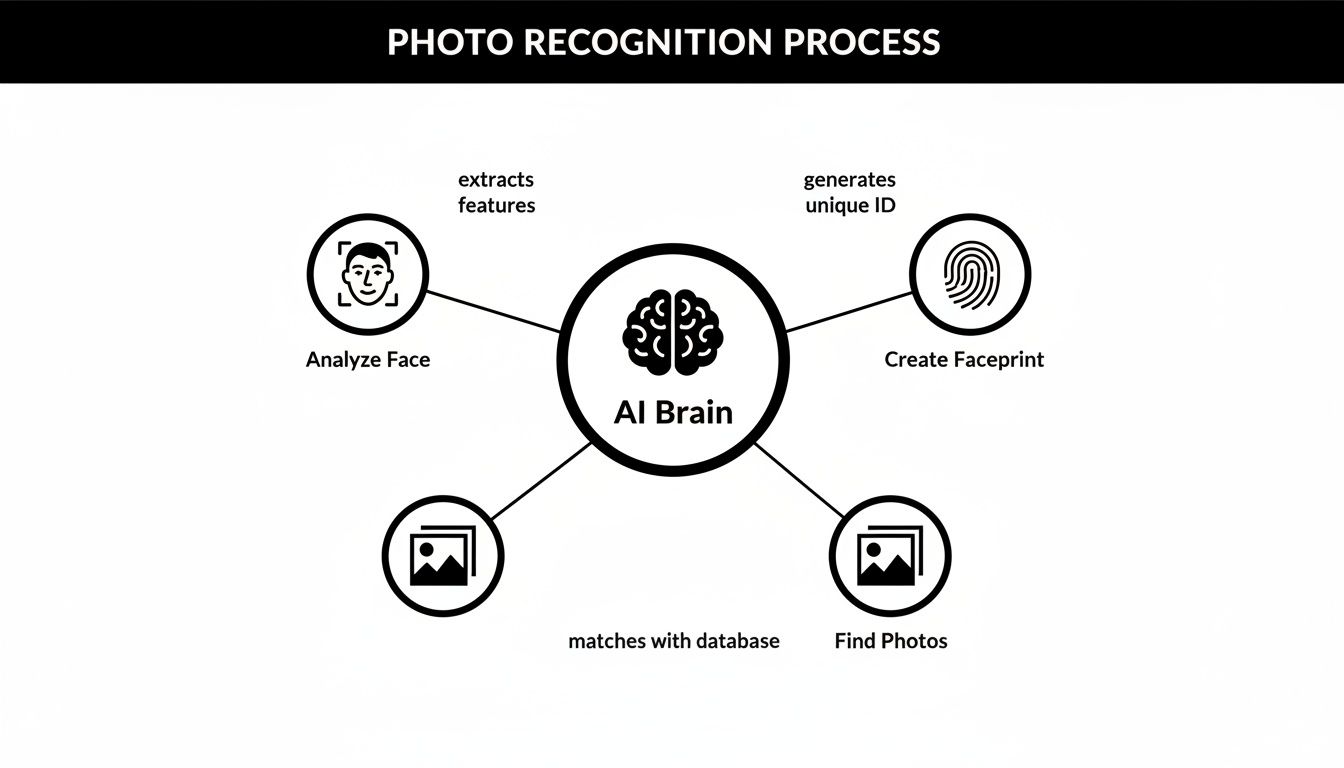
As you can see, the AI essentially learns what a person looks like from one photo and then uses that data to find them in hundreds or even thousands of others.
A Seamless Experience for Attendees
For the guest, the whole process is designed to be completely effortless. There’s no app to download or complicated account to create. The workflow is built for immediate engagement with as little friction as possible.
Here’s how it usually works:
- Scan a QR Code: Guests simply scan a QR code at the event or click a link sent to them.
- Snap a Quick Selfie: They’re prompted to take a quick, one-time selfie right in their phone’s web browser.
- Get Instant Galleries: In just a few seconds, the software delivers a private gallery containing only the photos they are in.
This instant gratification is what makes the technology so sticky. It replaces the chore of hunting for photos with a quick, fun interaction that feels personal and modern. For event planners and photographers, this translates directly into more social shares, higher engagement, and genuinely happy guests who can easily find and relive their favorite memories.
Let's look at how this new method stacks up against the old way of doing things.
Event Photo Sharing Old Way vs New Way
| Feature | Traditional Method (Cloud Drive) | Photo Recognition Software |
|---|---|---|
| Delivery Speed | Days or weeks after the event | Instant, often within seconds |
| Photo Access | Guests hunt through one massive album | Personalized galleries sent directly |
| Attendee Effort | High - endless scrolling required | Low - snap one selfie and you're done |
| Engagement | Low - most people give up | High - instant gratification encourages sharing |
| Branding | Limited to the cloud drive's interface | Fully branded galleries and pages |
| Data & Analytics | Almost none | Rich data on shares, views, and engagement |
The contrast is pretty stark. The old way creates work for your attendees, while the new way delivers a premium, personalized experience that makes them feel valued.
Why This Technology Is a Game Changer for Events
Understanding the mechanics of photo recognition is one thing, but seeing what it actually does for an event is where the lightbulb really goes on. This isn't just a minor upgrade; it fundamentally changes how event photography works, shifting it from a passive archive into a living, breathing part of the experience. It solves problems that have plagued organizers and photographers for years and opens up some seriously exciting new doors.
Think about the old way: an event host dumps a few thousand photos into a cloud drive and emails a link a week later. A few dedicated people might dig through it, but most will give up after a few minutes of scrolling. The engagement dies almost as soon as the event ends. Photo recognition completely flips that script.
Amplifying Engagement and Brand Reach
When you give attendees a gallery of just their photos delivered almost instantly, you give them a powerful reason to stay connected. Finding every picture of yourself with a simple selfie photo matching process takes seconds, not hours. What do people do when they get great photos of themselves? They share them.
Suddenly, your attendees become your best marketers.
This wave of user-generated content (UGC) is pure gold. Every share on social media expands your event's footprint organically, keeping the buzz going long after the last guest has gone home. Instead of one giant, forgotten photo dump, you're creating hundreds of small, personal "wow" moments that people are genuinely excited to post.
The real win here is turning photo delivery from a boring administrative task into a killer marketing engine. You’re not just sharing pictures anymore; you're delivering personalized experiences that drive measurable post-event engagement.
That immediate, personal connection makes your event memorable. It builds a stronger community vibe and gives you a tangible return on your photography budget in the form of authentic social proof. The excitement doesn't just fade away—it multiplies.
Creating New Revenue Streams for Photographers
For the photographers in the trenches, the benefits are even more direct and profitable. The old model was usually a flat fee from the organizer, and that was it. The idea of selling prints or downloads directly to attendees was a logistical nightmare. Who has time to manually tag thousands of photos to figure out who is who?
Photo recognition software crushes that barrier. It automates the most soul-crushing part of the job—the sorting and tagging—which frees up a staggering amount of time for more creative work. Even better, it creates a direct line of communication to every single person in the photos.
This opens up a whole new way to do business. Photographers can now easily sell directly to the people who want the photos most—the attendees. Think about the possibilities:
- High-Resolution Digital Downloads: Offer premium, unwatermarked versions for a small fee.
- Professional Prints and Canvases: Connect to a print-on-demand service to sell physical keepsakes.
- Branded Digital Frames: Let sponsors pay to add their logo to photos attendees share.
- Curated Photo Packages: Bundle an individual's or a group's best shots together for a special price.
This direct-to-attendee model can be a massive financial boost. By offering a photographer upsell to attendees for digital downloads or custom prints, photographers can see a 20-40% lift in sales from a single event, with no organizer acting as a middleman. The financial impact is real, as you can see from the growth of the image recognition market.
At the end of the day, photo recognition software takes a huge logistical headache and turns it into a strategic advantage. For organizers, it’s a tool for driving real, lasting engagement. For photographers, it’s a direct route to more income and a saner workflow. It elevates event photography from a simple service to a value-packed experience for everyone involved.
How to Implement Photo Recognition at Your Next Event
Bringing photo recognition to your event might sound like a massive technical undertaking, but modern platforms have made it incredibly simple. The whole point is to create a dead-simple experience for you and your attendees—no tech headaches, no confusing steps, just a smooth, impressive workflow. You can get a system up and running in just a few minutes by following a basic three-step process.
Think of this as your easy-to-follow blueprint. It’s designed to help you integrate this technology with confidence and turn photo delivery from a post-event chore into a genuine highlight.
Step 1: Upload Your Event Photos
First things first, you need to get your professional photos into the system. This is usually the easiest part of the whole deal. Modern photo recognition software is built with clean, user-friendly interfaces, so you definitely don't need to be a tech wizard to get started.
Most platforms, including Saucial, feature a simple drag-and-drop uploader. You just grab the photos from your computer and drop them right into your web browser. That’s it. The system handles the rest, automatically prepping them for the AI analysis that happens next. It's as easy as posting to your favorite social media site. You can get a closer look at the Saucial photo upload process to see just how straightforward it is.
Once the upload is complete, the software's AI engine quietly gets to work in the background. It scans every single image, detects every face, and gets the gallery ready for the matching process. This all happens automatically, saving you hours of painful manual sorting and tagging.
Step 2: Generate Your Unique Shareable Link
After your photos are processed, the system creates a single, unique link and a matching QR code for your event gallery. This is your golden ticket for sharing all the photos with your guests. It's a much cleaner, more professional alternative to sending out messy cloud drive links that dump people into a massive, unorganized folder.
This single point of access is key to a great attendee experience. You can share this link in a bunch of different ways to make sure everyone sees it:
- Email Campaigns: Drop the link into your post-event thank-you emails.
- On-Site QR Codes: Put the QR code up on screens, signs, or table tents at the event for people to scan right away.
- Social Media: Post the link on your event’s social media channels.
- Event Website: Add a big "Find My Photos" button to your event webpage.
The beauty of a single link and QR code is that you can reach your attendees wherever they are, making it ridiculously easy for them to get their hands on their memories.
Step 3: Guide Attendees Through the Experience
The final step is where the real magic happens for your guests. When someone clicks the link or scans the QR code, they're taken to a simple, mobile-friendly webpage. And here’s the best part: there is no app to download and no account to create. This is huge, as it removes the biggest hurdle to getting people to actually use it.
The attendee journey is designed to be as quick and painless as possible:
- Welcome Screen: They land on a branded page that explains the "Find My Photos" feature.
- Selfie Time: The page prompts them to take a quick, one-time selfie with their phone's camera.
- Instant Matching: In just a few seconds, the photo recognition software compares that selfie to every face in the entire gallery.
- Personal Gallery: The system instantly shows them a curated gallery with only the photos they’re in.
This image shows the simple, three-step guide that attendees often see, making the process feel intuitive and easy to follow.
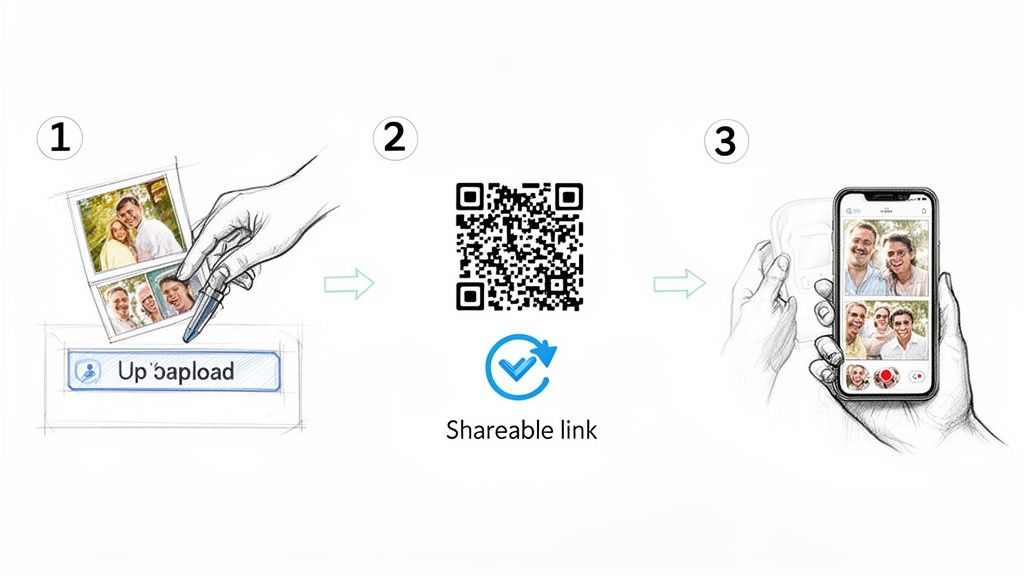
The experience is designed to be completely frictionless. Users can go from scanning a code to seeing their personal photo album in under a minute.
To make sure this is a hit, you have to communicate it clearly. Announce it during the event, and tell guests they can get their photos instantly by scanning the QR codes you have on display. A little bit of promotion goes a long way.
From their personal gallery, attendees can download their favorite shots, share them directly to social media, or even buy high-res prints if you have that feature turned on. This simple, three-step process turns photo delivery into a powerful engagement tool and creates a memorable, personalized experience for every single guest.
Putting Photo Recognition Software into Action
Theory is one thing, but the real test of any tech is how it performs in the wild. When it comes to photo recognition software, its power truly comes to life across all kinds of events, from buttoned-up corporate conferences to the chaotic energy of a youth sports tournament.
The core idea is simple but profound: connect people to their moments, instantly. This isn't just about speed; it's about shifting the entire event experience. For planners and photographers, it turns a tedious post-event chore into a dynamic tool for engagement and a new way to make money.
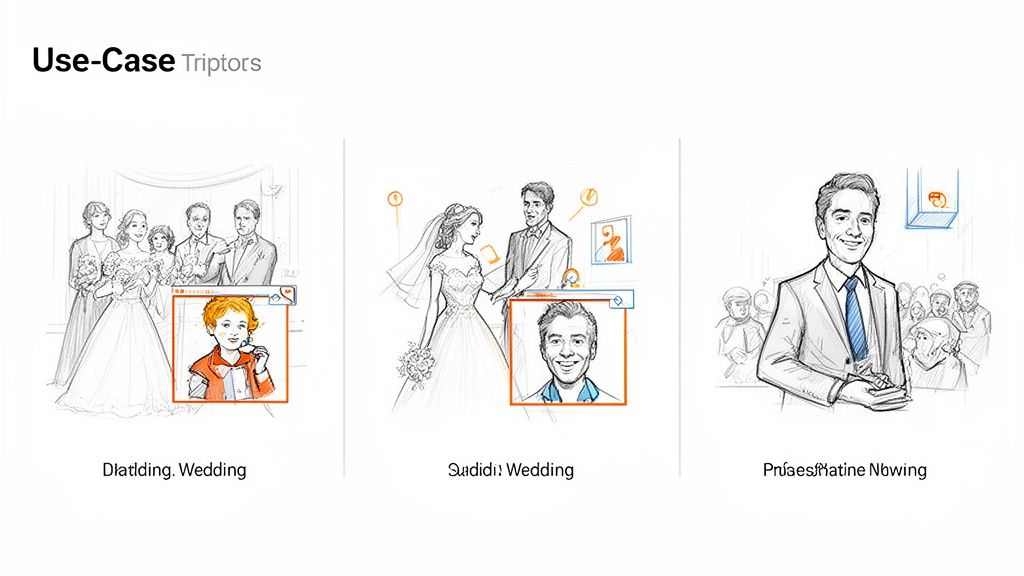
Let's break down a few real-world scenarios where this technology is an absolute game-changer.
Corporate Conferences and Networking Events
At any big conference, the real goal is to get people talking. Your photographers are snapping thousands of pictures of speakers, panel discussions, and those all-important hallway conversations. But here's the problem: nobody has the time to sift through a gallery of 3,000+ photos to find that one shot of them shaking hands with a key contact.
That's where a face recognition event gallery becomes an incredible networking asset.
- The Old Way: An attendee wants a photo of themselves with a potential client to post on LinkedIn. They're faced with a massive, unorganized album and eventually give up.
- The New Way: They scan a QR code, snap a quick selfie, and get a curated gallery of just their photos in seconds. They find the perfect shot, share it with a branded event frame, and tag their new connection—instantly boosting the event's visibility online.
Suddenly, photos aren't just a static record of the event; they're an active tool for building professional relationships and driving huge post-event engagement.
Sports Tournaments and Action Photography
Youth sports tournaments are a photographer's dream and nightmare. Parents are desperate for great action shots of their kids, but the sales process is a nightmare. Forcing them to scroll through hundreds of photos of other children is a surefire way to kill a sale.
Sports tournament photo sales can be completely overhauled with this tech.
Think about a parent at a weekend soccer tournament. Instead of crossing their fingers and hoping the photographer caught a good shot, they just scan a code and upload a selfie of their child. In an instant, they see every single photo of their kid on the field, ready to purchase. It’s a complete game-changer for actually selling your work.
This direct-to-parent model demolishes the biggest sales barrier. The result? Photographers sell more, and families get to keep those priceless moments of their kids in action.
Weddings and Personal Celebrations
Weddings are all about emotion and shared memories. Guests are buzzing with excitement and can't wait to see the candid moments captured by the photographer. But making them wait weeks for a link to a giant, messy gallery kills that buzz. People want to find and share photos of themselves with the happy couple while the feeling is still fresh.
Here’s how photo recognition transforms the wedding guest experience:
- Instant Joy: Guests can scan a QR code at the reception and see photos of themselves pop up almost in real-time. Think of all those great shots from the dance floor or cocktail hour, delivered on the spot.
- Frictionless Sharing: They can immediately find photos of their family or group of friends and post them to social media, creating a beautiful, crowd-sourced album of the day.
- A Gift to the Couple: The newlyweds get to experience their wedding through the eyes of their guests as these photos are shared, making the celebration last even longer.
By giving guests a seamless way to access their photos, you create a far more engaging and memorable experience for everyone. It's surprisingly easy, too—you can explore how a few simple tweaks to your gallery settings in Saucial can tailor this experience for any event you're working on.
Photo Recognition Software Applications by Event Type
To really see the flexibility of this technology, let's look at how different events can use it to hit their specific goals.
| Event Type | Primary Goal | How Photo Recognition Helps |
|---|---|---|
| Corporate Events | Attendee Engagement & Brand Reach | Delivers branded photos directly to attendees for instant social sharing, turning them into brand ambassadors. |
| Trade Shows | Lead Generation & Follow-Up | Connects photos of booth visitors to their contact info, creating a visual and personalized follow-up. |
| Sports Tournaments | Photo Sales & Monetization | Creates individual player galleries, making it incredibly easy for parents to find and purchase action shots. |
| Weddings | Guest Experience & Social Buzz | Allows guests to instantly find their photos, share them, and contribute to the couple's collective memories. |
| Music Festivals | Sponsorship Value & Fan Engagement | Tags attendees in branded content, amplifying sponsor visibility and creating user-generated content. |
| Graduations | Memory Preservation & Sales | Automatically sorts photos by graduate, simplifying the process for families to find and buy their official pictures. |
As you can see, the application isn't one-size-fits-all. The technology adapts to the unique needs of each event, solving specific problems and creating tangible value for organizers, photographers, and attendees alike.
Navigating Privacy and Data Security Concerns
Let's talk about the elephant in the room: privacy. Anytime you introduce technology that deals with people's faces, it's natural to have questions. As an event professional, it's your job to protect your attendees, so understanding how ethical photo recognition software handles sensitive information is non-negotiable.
The good news is that modern platforms are built with a privacy-first mindset. The entire process is designed to be completely permission-based. Attendees have to actively choose to participate—they opt-in by scanning a QR code and taking a selfie. There’s no sneaky, behind-the-scenes data collection happening here. This consent-driven model puts guests firmly in control of their own images and their experience.
How Attendee Data Is Handled
So, what actually happens to that selfie an attendee submits? This is a crucial point. In a well-designed system, that selfie has only one job: to create a temporary "faceprint" that helps find their photos in the event gallery. Think of this faceprint as a mathematical recipe of facial features, not the actual photo itself.
The key takeaway is that this data is temporary and transactional. Once the system has done its job and delivered the personalized gallery, the initial selfie and its faceprint are discarded. The software isn't building some giant, permanent database of faces.
This approach is designed to dramatically reduce privacy risks by ensuring personal biometric data isn't held long-term.
Control and Security for Event Organizers
Beyond the attendee's experience, you, the organizer, maintain total authority over the event photos. A reputable platform will give you robust tools to control access and sharing, which is a massive improvement over just dumping everything into a public cloud folder for anyone to see.
Here are the core security principles you should be looking for:
- Organizer Control: You get the final say. You can review, approve, or delete any images before a single guest sees them.
- Private Galleries: Each attendee gets their own unique, private link. They aren't forced to scroll through a massive public album to find their five photos.
- Secure Infrastructure: The entire process—from photo upload to processing and delivery—should be handled on secure cloud infrastructure to keep everything locked down.
This framework ensures you're always in the driver's seat, protecting both your brand and your guests. If you want to get into the weeds on account security, you can learn more about how platforms like Saucial manage user authentication.
The Question of Accuracy
Okay, but does it actually work? In a real-world event with funky lighting and people photobombing everywhere? Absolutely. Today's AI algorithms are trained on enormous datasets, making them incredibly good at picking out faces even in tough conditions.
No system is 100% perfect, of course, but the technology has gotten remarkably good at telling people apart in a crowd and delivering the right photos to the right person. This high level of accuracy is what builds trust and creates that "wow" moment. When a guest snaps a quick selfie and instantly gets a gallery of their best moments, it proves the system is not only reliable but also respectful of their privacy.
Choosing the Right Photo Recognition Platform
Picking the right photo recognition software for your events feels like a big commitment, but it doesn't have to be a headache. The best platforms simplify your life, give your guests a fantastic experience, and actually deliver a return on your investment. Think of it less like buying a piece of complex software and more like hiring a hyper-efficient digital assistant to manage your event photos.
To make the right call, you need to focus on what really matters in practice. The goal is to find a tool that not only has smart tech under the hood but also makes the whole process effortless for you and your attendees. A clunky interface or forcing people to download an app will kill the vibe, no matter how cool the AI is.
Your Essential Feature Checklist
When you start comparing options, it helps to have a checklist of the absolute must-haves. These are the things that separate a genuinely useful tool from one that just causes frustration. Make sure any platform you're seriously considering checks all these boxes.
- No App Downloads: This is a huge one. Forcing guests to download an app is a surefire way to kill participation. The whole experience needs to be web-based, accessible with a simple QR code or a link.
- Intuitive Organizer Interface: You shouldn't need a computer science degree to upload and manage your event gallery. Look for a clean, simple dashboard with easy-to-use features like drag-and-drop uploading.
- Robust Privacy Controls: You need the final say. The ability to review, approve, or delete photos before they're visible to guests is non-negotiable for brand safety and respecting privacy.
- Flexible Monetization Options: For photographers or events that want to create a new revenue stream, being able to sell digital downloads or prints directly is a game-changer. This feature can turn your photo gallery into a profit center.
The real test of a great platform is the attendee experience. If a guest can scan a QR code, take a quick selfie, and see their photos in under a minute, you've got a winner. Anything that adds extra steps or confusion just ruins the magic.
Measuring Your Return on Investment
Bringing in photo recognition software isn't just about creating a "wow" moment—it's about getting real results. A good platform should pay for itself by saving you time, boosting your brand's reach, and even opening up new ways to make money. Tracking a few key metrics will prove its value.
First, calculate the hours saved now that you've automated photo sorting. Think about it: what used to take days of tedious manual work can now be done in minutes. That frees you or your photographer up for tasks that actually matter.
Next, keep an eye on your social media engagement. Watch how many attendees download and share their photos. Every single share is a piece of authentic marketing that extends your event's reach far beyond the venue walls. A big jump in user-generated content is a clear sign you're on the right track. Finally, if you're using monetization features, track the revenue generated from photo sales. This gives you a direct, hard number for your ROI. With the right solution, you'll see how a platform like Saucial helps deliver a modern photo experience that’s a win for everyone involved.
Frequently Asked Questions
Jumping into new event technology always brings up a few questions. Let's walk through some of the most common ones we hear from event pros, so you can see exactly how this works in a real-world setting for you and your guests.
How Hard Is It to Set This Up for My Event?
Honestly, it's designed to be incredibly simple—we're talking a few clicks and you're done. The whole process usually takes just a few minutes.
- Create Your Gallery: Just give your event a name and set up a new gallery.
- Upload Photos: Drag and drop your event photos right into the uploader from your web browser.
- Share Your Link: You’ll get a single link and a QR code to share with everyone.
That's it. The AI does all the heavy lifting behind the scenes, scanning the photos and matching faces. You don't need to be a tech wizard to make it happen.
Do My Guests Have to Download an App?
Nope! This is probably one of the biggest wins for getting people to actually use it. Attendees access their photos straight from their phone's web browser.
This is all about making it frictionless. A guest scans a QR code or clicks a link, takes a quick selfie for the selfie photo matching, and instantly sees their pictures. By skipping the app store, you remove that major roadblock and get way more people engaging with their photos.
The name of the game is easy access. When you make it this simple for someone to find their photos, they are far more likely to share those moments on social media. That's how you amplify your event's reach organically.
Can I Control Which Photos People See?
Absolutely. You have 100% control over the entire gallery. Before you send the link out, you can go through and approve, hide, or delete any images you want.
This curation step is huge for brand safety and making sure everyone feels comfortable. It gives you the final say, ensuring only the best, most appropriate shots get shared. You get to protect your brand's image while still delivering that personalized "wow" moment for your attendees.
How Accurate Is This in a Crowded Room?
Modern photo recognition software is powered by some seriously smart algorithms that have been trained on millions of diverse images. Because of that, they're surprisingly accurate, even in tricky lighting or on a packed trade show floor.
No technology is perfect, of course, but it’s more than capable of picking out individual faces in a crowd. It consistently nails that magical experience of finding every photo for the vast majority of your guests, making them feel seen and special.
Ready to give your guests a modern photo experience they won't stop talking about? With Saucial, you can transform your event photos into a powerful engagement tool and create personalized galleries in seconds. Discover how Saucial can elevate your next event.


