A Guide to Photo Face Tagging Software for Events
Ever spent what feels like an eternity scrolling through a massive event gallery, your eyes glazing over as you hunt for that one perfect shot of yourself? It’s a frustrating experience we’ve all had. Photo face tagging software puts an end to that digital scavenger hunt.
Instead of forcing your guests to wade through a sea of other people's pictures, this technology lets them find their photos instantly. They just snap a quick selfie, and a smart AI system scans the entire event gallery to pull up every single photo they’re in. It’s that simple. A personalized gallery, delivered in seconds.
How Event Photos Are Delivered: Old vs. New
For too long, sharing event photos has been a clunky, inefficient process. The go-to method was dumping all the photos into a shared drive or a generic online album. This approach put all the work on the attendees, asking them to manually sift through hundreds—sometimes thousands—of images just to find themselves. Frankly, it was a broken system that led to a massive drop-off in engagement.
This old model created a ton of headaches for everyone involved:
- Wasted Time for Everyone: Guests would get frustrated and give up, while photographers and planners spent hours fielding emails and DMs asking, "Can you find my photos?"
- Missed Engagement: If photos are hard to find, they don’t get shared. This means events miss out on a huge wave of organic social media buzz and valuable user-generated content.
- Lost Revenue Opportunities: Photographers had no easy way to connect with the people in their photos who might want to buy prints, digital copies, or book them for future gigs.
A Modern Solution for Instant Gratification
Photo face tagging software completely turns this outdated model on its head. The workflow is refreshingly simple: the photographer uploads the gallery, the AI scans every face, and when an attendee submits their selfie, the system instantly matches them to their photos. It’s like having a personal photo concierge for every single guest.
This isn't just a minor convenience; it's a fundamental change in how people connect with their event memories. It transforms a passive, static photo gallery into a dynamic, interactive experience that provides immediate value.
To really see the difference, let’s compare the two approaches side-by-side.
Old vs New How Event Photos Are Delivered
| Feature | Traditional Method (Shared Drive or Gallery) | Modern Method (Face Tagging Software) |
|---|---|---|
| Discovery Process | Manual scrolling and searching by attendees | Automated selfie-based matching |
| Time to Find Photos | Can take minutes, hours, or never happens | Under 10 seconds |
| Attendee Experience | Frustrating, time-consuming, low engagement | Fast, fun, and highly personalized |
| Sharing Likelihood | Low; users often give up before finding photos | High; easy access encourages immediate sharing |
| Organizer/Photographer Workload | High; involves managing links and fielding requests | Low; upload once and the system handles the rest |
| Monetization | Difficult; no direct link to photo subjects | Easy; can integrate print sales or sponsored galleries |
The takeaway is clear. The frustrating, endless scroll is replaced by a seamless, instant connection. Guests are thrilled, organizers see a huge lift in post-event buzz, and photographers can finally unlock new ways to benefit from their amazing work.
You can see how platforms like Saucial are built specifically to deliver this modern photo experience for every type of event, from corporate galas to music festivals. This technology isn't just about finding photos—it's about effortlessly connecting people with their best moments.
How AI Selfie Matching Actually Works
The magic behind photo face tagging software isn't really magic at all—it's a clever, step-by-step process that turns a chaotic pile of event photos into perfectly organized personal galleries. It all happens in seconds.
Think of it like a high-tech, digital coat check for your photos.
Imagine a gala with a thousand guests. The old way meant a thousand people scrolling through a single, massive online gallery, hoping to spot themselves. It’s a tedious, frustrating experience. With AI selfie matching, each guest gets their own unique, digital “claim ticket” just by taking a selfie.
The system doesn’t see names or personal information. It just sees a unique mathematical pattern—a biometric signature. This privacy-first approach means the technology is matching anonymous data points, not personal identities, building trust right into the workflow.
The entire process unfolds quietly in the background, demanding almost no effort from you after the initial photo upload. Let’s pull back the curtain and see exactly how this digital coat check finds every guest’s photos instantly.
The Four Steps of Instant Photo Delivery
The journey from the photographer's camera to an attendee's phone is a simple, four-part workflow. The whole operation is designed to be fast, secure, and fully automated, which saves an incredible amount of manual labor.
Secure Photo Upload: It all starts when the event photographer or organizer uploads the complete set of event photos into a secure, cloud-based system. This is usually as simple as a drag-and-drop.
AI Facial Processing: Once the photos are in, the AI gets to work. It scans every single image, detecting and analyzing each face it finds. For every unique face, it creates a distinct, anonymous biometric template—basically, a numerical representation of facial features.
Attendee Selfie Matching: Now it’s the attendee’s turn. They scan a QR code or click an event photo sharing link, which prompts them to take a quick selfie. The system instantly converts that selfie into the same kind of anonymous biometric template.
Instant Personalized Gallery: The software then compares the attendee’s selfie template against the entire database of templates it just created from the event photos. When it finds a match, it gathers every corresponding photo and delivers them into a private, personal gallery for that specific guest.
This visual shows just how big the leap is from tedious manual searching to an instant AI match.
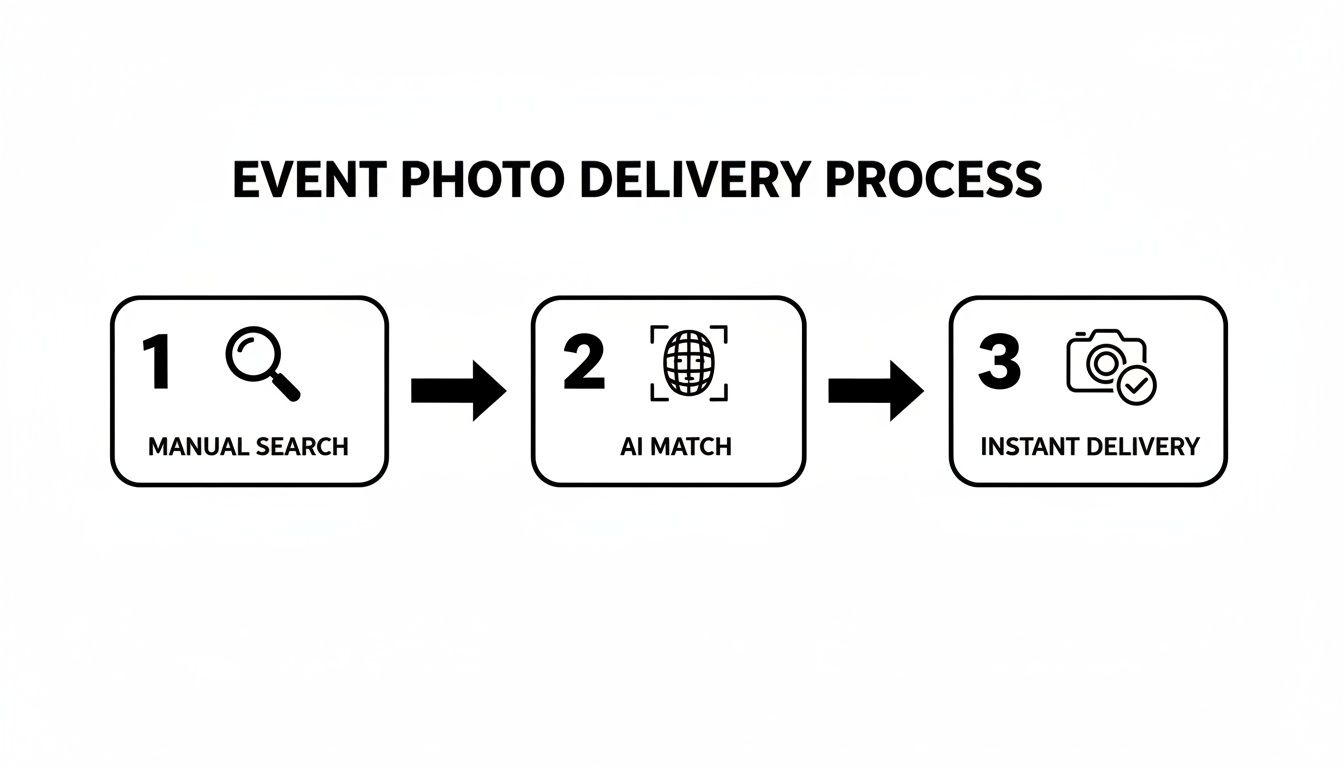
The real win here is the removal of friction. The AI workflow completely eliminates the guest's burden of searching, which naturally leads to much higher engagement and a happier crowd.
The Technology Powering the Process
This seamless experience is all made possible by sophisticated facial recognition algorithms. This technology has matured quickly, becoming remarkably accurate and efficient. Its adoption isn't just a fleeting trend; it’s a real shift in how events are managed.
The facial recognition market, which powers tools like selfie photo matching and face recognition event galleries, is seeing huge growth that directly benefits event organizers and photographers. According to a forecast from Technavio, the market is set to surge by USD 20.37 billion between 2026 and 2030, growing at a blistering 25.5% CAGR. This boom is driven by the real-world demand for secure, efficient photo tagging at events like galas, sports tournaments, and trade shows where thousands of photos need to be sorted instantly. You can dig into the numbers yourself in Technavio’s official report.
This growth isn't just hype; it proves the reliability and scalability of the technology. For event professionals, this means photo face tagging software is no longer a futuristic concept but a proven, accessible tool. It uses complex AI to deliver a result that feels simple, personal, and immediate. The system does all the heavy lifting, so you and your guests can focus on enjoying and sharing the memories.
Transforming Experiences at Any Event
The real magic of photo face tagging software isn't just in the technology itself; it's how it molds to the specific vibe and goals of any event. Think of it less as a simple tool for finding pictures and more as a strategic partner. It’s built to solve real-world problems, whether you're aiming to get your brand seen, deliver a VIP experience, or find new ways to make money from your photos.
Let's move past the technical "how" and dig into the practical "why" it makes such a difference.
For corporate events like trade shows and conferences, it’s all about networking and brand reach. This is where photo face tagging turns from a convenience into a marketing powerhouse.
Instead of attendees getting lost in a sea of generic event photos, they can instantly pull up their own professional headshots and candid networking moments. This makes it incredibly easy—and tempting—for them to share on platforms like LinkedIn. Every one of those posts becomes an organic endorsement, showing off the event's value to a perfectly targeted professional audience.
The Premium Touch for Galas and Fundraisers
At high-end gatherings—galas, fundraisers, alumni dinners—the atmosphere is paramount. The whole point is to create an experience that feels exclusive, effortless, and polished. Making your distinguished guests hunt through hundreds of photos on a generic gallery completely shatters that illusion.
This is where photo face tagging software truly shines. When you can offer a simple QR code that takes someone straight to their personal, curated gallery, you're providing a white-glove service. It's a frictionless touch that reinforces the premium nature of the event and shows you genuinely respect your guests' time.
This demand for a better experience is driving the entire photo management industry. The market was already valued at USD 3.61 billion in 2024 and is expected to climb to USD 6.28 billion by 2031, growing at a solid CAGR of 7.16%. This isn't just random growth; it’s a clear signal that people want smarter, AI-driven solutions. A face recognition event gallery with features like selfie photo matching is fast becoming the new standard. If you're interested in the data, you can dive deeper in the full Verified Market Research report.
Monetization for Sports and Festivals
Now, let's switch gears to large-scale public events like marathons, sports tournaments, or music festivals. The financial game here is completely different. These events produce an unbelievable volume of photos, which opens up a huge opportunity for photographers to sell their work.
The age-old problem for photographers has always been connecting their incredible action shots with the people who would actually pay for them. A QR code photo gallery that uses face tagging finally solves this puzzle.
- Direct-to-Consumer Sales: An athlete finishes a race, scans a QR code, snaps a selfie, and boom—they're looking at a gallery of all their race photos, ready to buy. They can purchase high-res digital files or prints on the spot.
- Tiered Access Packages: Photographers can get creative with their offerings. Maybe it's a flat fee for the entire digital gallery or a-la-carte pricing for individual shots. This flexibility creates multiple revenue streams from a single event.
- Reduced Administrative Overhead: The system handles all the sorting and delivery automatically. No more late nights manually tagging photos or fielding endless "can you find me?" emails.
By creating a direct line between the photographer and their subjects, the software turns a logistical headache into a profitable and scalable business. Whether your goal is creating social media buzz, delivering a VIP experience, or driving direct sales, photo face tagging is a flexible solution that turns photo delivery from a chore into a core part of your event's success.
Essential Features for Privacy and Control
Not all photo face tagging platforms are created equal. On the surface, they all promise the same thing: find your photos with a selfie. But when you dig a little deeper, the professional-grade tools stand out by focusing on security, smart workflows, and a fantastic attendee experience. When you're picking a solution, the goal should be to find a system that gives you total control over your event's memories.
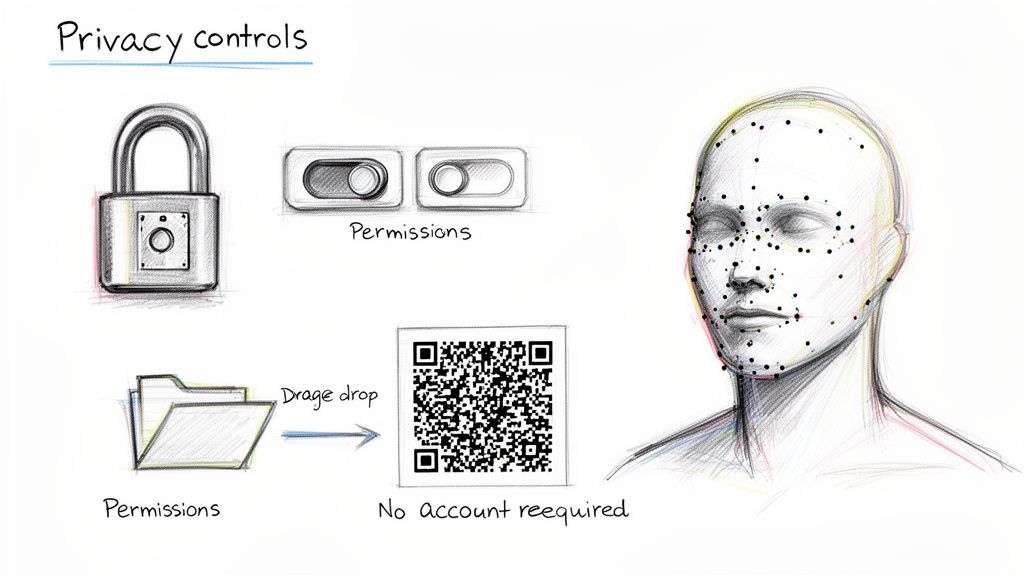
This technology is booming for a reason. The broader facial recognition market is projected to hit USD 9.95 billion in 2026 and jump to USD 20.88 billion by 2031. This isn't just a tech trend; it's driven by real demand in sectors like media and entertainment, where managing assets quickly and securely is everything. Modern systems are even reducing cloud dependency and privacy risks, making them perfect for handling something like a QR code photo gallery at a live event. You can dive into the numbers in this comprehensive market report from Mordor Intelligence.
This rapid growth is exactly why you can't settle for a platform with flimsy features.
Non-Negotiable Privacy and Permission Settings
At the end of the day, a professional system has to put the event organizer in the driver's seat. Managing who sees what isn’t just a nice-to-have feature—it’s fundamental to building trust with your attendees and clients. You should be looking for platforms that give you fine-grained control over gallery access.
Here are the key controls you should demand:
- Password Protection: The simple ability to lock down an entire event gallery behind a password.
- Public vs. Private Toggles: Instantly switch a gallery from being open to the public to being accessible only to people with a direct link.
- Attendee Opt-Out: A clear, easy way for any guest to request their photos be removed from the system, respecting their right to privacy.
These controls give you the power to tailor the photo sharing experience to the specific vibe of your event, whether it's a private corporate retreat or a huge public festival. You can learn more about configuring gallery permissions and controls to see how this works in practice.
A Frictionless Attendee Experience
The most amazing technology is completely useless if people don't use it. The best photo face tagging software is the kind that guests barely even notice. The goal is instant gratification, not a complicated setup that makes them give up and walk away.
The gold standard is a zero-friction experience. If your guests need to download an app, create an account, or figure out a confusing interface, you've already lost. The process should be as simple as scan, selfie, and smile.
A truly seamless workflow means nothing stands between an attendee and their memories. That focus on the user is what separates a professional tool from a clunky consumer app.
Flexible Delivery and Workflow Integration
Finally, a top-tier platform has to fit into your event workflow, not the other way around. This flexibility needs to cover everything from the initial photo upload all the way to how guests get their pictures.
Look for these essential workflow features:
- Drag-and-Drop Uploads: The system should make it dead simple for photographers or event staff to add hundreds or even thousands of photos at once. No complicated steps needed.
- Multiple Delivery Options: A great platform gives you choices. You should be able to share a single link via email or text, but also generate a QR code for posters and signs on-site.
- Monetization-Ready: For professional photographers, the ability to integrate print sales or sell digital downloads right from the gallery is a game-changer. It turns photo delivery into another revenue stream.
Measuring the Tangible ROI for Your Event
It’s easy to get excited about new event tech, but let's be honest—the real question is always, "What's the return?" With photo face tagging software, the value isn't some fuzzy, abstract concept. It delivers a hard, measurable ROI that shows up in your budget, your brand's reach, and your bottom line.
Once you look past the initial cool factor of getting your photos instantly, you’ll find solid business results that make the investment a no-brainer. The ROI really boils down to three key areas: saving a ton of time and money, boosting attendee engagement, and opening up brand-new ways to make money.
Drastically Reducing Time and Cost
In the event world, time is absolutely money. We've all been there—the old way of delivering photos was a black hole for time. Photographers spent days manually sorting pictures, and organizers were buried under an avalanche of "Can you find my photos?" emails. AI-powered tagging makes that entire headache disappear, instantly freeing up dozens, if not hundreds, of hours.
Picture a photographer at a 500-person gala who snaps 2,000 photos. Sorting those images and handling individual requests could easily eat up 10-15 hours of post-event work. At any decent freelance rate, that's a huge operational cost that just vanishes.
For an event organizer, this saved time is just as valuable. Instead of playing customer service for photo requests, your team can focus on what really matters: nurturing sponsor relationships, sending out post-event follow-ups, and planning your next success. You get to focus on activities that actually make money, not just drain your resources.
This efficiency is the most immediate and direct return you'll see. The hours you and your photographer get back are real costs you've just put right back into your budget.
Amplifying Attendee Engagement and Brand Reach
What good are amazing event photos if they never see the light of day? When people can't find their pictures, they don't share them, and a golden marketing opportunity is lost. Photo face tagging flips the script by making sharing simple and immediate. It turns your guests into a volunteer army of brand ambassadors.
The results here are all about organic marketing and user-generated content (UGC), which is marketing gold.
- Skyrocketing Social Shares: When attendees get a link to their own personal gallery right away, they’re far more likely to post their favorite shots on LinkedIn, Instagram, or anywhere else. This creates a wave of authentic, positive buzz that you could never buy with traditional ads.
- A Treasure Trove of UGC: All those shares give you a mountain of user-generated content. You can repurpose these photos and posts for your next event's marketing campaign, showing real people having an amazing time.
- Massive Value for Sponsors: Think about it: every time a photo with a sponsor's logo gets shared, your partners get more visibility. This dramatically increases the value you deliver to them, making it much easier to renew those sponsorships next year.
This creates a powerful marketing cycle. The buzz from this event directly helps sell tickets for the next one, all without you having to spend an extra dime on marketing.
Unlocking New Monetization Channels
Beyond the savings and marketing boosts, photo face tagging software opens up completely new ways to generate revenue, especially for photographers. The technology creates a direct sales channel from the photographer to every single person in their photos—a connection that used to be nearly impossible to make at scale.
This direct-to-attendee model lets photographers monetize their craft in several smart ways:
- Selling Prints and Digital Packages: Attendees can easily buy high-resolution downloads or order professional prints right from their personal gallery.
- Offering Premium Edits: Photographers can offer add-on services like advanced retouching or special filters for a fee.
- Creating Curated Photo Sets: As an organizer, you could team up with your photographer to sell a "VIP Photo Package" as part of a premium ticket, adding another layer of value and revenue.
For bigger events like a sports tournament or a music festival, these sales can add up to a significant new revenue stream. Suddenly, your event photography shifts from being just another line item on the expense sheet to a profitable part of the whole experience.
How to Launch Your First AI Photo Gallery
So, you’ve got a mountain of event photos and want to get them to your guests without spending all weekend manually sorting. Good news: launching an AI-powered gallery is a lot less intimidating than it sounds. You don't need a degree in computer science. Modern photo face tagging software boils the whole thing down to just three core steps.
Let's walk through how to go from a hard drive full of images to a personalized gallery for every single attendee.
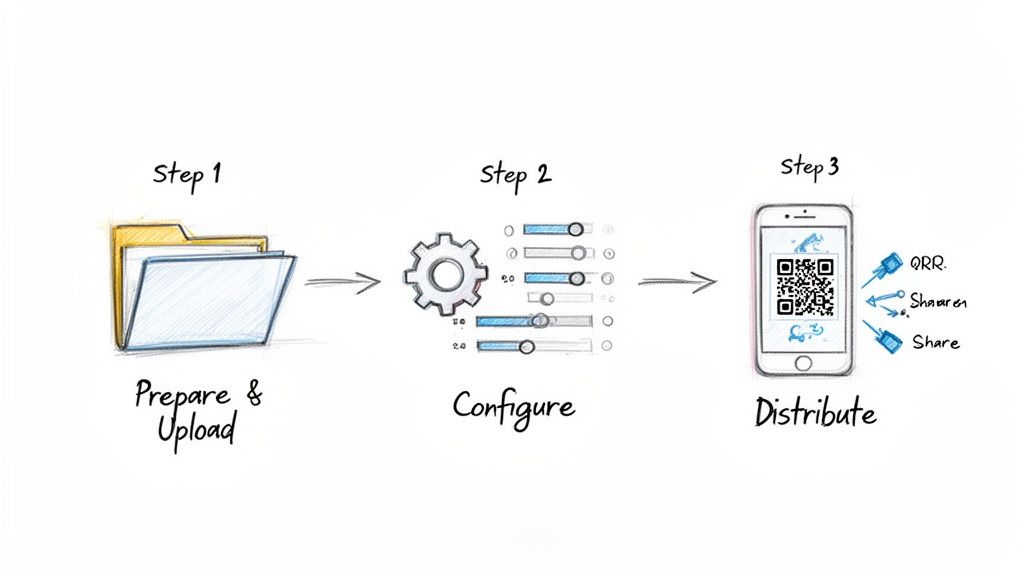
The goal here is simple: save a ton of time while giving your guests a "wow" moment that gets them sharing and talking about your event right away.
Step 1: Prepare and Upload Your Photos
The magic starts with your photos. A little bit of prep work here goes a long way. Before you even think about uploading, just make sure your photos are in a standard format like JPEG or PNG. This isn't usually a strict requirement, but it helps everything run smoothly.
Next, do yourself a favor and organize all the photos into one folder on your computer. When you’re ready to upload, most platforms have a simple drag-and-drop area. It’s that easy.
- Best Practice: Always upload the high-resolution versions. The system will create web-friendly copies, but you want your attendees to have access to the best quality images possible.
- Pro Tip: Was your event a multi-day conference or held at a few different venues? Consider making a separate gallery for each day or location. It keeps things tidy and makes it much simpler for guests to find what they're looking for.
For a more detailed checklist, our guide on how to prepare your event photos for upload has you covered. Once your photos are in the system, the AI quietly gets to work in the background, mapping out every face it finds. You don't have to do a thing.
Step 2: Configure Your Gallery Settings
While the AI is doing its thing, you can jump in and customize the gallery experience. This is where you decide who sees what, what the gallery looks like, and if you want to make money from the photos. A professional platform will put all these controls right at your fingertips.
Here’s what you can typically tweak:
- Privacy Controls: Lock it down or open it up. You can make the gallery public, completely private, or just require a simple password. This lets you tailor the access to the event—a private wedding gallery has different needs than a public music festival.
- Branding Elements: Add your event logo, or better yet, a sponsor's logo. This keeps your brand front and center and can be a huge value-add for your partners.
- Monetization Options: For photographers, this is a game-changer. You can often enable print sales or paid digital downloads directly within the gallery, opening up a whole new way to earn from your work.
Don't skip this step. This is what turns a simple folder of pictures into a strategic asset that's secure, on-brand, and actually helps you meet your business goals.
Step 3: Distribute Your Gallery to Attendees
The gallery is built, the photos are tagged, and everything looks great. Now for the most important part: getting it in front of your guests. Making it ridiculously easy for people to access their photos is the key to getting them to actually use—and share—the gallery.
Here are the most effective ways to get the word out:
- On-Site QR Codes: This is the fastest method. Put a QR code up on big screens, print it on posters, or stick it on table tents. Guests can scan it with their phone and get to their photos before they've even left the venue.
- Email and SMS Campaigns: The post-event follow-up email is the perfect place to drop the gallery link. It’s a natural way to re-engage everyone and give them another reason to remember how great your event was.
- Social Media Sharing: Post the link across your event's social channels. This not only serves your attendees but also shows everyone who didn't come what they missed out on.
By following these three steps, you're all set to launch an AI photo gallery that your attendees will love and that works hard for your brand long after the event is over.
Frequently Asked Questions
Jumping into new event technology always brings up a few questions. How does it work? Is it secure? What does it cost? Let's clear up some of the most common queries about using photo face tagging software at your events.
How Does the Software Handle Privacy and Data Security?
This is, rightfully, the number one concern. Professional platforms are built with privacy as the foundation. The AI doesn't know or store anyone's personal identity—no names, no contact information. Instead, it creates an anonymous numerical code, called a biometric template, to represent a face. Think of it as a unique digital fingerprint used only for matching photos within that one specific event gallery.
Even better, all attendee data, including the selfie they take to start the matching process, is temporary. Good systems are designed to automatically delete this information after the event is over, making sure guest privacy is respected from beginning to end.
Do Attendees Need to Download an App?
Absolutely not, and that’s a key part of what makes this so effective. The best systems are completely browser-based, which means there's zero friction for your guests. They just scan a QR code or tap a link, and a simple webpage opens right on their phone.
They snap a selfie on that page, and a few seconds later, their personalized gallery is ready. Forcing people to download an app or create an account is a surefire way to kill engagement. The whole experience needs to be as simple as scan, selfie, and smile.
What if the AI Misses a Photo or Makes a Mistake?
Today's facial recognition AI is incredibly accurate, often hitting over 99% precision, but no technology is flawless. Every now and then, things like dramatic lighting changes, a tricky camera angle, or a face partially hidden by sunglasses can cause the AI to miss a match.
That's why professional photo face tagging software almost always includes a manual override. If an attendee feels like a photo is missing, they can still easily browse the full public gallery. It's a simple backstop that ensures no one leaves without finding all their pictures. For a closer look at this process, check out our guide on how to launch your first AI-powered gallery.
Is This Technology Expensive to Implement?
It’s far more accessible than most people think, with pricing that scales to your event. Models are typically based on practical things like the number of photos you upload or how many people attend. This makes it a viable option for a small community fundraiser just as much as a massive, multi-day conference.
When you really break it down, the return on investment is strong. Consider the hours you save by not having to manually sort thousands of photos, the marketing boost you get from all the social sharing, and even new revenue streams from print sales. The software quickly stops being a cost and becomes a powerful engine for engagement.
Ready to stop making attendees scroll and start delivering instant memories? With Saucial, you can launch a "Find My Photos" experience for your next event in minutes. See how easy it is to create a QR code photo gallery that delights your guests and amplifies your brand. Discover Saucial today!


