Facial Recognition Photo Organizer: Effortless Event Photo Sorting and Sharing
Ever tried finding your picture after a big event? You know the drill. Someone sends a link to a massive online gallery, and you're stuck scrolling through hundreds, sometimes thousands, of photos, squinting at every face. It’s like looking for a needle in a haystack.
Most people just give up.
A facial recognition photo organizer completely changes that experience. Think of it as a personal photo assistant for every single one of your guests. All they do is upload a quick selfie, and bam—the software scans the entire event album and instantly pulls every photo they appear in. It takes a chaotic, jumbled mess of images and turns it into a personalized, ready-to-share album for each person.
This guide will break down exactly how this technology works, why it's such a big deal for events, and how you can use it to create an experience your guests won't forget.
Transforming the Photo Experience
Let's be honest, the old way was broken. For years, the standard was to dump all the photos onto a cloud drive and send out a link. This put all the work on the attendees, forcing them to do the tedious job of finding their own pictures. The result? Rock-bottom engagement. Only the most dedicated people ever bothered to find, download, and share their photos.
A facial recognition photo organizer flips that entire process around. Instead of making people hunt for their photos, it delivers their photos directly to them. It’s a simple change, but it makes all the difference in creating a smooth and genuinely enjoyable post-event experience.
The real magic is turning a frustrating photo hunt into an instant, engaging experience. It’s not just about finding photos; it's about delivering joy and value to every single attendee without the friction of traditional methods.
Key Benefits for Events
The benefits go way beyond just being convenient. For event organizers and photographers, a platform like Saucial offers some serious advantages that can make a huge impact.
- Boosted Guest Engagement: When guests find their photos in seconds, they're far more likely to share them all over social media. That means more buzz and a much wider reach for your event, completely organically.
- Time Savings: Photographers can finally stop spending hours manually tagging photos or sorting them into folders. This technology handles the heavy lifting, freeing them up to focus on what they do best—capturing amazing moments.
- Enhanced Attendee Satisfaction: Giving your guests a modern, seamless way to get their photos leaves a fantastic lasting impression. It shows you value their time and went the extra mile to deliver a great experience.
How AI Finds Your Face in the Crowd
So, how does a system sift through hundreds, or even thousands, of event photos to find every single picture of you? It might feel like a magic trick, but the technology behind a facial recognition photo organizer is a smart, secure, and surprisingly straightforward process. For your guests, it all happens in just a few moments with zero effort on their part.
Let's break down the three core steps.
Step 1: The Photo Dump
It all starts when the event photographer or organizer uploads the entire photo collection to a secure, cloud-based platform like Saucial. We're talking about a massive batch of high-resolution images from a conference, wedding, or corporate gala. This is the only real "manual" work the host needs to do.
Step 2: The AI Scan and Analysis
Once the photos are uploaded, the AI gets to work. It meticulously scans every single image in the gallery, identifying and isolating each face it finds. For every unique face, the system generates a faceprint—a distinct mathematical representation of that person's facial features.
It's crucial to understand that this isn't a saved picture of someone's face. Think of it more like an anonymous string of numbers that serves as a unique digital signature.
Step 3: The Attendee's Instant Gratification
This is where your guests get that "wow" moment. They simply visit a link or scan a QR code provided at the event. From there, they're prompted to take a quick selfie.
The system analyzes this new selfie, creates a temporary faceprint for it on the spot, and then compares that digital signature against all the faceprints it already generated from the main event gallery.
Within seconds, it finds every single match. Just like that, the guest is presented with a personalized album containing only their photos. No more endless scrolling through a giant, unorganized gallery.
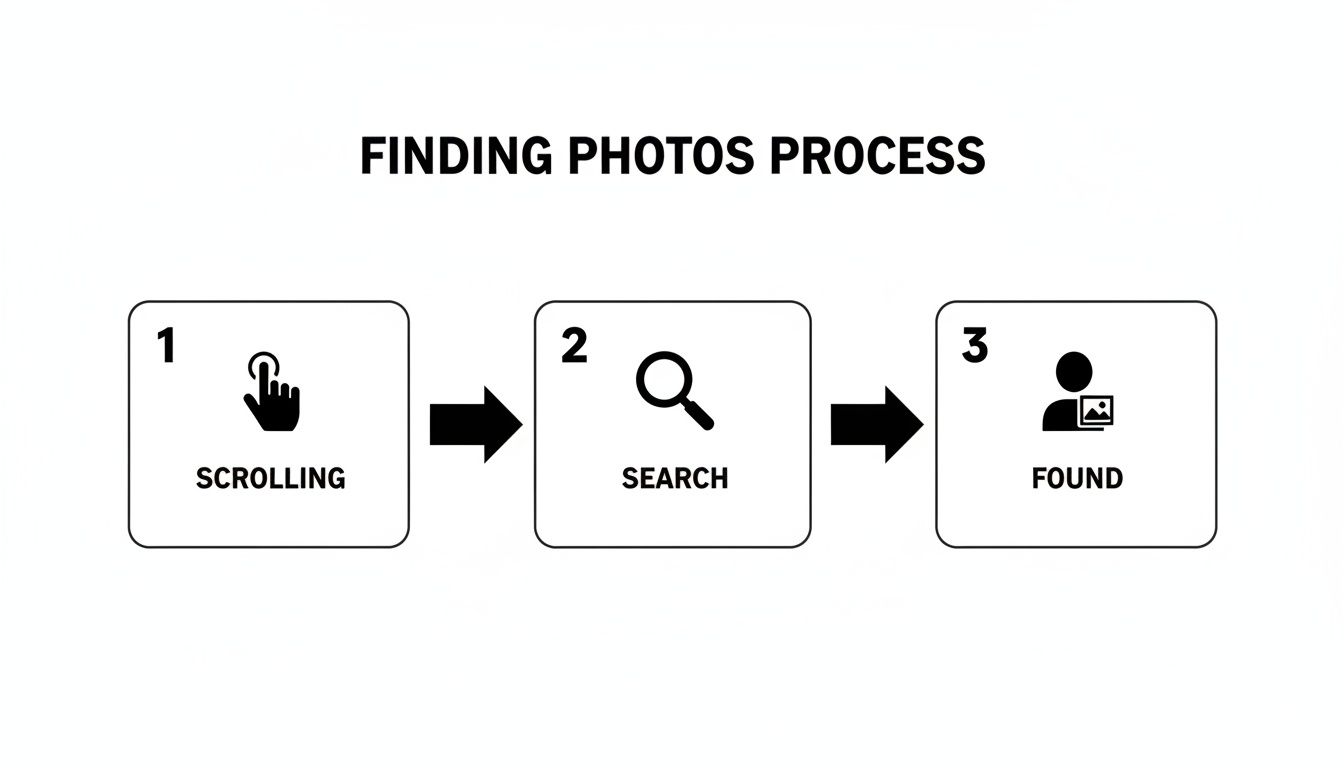
The best part? It’s designed for total convenience. Guests don’t need to download an app, create an account, or come up with another password they'll immediately forget.
Think of it like a digital coat check. Your selfie is the claim ticket. You hand it over, and the system instantly retrieves only your photos from a massive collection, ignoring everyone else's.
This process is built to be fast, but it’s also built with privacy at its core. Most reputable platforms discard the attendee's selfie immediately after the match is made, ensuring personal data isn't stored. The search relies on that anonymous mathematical signature, not an identifiable image, delivering both powerful efficiency and peace of mind.
Why Event Planners and Photographers Are All In On This Tech
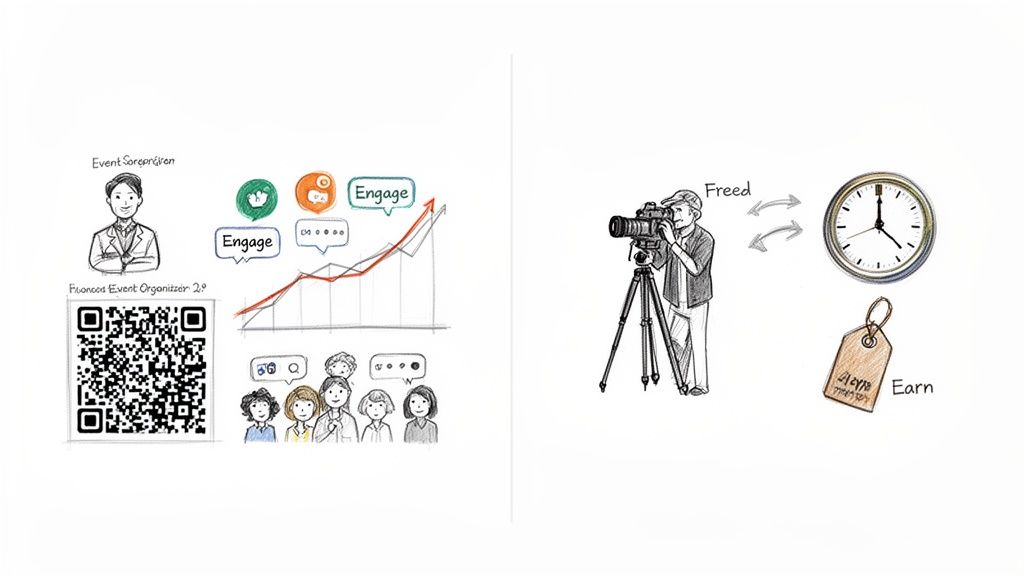
Sure, the "find my photos" experience is a huge win for guests, but the real magic of a facial recognition photo organizer happens behind the scenes. For event planners and photographers, this technology is a game-changer. It tackles old-school logistical nightmares and opens up completely new ways to boost engagement and make money.
If you're an event organizer, you know the drill. The event ends, and your inbox explodes with "where are the photos?" emails. The old way—dumping thousands of unsorted pictures into a cloud folder—is a recipe for low engagement and a massive administrative headache.
This is where things get interesting. Instead of a clunky Dropbox link, you give guests a single, smart QR code. They scan it, snap a selfie, and instantly get their photos. This self-service approach isn't just convenient; it dramatically increases the odds of those photos getting shared, turning attendees into your best marketing team.
A New Playbook for Event Organizers
Picture a big corporate conference. Attendees get a simple prompt to find their pictures and are immediately greeted with a personalized gallery of their headshots, networking conversations, and main-stage moments.
This one small change creates a massive ripple effect:
- Sky-High Social Reach: Guests are a whopping 70% more likely to share photos when they don't have to hunt for them. That's free, authentic promotion that money can't buy.
- Zero Administrative Drag: The system does the heavy lifting, freeing up your team from the tedious task of manually finding and emailing photos. This saves an incredible amount of post-event time.
- Real Value for Sponsors: Offer up branded photo overlays or galleries as a premium sponsorship package. It’s a modern, measurable activation that gives sponsors direct exposure to your audience.
Suddenly, photos are no longer a chore. They're one of your most powerful tools for marketing and engagement long after the event wraps up.
More Time and More Money for Photographers
For photographers, the impact is even more direct. The biggest win? Getting your time back. We all know that culling, sorting, and tagging photos from a major event can suck up days of non-billable hours.
A facial recognition photo organizer automates the most grueling part of the post-production workflow. This hands photographers back their most precious resource—time—so they can focus on creative edits, landing new clients, or shooting the next gig.
But it’s not just about saving time. This technology forges a direct commercial link between you and every single person in your photos. Instead of just handing over a gallery to the event host, you’re now presenting a personalized storefront to each guest.
This unlocks brand-new revenue streams that were nearly impossible before:
- Direct-to-Guest Sales: Easily offer high-resolution prints, digital downloads, or special edits directly to the people who want them most.
- Smart Upsell Opportunities: Create curated photo packages or limited-time offers, turning one event contract into hundreds of potential small sales.
- Actionable Insights: See which photos get the most views and shares. This data is gold, helping you understand what moments resonate most and refine your shooting style for future events.
Let's break down just how different the two approaches are.
Traditional Photo Sharing vs Facial Recognition Organizer
The old way of sharing photos just doesn't compare to the speed and engagement you get with an intelligent system. It's the difference between asking guests to dig through a messy closet and handing them exactly what they were looking for.
| Feature | Traditional Method (e.g., Drive/Dropbox) | Facial Recognition Organizer (e.g., Saucial) |
|---|---|---|
| Photo Retrieval | Guests manually scroll through hundreds or thousands of photos. | Guests get a personalized gallery delivered to them in seconds. |
| Time to Find | 15-30 minutes (or they give up). | Less than 30 seconds. |
| Engagement | Very low. Most attendees never bother to look. | Extremely high. The process is instant and rewarding. |
| Social Sharing | Minimal. It's too much work to find and download a photo. | High. Guests are 70% more likely to share. |
| Admin Work | High. Constant emails and requests for specific photos. | Nearly zero. The system is fully automated and self-service. |
| Monetization | Difficult. No direct way to sell to individual guests. | Built-in. Creates a direct sales channel to every attendee. |
At the end of the day, a facial recognition photo organizer isn't just a cool new tool. It fundamentally changes the business model, turning a photographer's service from a one-and-done delivery into a scalable, ongoing relationship with a much broader audience.
Putting Your "Find My Photos" Plan into Action
Successfully rolling out a facial recognition photo organizer is less about the tech itself and more about designing a seamless experience for your guests. You want them to find their photos so easily it feels like magic. A good plan makes accessing photos a natural part of the event, not a chore they have to deal with later.
The groundwork starts before a single picture is snapped. You've got to build a little anticipation. Mention the "Find My Photos" feature in your pre-event emails and social media posts. It's a small heads-up that tells attendees you're on top of things and have a modern, simple way for them to get their pictures.
On-Site Execution for Maximum Engagement
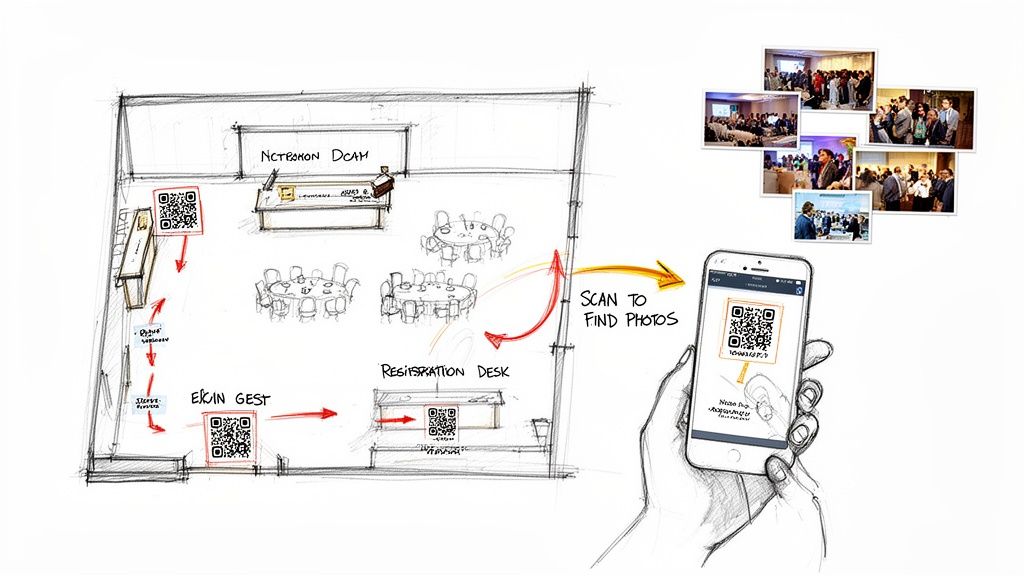
Once the event kicks off, your job is to make finding the gallery impossible to miss. Don't hide the link on a website or bury it in an app. You need to bring the gallery directly to your guests with QR codes placed in high-traffic, can't-miss spots.
Think about all the places your guests will naturally be:
- Registration Desks: This is your first touchpoint. Make it one of the first things they see.
- Event Signage: Weave the QR code into welcome banners and directional signs.
- Table Tents: A small card on every table gives people something to do during a lull.
- Exit Points: Give them one last, easy chance to grab their memories on the way out.
This multi-pronged approach means that wherever a guest is, they're just a quick phone scan away from seeing themselves in the action.
The best systems are completely frictionless. A guest shouldn't have to download an app, create an account, or fumble through a confusing menu. One scan and a quick selfie—that's all it should take to unlock their personal photo album from the event.
Post-Event Follow-Up and Control
The event might be over, but your job isn't quite done. A final follow-up email or a social media push with the gallery link is a fantastic way to re-engage everyone. This catches anyone who might have missed the QR codes on the day and often triggers a whole new wave of excitement and social sharing.
On the back end, a good facial recognition photo organizer gives you the keys to the kingdom. You're not just throwing a public link out there; you're managing a valuable asset. For instance, once the photographer delivers the final images, a simple photo upload process is critical to getting the gallery up and running without delay.
From your dashboard, you can typically dial in the important settings:
- Photo Visibility: You get to decide which photos are public and which should remain private.
- Download Permissions: Keep control over whether guests can save images directly to their devices.
- Gallery Branding: Customize the gallery with your event's colors, logos, or even a sponsor's branding.
By following this simple playbook—building hype beforehand, making access obvious on-site, and following up afterward—you turn a photo gallery from a static archive into a dynamic engine for engagement. It creates a genuinely memorable experience that guests will be excited to talk about and share.
Your Guide to Privacy and Security with Facial Recognition
Let's be honest: when you hear "facial recognition," your mind might jump straight to surveillance and security cameras. It's a natural concern, but it's important to understand that a facial recognition photo organizer operates on a completely different playing field. We're not talking about tracking people. We're talking about a consent-based tool designed for one thing: making it incredibly easy for your guests to find their own photos.
The whole system is built on trust. When an attendee wants to find their pictures, they're in the driver's seat.
A major myth is that these platforms are hoarding a giant database of everyone's selfies. That couldn't be further from the truth. When a guest uploads their selfie, the AI doesn't store the picture. Instead, it converts their facial features into a faceprint—basically a unique mathematical code. Think of it like a digital fingerprint, but for a face.
This numerical signature is what the system uses to scan the event gallery for matches. Once it finds the photos and delivers them to the user, the original selfie is permanently deleted. This "use and forget" approach is fundamental to protecting everyone's privacy.
How Ethical Platforms Keep Data Safe
Any platform worth its salt puts transparency and user control front and center. This isn't just a "nice to have"; it's the foundation of a service people will actually want to use. Both you, the organizer, and your guests should always feel in command of your data.
Here are the non-negotiable privacy features you should look for:
- It's Always Opt-In: The system can't do anything until a user decides to participate by uploading a selfie. There’s no sneaky background scanning—it’s an explicit, one-time action from the guest.
- Data is Temporary: That selfie has one job: find the photos. Once that's done, it's gone for good. It's not kept for any other purpose.
- Faceprints are Anonymous: The mathematical codes generated are just strings of numbers. They can't be reversed-engineered to reconstruct someone's face.
This ethical design is precisely why the technology is taking off. The global facial recognition market isn't just growing; it's exploding, projected to jump from $5.15 billion in 2022 to $15.84 billion by 2030. That kind of growth only happens when people trust the tools they're using. For a deeper dive into what's driving this trend, check out this detailed facial recognition market analysis.
The core principle is simple: your face is your key, but the system never keeps a copy of the key. It uses it once to unlock your photos and then forgets it, ensuring your privacy is always protected.
You're in Full Control—And So Are Your Guests
A reliable facial recognition photo organizer gives you, the event organizer, the power to set the rules. You get to decide exactly how your gallery works, who gets to see the photos, and what they can do with them. If you’re curious about how this works in practice, you can create an account and explore the privacy-centric user authentication options to see the controls for yourself.
This level of control ensures the technology is working for you and your event, not the other way around. By choosing a platform with a clear, upfront privacy policy, you can offer a fantastic, modern photo experience that’s not just engaging but also completely respectful of everyone's data.
How to Choose the Right Photo Organizer for Your Event
Not all facial recognition platforms are created equal. When you're trying to pick the right solution for your event, you need to look past the simple promise of "find my photos." The best tool should feel like magic for your guests and be a powerhouse for you, whether you're the organizer or the photographer.
The first thing to kick the tires on is the core technology. How fast and accurate is the matching algorithm, really? A system that drags its feet or misses obvious faces is more frustrating than helpful, completely defeating the point. Just as crucial is the user experience—if your guests have to download an app or navigate a clunky interface, they'll just give up.
Key Evaluation Criteria
A truly modern facial recognition photo organizer has to be 100% cloud-based. This is non-negotiable. It means no special hardware, no software to install, and maximum flexibility for you and your team. This move towards software-driven solutions is a huge market shift, with companies choosing the scalability of the cloud over clunky hardware. You can dig deeper into the growth of facial recognition software solutions to see just how big this trend is.
As you start comparing your options, use this checklist to cut through the marketing noise:
- Ease of Use: Could a non-tech-savvy guest figure it out in under 30 seconds? The gold standard is a quick QR code scan and a selfie. That’s it.
- Privacy Policy: Is their privacy policy written in plain English, or is it a wall of legalese? Vague language is a massive red flag. Reputable platforms will be upfront about not permanently storing attendee selfies.
- Customization and Control: Can you slap your event's logo and brand colors all over the gallery? You should also have total control over who sees which photos and whether they can be downloaded. A quick look at the back end, like checking out the event and gallery settings, will show you how much control you actually get.
- Business Model Alignment: Think about your end goal. Are you simply trying to get photos out the door faster? Or are you a photographer looking to sell more prints and digital downloads? Make sure the platform’s features actually support what you’re trying to accomplish.
A great platform doesn’t just find photos; it enhances the event experience. It should be intuitive for guests, insightful for organizers, and profitable for photographers, all while putting privacy first.
Got Questions? Let's Talk Facial Recognition Photo Tech
Even after seeing how it all works, you probably still have a few questions. That’s normal. Let's tackle some of the most common ones that pop up when organizers and their guests first encounter a facial recognition photo organizer.
Just How Accurate Is This Stuff, Really?
It's surprisingly accurate, even in the middle of a chaotic event. Today's AI is built to handle the real world—think weird lighting, people turning their heads, and busy backgrounds. When an attendee uploads a selfie, the system is remarkably good at finding their photos.
For the absolute best results, clear, well-lit photos from your photographer will always yield the highest match rates. The tech works by creating a unique digital signature of someone's face, and it's far more reliable than a person trying to manually scan through hundreds of photos.
Is It Actually Safe for My Guests to Upload a Selfie?
Yes, as long as you're using a privacy-focused platform, it's completely safe. Trustworthy providers don't hang onto the selfie. It's used for one thing only: to find that person's pictures in the gallery. After that, it's gone.
Think of it this way: the system doesn't store the selfie itself. It creates a temporary mathematical map to find the matches and then forgets the map. This keeps personal identity private and puts guest consent first.
This "one-time-use" approach is what makes the whole system work so well without being creepy. It’s effective and respectful.
Can I Use This for My Type of Event?
Almost certainly. A facial recognition photo organizer is incredibly versatile and works brilliantly for all sorts of gatherings. We see it used all the time for:
- Corporate conferences and massive trade shows
- Weddings and big family reunions
- Charity fundraisers and formal galas
- Sports events, from marathons to golf tournaments
- Music festivals and concerts
Basically, if you have an event where guests will want a fast, cool, and modern way to find their photos, this technology is a perfect fit.
Ready to give your attendees a photo experience they'll actually talk about? See how Saucial helps you launch your own "Find My Photos" gallery in just a few minutes. Get started over at https://saucial.com.


