Face Recognition Software for Photos: Transform Your Event Albums
Ever had to hunt for your own face in a sea of event photos? Face recognition software for photos is designed to fix that exact problem. It works by taking a selfie you upload and then instantly scanning an entire event album to find every picture you're in.
This completely gets rid of the soul-crushing task of scrolling through hundreds, or even thousands, of images just to find the few that matter to you. It’s a simple, elegant solution that delivers your personal photo collection in seconds.
The End of Endless Scrolling: How AI Delivers Photos Instantly
Think back to the last big event you went to—a gala, a wedding, or a major conference. The energy was high, the photographer was snapping away, but what happened after? More often than not, you got a link to a giant, messy gallery filled with every photo taken that day.
Your mission, if you chose to accept it, was to spend the next 20 minutes squinting at your screen, scrolling and scrolling, just to find a handful of pictures of yourself. This “photo dump” is a classic post-event letdown for guests and a huge missed opportunity for organizers.
Solving the “Find My Photos” Problem
The root of the issue is that old-school photo sharing is clunky and impersonal. It puts all the work on the guest, which quickly leads to frustration and people just giving up. As a result, countless incredible professional photos never get seen or shared.
This is where face recognition software for photos really flips the script. Instead of one massive gallery for everyone, platforms like Saucial create a personalized "Find My Photos" experience for every single person. The whole process couldn't be simpler for the guest:
- One Link: Guests get a single link or scan a QR code at the event.
- Quick Selfie: They snap a quick selfie right on their phone—no app needed.
- Instant Delivery: The AI scans the entire album in a flash and presents them with a curated gallery of just their photos.
What was once a chore becomes a genuinely cool moment. Attendees feel seen, and that positive experience makes them far more likely to download their photos and post them online. For event teams, this solves a huge engagement headache after the curtains close.
By using a simple selfie to automate photo delivery, you turn a static photo album into an active, engaging experience that keeps the event buzz going long after it’s over.
Comparing Traditional vs. AI-Powered Photo Sharing
The difference between the old way and the new is night and day. One creates a roadblock for your guests, while the other builds a bridge.
To see just how big the gap is, let's put the two methods side-by-side.
| Feature | Traditional Method (e.g., Shared Drive) | AI-Powered Method (e.g., Saucial) |
|---|---|---|
| Photo Discovery | Manual scrolling through hundreds of images | Instant delivery via selfie photo matching |
| Guest Experience | Tedious, time-consuming, and often frustrating | Fast, personalized, and delightful |
| Time to Find Photos | 10-30 minutes on average | Under 30 seconds |
| Engagement Rate | Low; many attendees abandon the search | High; personalized galleries encourage sharing |
| Privacy | Guests see all photos, including others' | Guests only see their own photos automatically |
| Organizer Effort | Minimal setup, but high manual follow-up | Simple upload, fully automated distribution |
Ultimately, the choice comes down to the kind of experience you want to provide. An AI-powered approach prioritizes the guest, making them feel valued while ensuring your event's best moments actually get seen and shared.
How Selfie Photo Matching Actually Works
Ever wonder how you can get all your event photos delivered to you instantly, without scrolling through hundreds of pictures of strangers? It’s not magic, but it’s close. Think of face recognition software for photos as your personal photo assistant at an event. Its only job is to spot you in the crowd and pull together a gallery that’s all yours.
The whole thing is powered by a straightforward, three-step process designed to be fast, accurate, and completely private. It all starts with the event photos and ends with a guest happily swiping through their personal album just moments later.
The Three Core Steps of Photo Matching
The system is built to take a massive gallery of unsorted photos and automatically create individual collections for every attendee. Here’s a look at how it all comes together.
Gallery Upload and AI Processing: First, the photographer or event organizer uploads the entire collection of event photos to a platform like Saucial. As soon as the photos are uploaded, an AI engine kicks in and starts scanning every single image. For each face it finds, it creates a unique, anonymous numerical map of that person's facial features—things like the distance between the eyes, the bridge of the nose, and the jawline. This "facial template" is just a string of numbers, not a picture, and contains zero personal information.
The Attendee Selfie: Now for the guest's part. They simply click a link or scan a QR code provided at the event. This opens a private, secure page in their browser where they’re prompted to take a selfie. This single selfie acts as the key to unlock their photos from the main gallery.
The Instant Match: The software takes that new selfie and instantly converts it into its own numerical facial template. It then compares that one template against all the templates it created from the main gallery photos. When it finds a match—which usually takes a couple of seconds—it pulls every photo featuring that person into a private, personalized collection just for them.
This simple workflow completely replaces the old, frustrating way of finding photos.
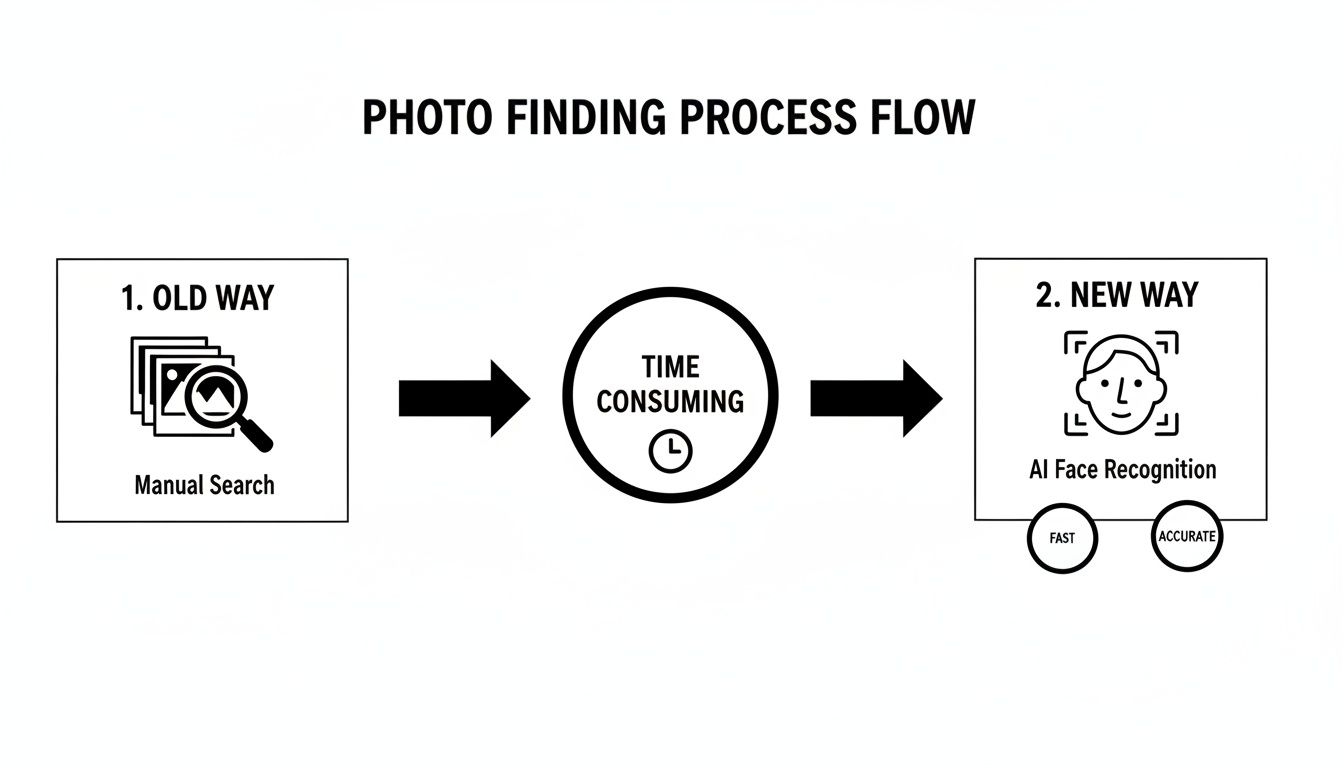
The difference is night and day. You go from the tedious "Old Way" of endless scrolling to the instant gratification of the "New Way" powered by a simple selfie.
Privacy Is Built-In, Not Bolted-On
Let's talk about the most important part: privacy. The selfie a guest takes is never stored or used for anything beyond that one-time search.
Think of the selfie as a temporary password. It grants access for a moment, finds your photos, and is then immediately discarded. It's never saved to a database, used to train other AI models, or linked to your personal identity.
This keeps the guest's data entirely in their own hands. The system also works in a closed loop for each event, meaning the facial templates from your company gala will never be mixed or compared with those from another event. It's a secure, consent-based process where the user is always in control.
For event teams, this means you can offer a genuinely useful and modern perk without creating any privacy headaches. Photographers looking to drastically cut down on their post-event workload can see how an event photo sharing link automates the entire delivery process.
Ultimately, the technology handles all the heavy lifting—analyzing thousands of data points in the background—so that every guest gets a simple, fast, and fun experience.
Putting AI Photo Sharing to Work in the Real World
The theory behind face recognition is fascinating, but its real value comes to life when you see it solving actual problems at events. It’s not just about cool tech; it’s about creating better experiences and measurable results.
Let's move past the 'how' and dig into the 'why' this technology is becoming a go-to tool for event professionals. Different events have completely different goals, and the beauty of AI-powered photo sharing is how it adapts to meet them, turning a simple photo gallery into an engine for engagement and revenue.
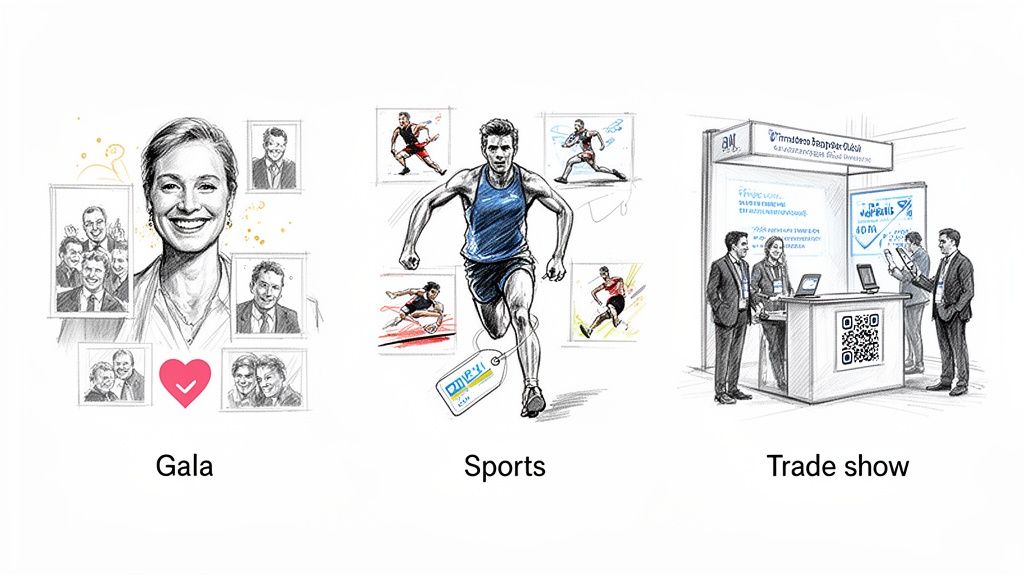
Gala Fundraisers and Charity Events
For any gala or fundraiser, the night itself is just the beginning. The real goal is to keep the energy going and drive post-event donations. This is where a gala fundraiser photo gallery using face recognition can be a game-changer.
When guests get a link to instantly find amazing photos of themselves from the evening, it does more than just bring a smile. It reignites the emotion they felt at the event—the powerful speeches, the exciting auction, the community spirit. That emotional connection is what inspires people to give.
- A Personal Touch: Include a "Find My Photos" link in your thank-you emails. It's a simple, personalized touch that reinforces the value of the evening.
- The Perfect Nudge: This warm reminder makes a follow-up donation request feel genuine and meaningful, not like just another generic ask.
The result is a much stronger connection with your supporters that can directly translate into more donations for your cause.
Sports Tournaments and Action Photography
Sports photographers have a tough job. They capture thousands of incredible action shots, but then face the daunting task of getting those photos in front of the right athletes. Huge, unorganized online galleries are a nightmare to search through, leading to frustrated parents and tons of lost sales.
Selfie photo matching completely flips the script. A photographer can just put a QR code on a flyer or at their tent.
Athletes and their families scan the code, snap a quick selfie, and are immediately shown a curated gallery of all their action shots. What was once a chore becomes an exciting, instant discovery.
This creates a direct and seamless path to purchase. It lets photographers sell digital downloads and prints right on the spot, maximizing their revenue from every single game.
Conferences and Trade Shows
At a corporate event or trade show, it's all about lead generation, brand exposure, and keeping attendees engaged. Trade show photo sharing with face recognition nails all three.
Think about a sponsored photo booth or a photographer roaming the floor. Instead of just getting an email or a business card, attendees can be directed to a branded gallery to find their professional headshots or candid networking photos.
Here’s how it delivers for conferences:
- Boost Booth Traffic: A "Find Your Photos Here" sign with a QR code is a fantastic way to draw people to a sponsor's booth.
- Capture Qualified Leads: You can ask for a quick email or badge scan to access the photos, turning a fun interaction into a valuable lead.
- Amplify Social Reach: When attendees find great photos of themselves, they share them on LinkedIn, tagging the event and the sponsor. This generates a wave of authentic, user-generated content (UGC).
This turns a photo op into a powerful marketing tool that gives attendees something they actually want while delivering concrete results for organizers and sponsors.
The explosive growth in this area speaks for itself. The facial recognition market is projected to hit USD 9.30 billion in 2025 and skyrocket to USD 36.75 billion by 2035. In the U.S. alone, the market is expected to grow from USD 2.65 billion in 2025 to over USD 10.62 billion by 2035. You can dig into the full market projections to see just how quickly event professionals are adopting this technology.
Weddings and Private Celebrations
Even personal events like weddings can benefit. Couples spend a fortune on photography and want their guests to relive the day. But sending a link to a massive gallery with 1,000+ images means most guests will never find their photos.
By placing a simple QR code on tables at the reception, the couple can give their friends and family a fun, easy way to find every photo they're in. It makes the professional photos feel more personal and ensures all those beautiful, captured moments are actually seen and enjoyed.
What's the Real-World Payoff for You?
Let's get down to brass tacks. Adopting any new tech hinges on one simple question: what’s the ROI? With face recognition software for photos, the benefits aren't just buzzwords on a sales page. They’re tangible, measurable, and can genuinely change the game for event organizers and photographers alike by hitting the three things that matter most: efficiency, engagement, and revenue.
For event teams, the most immediate and satisfying win is getting out of the photo-finding business. Think about it—no more digging through folders to answer "Can you find my photos?" emails. Instead of burning hours sorting and sending, you automate the entire distribution process. That’s time you can now pour back into planning your next knockout event.
Watch Your Brand's Reach and Engagement Explode
When people can find their photos in seconds, they share them. It’s that simple. This sparks a wave of authentic, user-generated content that organically pushes your event's reach far beyond its original audience. Every photo shared on social media is a personal endorsement, often featuring your event’s branding.
This isn't just a "nice-to-have"; you can track the impact on your bottom line:
- Skyrocketing Social Media Mentions: More shares directly translate to more tags and mentions for your event, sponsors, and brand.
- A Longer Post-Event Buzz: Personalized photo galleries keep the conversation and excitement alive long after the doors have closed.
- Deeper Attendee Loyalty: Giving guests a seamless, modern experience makes them feel seen and valued, making them far more likely to come back.
The market itself tells the story. Technavio predicts the facial recognition market will swell by an incredible USD 20.37 billion between 2026 and 2030, growing at a blistering 25.5% CAGR. This explosion is fueling innovations like a simple event photo sharing link that fundamentally changes how brands connect with their audiences. We've seen event teams cut their photo-related admin time by up to 60%, while schools report a massive spike in alumni engagement after launching selfie photo matching. If you're curious, you can dig into the market trends reshaping media and events yourself.
A New Playbook for Photographer Revenue
For professional photographers, automating photo delivery isn't just about saving time—it's a complete business model upgrade. The old way involved handing over a massive folder of images to the organizer, which usually ended the photographer's connection to the actual attendees. Face recognition completely flips that script.
By giving every guest a direct way to find their own photos, photographers open up a brand-new and incredibly powerful sales channel. This is especially potent for events where guests are emotionally invested and ready to buy keepsakes from a memorable experience.
You're no longer just a service provider hired for a day. You become a direct-to-consumer retailer, creating monetization opportunities that were simply impossible to manage at scale before.
This direct line allows photographers to sell high-margin products to the people who want them most: the ones actually in the photos. For example, at a gala fundraiser photo gallery, making it dead simple for guests to find and purchase prints can boost photo sales by as much as 25%.
So, what can you sell?
- Digital Downloads: Offer high-resolution digital files for a set price.
- Print Sales: Integrate with a print-on-demand service to sell professional prints, canvases, and other photo products.
- Branded Frames: Team up with sponsors to offer photos with custom-branded digital or physical frames.
- Premium Edits: Upsell guests on advanced photo editing or retouching services.
By letting the software handle the grunt work of sorting and delivery, photographers can get back to what they love—capturing incredible images. This boost in efficiency, combined with entirely new ways to make money, makes face recognition software for photos an essential tool for any modern photography business. To get the most out of it, take a moment to configure your event photo settings to match your goals.
A Responsible Approach to Privacy and Photo Sharing
Let's be honest: when people hear "face recognition," their minds often jump to surveillance or data mining. It’s a completely understandable reaction, which is why conversations about privacy are front and center.
But the software designed for events operates on a totally different playing field. Modern platforms are built from the ground up on a foundation of user consent and control, creating a secure and respectful experience that puts attendees in the driver's seat.
The core difference is its closed-loop design. A face recognition event gallery isn't some vast, open system connected to the wider world. It’s a private, temporary ecosystem controlled entirely by you, the event organizer. The technology works for the attendee, not on them.
Putting Attendee Consent First
The entire system is built around an active, consent-based model. We’re not scanning faces in the background and pushing photos to unsuspecting guests. The power is completely in their hands.
Here’s how it works:
- User-Initiated Search: An attendee has to actively decide to find their photos, usually by clicking a link or scanning a QR code you provide.
- Active Selfie Submission: To start the search, a guest must consciously take and upload a selfie. This single action is their explicit, one-time permission for the system to find their pictures.
This approach means the software only kicks into gear when a user specifically asks it to. It’s an on-demand tool that waits for a direct command.
Think of it like a digital coat check. You hand over your ticket (the selfie) to retrieve your specific items (your photos). Once you have your coat back, the transaction is over. The ticket isn't saved or used for anything else.
How Attendee Data Is Protected
So, what happens after a guest uses the system? This is where strict privacy protocols take over. The goal is to deliver photos with incredible efficiency while leaving the smallest data footprint possible. Any responsibly designed system operates on two core principles.
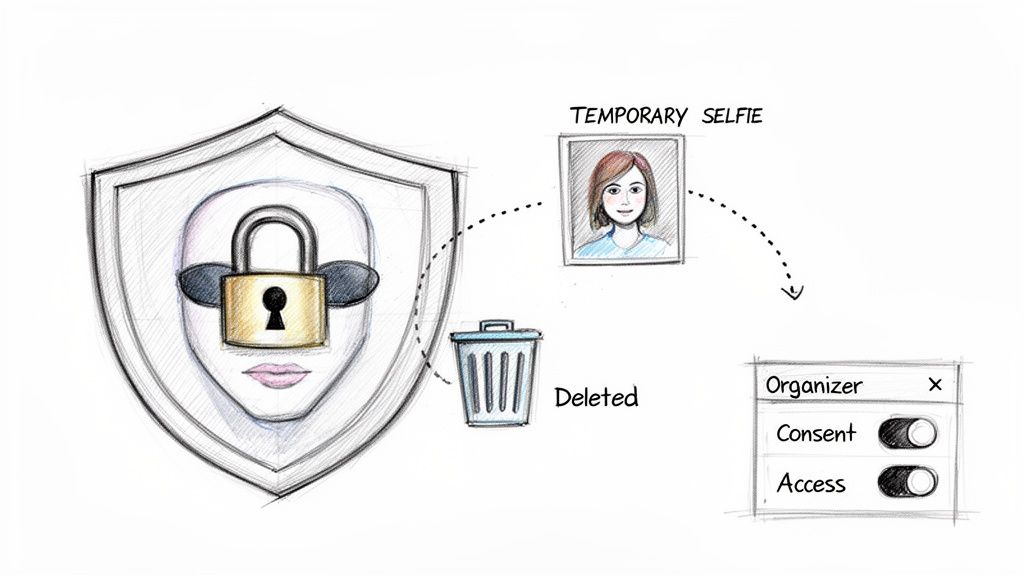
1. The Selfie is Temporary The selfie an attendee uploads is used only for that immediate search. That’s it. It is never stored in a permanent database, never used to train AI models, and never shared with anyone else. Its purpose is singular and momentary before being discarded.
2. Organizer Control is Absolute The event host or photographer maintains complete control over the photo gallery. You decide who gets access, how long the gallery stays live, and what people can do with the photos. This keeps the images within the trusted circle of your event.
As the global facial recognition market—which surpassed USD 3 billion in 2019 and is projected to grow at over 18% CAGR through 2026—continues to expand, the demand for privacy-first designs is more critical than ever. In fact, by 2025, over 61.45% of deployments were on-premise to ensure greater data security. Platforms like Saucial are built on this very principle, keeping everything locked down to the specific event. For more detail, you can read about the facial recognition market's growth.
Ultimately, this modern, consent-based approach empowers everyone. Guests get a genuinely fun and useful experience without a second thought about their privacy, and organizers can offer a standout service with total confidence.
If you’re planning an event, you can start setting up your own secure gallery and see for yourself how simple and safe it is.
How to Implement AI Photo Sharing for Your Next Event
So, you're ready to leave frustrating photo dumps in the past and modernize your event photography? Adopting face recognition software for photos is a lot more straightforward than it sounds. With a simple, three-step approach, you can go from chaos to delivering instant, personal galleries that your guests will absolutely love.
The first move is figuring out what you really want to achieve. Are you trying to reclaim countless hours spent on admin? Is the goal to get a huge bump in social media engagement after the event? Or maybe you're looking to open up a new revenue stream for your photography business? Nailing down your main objective from the start will shape every other decision you make.
Step 1: Define Your Primary Goal
Before you even look at a single tool, you need to be crystal clear on what a "win" looks like for your event. Your "why" is the foundation for everything.
- Looking for Engagement? If your top priority is getting people to share their photos and spread the word about your brand, then you need to make finding those photos dead simple and lightning-fast. The fewer clicks, the better.
- Need to Save Time? Tired of fielding endless "Can you find my photos?" emails? Then you'll want a system that automates the entire process, from the moment the photographer uploads the images to the second a guest finds their pictures.
- Focused on Revenue? For photographers aiming to sell prints or digital downloads, the right platform needs to have e-commerce baked right in. You're looking for a direct line from guest to checkout, making it easy for them to buy.
Step 2: Choose the Right Platform
Once your goal is set, it’s time to find the right tool for the job. You're looking for a solution that simplifies your workflow and—this is critical—gives your guests an effortless experience right in their web browser. Let's be honest, nobody wants to download an app just to see their pictures.
A platform like Saucial, for instance, was built from the ground up with events in mind. It's all about a simple drag-and-drop for the organizer and an intuitive selfie search for the attendee. The whole thing is designed to be smooth for everyone involved.
The best tool is one that feels invisible to the user. It should work instantly on any device, turning a complex technical process into a simple, enjoyable moment for your guests.
Step 3: Plan Your Launch and Share the Link
With your platform chosen, the final piece of the puzzle is planning how to get the word out. How you share your event photo sharing link directly impacts how many people actually use it.
Here are a few proven ways to do it:
- On-Site QR Codes: This is the most effective method. Put QR codes on tables, event screens, or banners. Guests can scan and find their photos while the excitement is still fresh.
- Post-Event Emails: A "Find My Photos" link in your follow-up email is a fantastic way to re-engage attendees and keep the event buzz going for days.
- Social Media Campaigns: Post the gallery link across your social channels. It encourages your followers to dive in, find their favorite shots, and share them with their own networks.
By taking these three steps, you can roll out a modern photo-sharing system that actually works and delivers measurable results. See for yourself and explore how an AI-powered platform like Saucial can elevate your next event.
Frequently Asked Questions
Whenever you bring in new tech, there are always a few questions. Let's walk through the most common ones we hear about using face recognition for event photos so you can get a clear picture of how it all works.
Is This Technology Difficult to Set Up for an Event?
Not in the slightest. Modern platforms are built to be user-friendly, not just for the attendees, but for you too.
The whole process is incredibly simple: you create a gallery for your event, upload the photos, and then share one link or QR code with everyone. The AI does all the heavy lifting in the background—no coding, no complex configurations, just a smooth experience.
What Happens to the Selfies Attendees Use for Matching?
This is a big one, and rightly so. With any privacy-focused system, that selfie has one job and one job only: to find that person's photos in that specific gallery.
It’s not stored long-term, it's not used to train AI models, and it's certainly not added to some massive database. As soon as the search is done, the selfie data is gone for good.
Think of the selfie as a temporary key. It unlocks the door to a personal gallery and is then immediately destroyed. The system is designed for a single purpose and doesn't hold onto personal data afterward.
Do I Still Control Who Can See the Event Photos?
Absolutely. You, the event host or photographer, are always in the driver's seat.
You decide how to share the gallery. Maybe it's a private link you email to a specific list, or perhaps it's a public QR code posted at the venue. Attendees only ever see their own matched photos, not the entire collection, which automatically keeps everything private and secure.
How Accurate Is the Selfie Photo Matching?
It's impressively accurate. The algorithms behind today's facial recognition are incredibly precise, which means the software has no trouble finding people across a whole set of event photos.
It handles real-world conditions with ease, accounting for:
- Lighting conditions, from a dimly lit gala to a bright outdoor festival.
- Various angles as people move around and turn their heads.
- Changing facial expressions, like a serious look in one photo and a huge smile in another.
This level of reliability means your guests get the right photos delivered to them almost instantly, without frustrating mismatches.
Ready to modernize your event photo sharing? Saucial makes it simple to create a "Find My Photos" experience that your attendees will love. Discover how Saucial can transform your next event.


