Event Photo Sharing: Elevate Engagement with event photo sharing
So, what exactly is event photo sharing? At its core, it’s the simple act of getting pictures to your guests after a conference, wedding, or any get-together. But the best way to do it has changed. Modern tools now use a single link or QR code to give each person their own AI-sorted gallery, so they don't have to hunt through hundreds of photos just to find themselves.
Moving Beyond Cluttered Folders and Broken Links
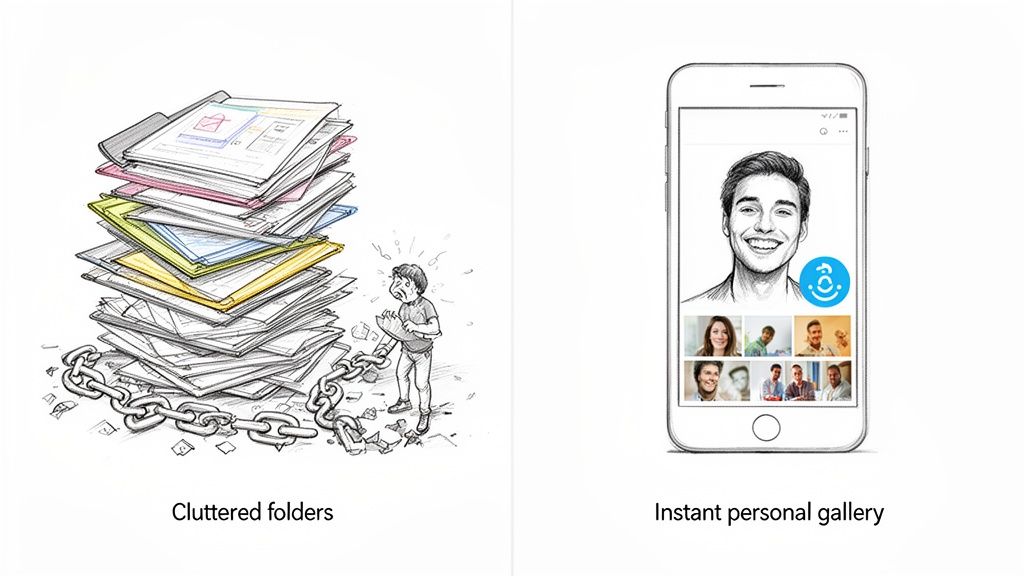
Let's be honest for a second: the old way of sharing event photos is a pain. For far too long, the go-to method has been dumping everything into a massive Google Drive or Dropbox folder and blasting out a link. This turns what should be a fun look back into a digital scavenger hunt, forcing people to scroll endlessly just to find a few shots of themselves.
This clunky experience does more than just frustrate your guests—it kills the post-event buzz before it even starts. When photos are a chore to find, they don’t get shared. You end up missing out on a huge opportunity for organic marketing, user-generated content, and genuine connection with your audience.
The Rise of Instant Gratification
People today expect everything to be immediate and personalized. They don't want to dig for their photos; they want their best moments served up to them on a silver platter. This is where new technology is completely changing the game.
Picture this: a guest at your conference scans a simple QR code. Instead of landing in a messy, shared folder, they're prompted to take a quick selfie. A moment later, an AI-powered system delivers a private, curated gallery of every single photo they appear in. This "find my photos" approach replaces tedious manual searching with instant, automated discovery.
By shifting from a one-to-many distribution model (a single link for everyone) to a one-to-one delivery system, organizers can dramatically increase photo interaction rates and overall guest satisfaction.
This isn't just a small tech upgrade; it's a fundamental rethinking of the post-event experience. By solving this one logistical headache, you open up powerful marketing and engagement channels that were impossible before. You can see how AI-powered platforms like Saucial make this happen on their product overview page.
A New Standard for Attendee Experience
Switching to a modern photo-sharing strategy does a lot more than just offer convenience. It creates a seamless, memorable interaction that makes your brand and event look great.
- Eliminates Attendee Frustration: Guests are happy because they don't have to waste hours scrolling. This directly improves their overall opinion of the event.
- Boosts Social Sharing: When people get their best photos instantly, they are far more likely to post them on social media. That means free marketing and a much wider reach for your event.
- Reduces Administrative Workload: Photographers and organizers get a huge chunk of their time back. No more manual sorting and no more fielding dozens of "can you find my photo?" emails.
Ultimately, this new approach turns photo delivery from a chore into a powerful strategic asset. It's built on the idea that how you share the memories is just as important as the memories themselves.
Comparing Traditional and Modern Photo Sharing Methods
Choosing how you’ll share your event photos isn’t just a small logistical detail—it’s a decision that directly shapes how your guests remember the experience. The right approach turns photos into a powerful tool that keeps the buzz going, while the wrong one can lead to frustration and a massive missed opportunity.
Let's walk through the common methods, from the old-school folder drop to the newer, smarter AI-powered platforms.
Think of it this way: a traditional public gallery is like a massive, crowded library. You know the book you want is in there somewhere, but you’re stuck wandering through endless aisles, hoping to spot it. An AI-powered personal gallery, on the other hand, is like having a private concierge who greets you at the door and hands you exactly the book you came for.
The Old Guard: Cloud Storage and Public Galleries
For years, the go-to solutions have been cloud storage services like Google Drive or photographer-focused galleries like Pixieset. They're familiar, for sure, but they create a ton of friction for your guests.
Cloud Storage Folders (Google Drive, Dropbox): This is what I call the "digital shoebox" method. You just dump every single photo into one huge folder and blast out a single link. For an attendee, this is a nightmare. They’re forced to scroll endlessly through hundreds, sometimes thousands, of images just to find the few of themselves. It’s slow, overwhelming, and frankly, feels a bit unprofessional.
Public Online Galleries (Pixieset, Zenfolio): These are a definite step up aesthetically. Platforms like these are designed for photographers, so they look much cleaner. But the core problem is still there: finding your photos is a completely manual chore. A guest still has to hunt and peck, which drastically lowers the odds they’ll ever find, download, and share their pictures.
The common enemy here is search fatigue. When finding a photo feels like work, people just give up. It’s no surprise that many of these galleries see interaction rates as low as 20-30%—not because the photos are bad, but because they're too hard to find.
The Social Scramble: Hashtags on Social Media
Using a unique event hashtag on a platform like Instagram seems like a brilliant, free way to get people sharing. It taps into behavior that's already happening and can create a fun, live feed of moments from your event.
But that convenience comes at a steep price. You have absolutely no control over the quality of the content, privacy is completely out the window, and good photos can easily get buried by the algorithm. Worse, you can't build a cohesive, branded album from a chaotic feed, and getting your hands on high-resolution images for your own marketing is next to impossible. It's organized chaos at best.
The Modern Solution: AI-Powered Personal Galleries
This is where the game really changes. Modern platforms use AI and facial recognition to completely automate the delivery process. Instead of one giant gallery for everyone, each guest gets their own personal gallery.
The new "find my photos" experience delivers instant gratification. An attendee scans a QR code, takes a quick selfie, and is immediately presented with a beautifully curated collection of every single photo they appear in.
This approach completely flips the old model on its head. It kills the manual search, respects guest privacy by only showing them their own photos, and gives the organizer total control over the branding and distribution.
To really see the difference, it helps to put these methods side-by-side.
Comparison of Event Photo Sharing Methods
This table breaks down how traditional and modern photo sharing methods stack up across the factors that matter most to event professionals.
| Method | Attendee Experience | Organizer Control & Branding | Privacy | Monetization Potential |
|---|---|---|---|---|
| Cloud Folders & Public Galleries | High-friction, manual search. Guests often give up. | Basic access controls, limited branding. | A single public link shared with everyone. | Clunky and indirect, if possible at all. |
| Social Media Hashtags | Unstructured and chaotic. Photos are public and hard to find later. | Almost zero control over content or quality. | Fully public by default, with no privacy controls. | Not possible. |
| AI-Powered Personal Galleries | Instant, personalized, and private. A "wow" moment for guests. | Full branding, watermarking, and privacy controls. | Permission-based and user-initiated. Highly secure. | Built-in and direct-to-attendee for prints or digital sales. |
As you can see, the differences are stark. Moving to an AI-powered system isn't just an upgrade; it's a fundamental shift in strategy.
By solving the core problem of photo discovery, AI-powered event photo sharing makes your attendees happier and transforms your photos from a simple keepsake into a measurable marketing asset. That instant access encourages people to share on social media while they're still buzzing from the event, amplifying your reach and creating a powerful stream of authentic user-generated content. You're no longer just storing photos—you're running a sophisticated engagement campaign.
How AI Selfie Matching Radically Improves the Guest Experience
Let's be honest, the old way of sharing event photos was broken. Guests had one burning question: "Where are my photos?" And our answer was usually a link to a giant, disorganized folder, forcing them into a digital scavenger hunt they’d almost always abandon.
The magic of modern event photo sharing is how it completely flips that script. It’s not about complex, space-age technology; it's a simple, elegant solution that delivers a personalized and instant "wow" moment for every single attendee.
At its core, the system creates a digital map of every face in the photographer's gallery. When a guest snaps a quick selfie, the AI simply compares their face to all the maps it created. In a split second, it finds every photo with a high match percentage and delivers a private, curated collection just for them.
This flowchart shows just how stark the difference is between the old, clunky manual process and the new, AI-powered approach.
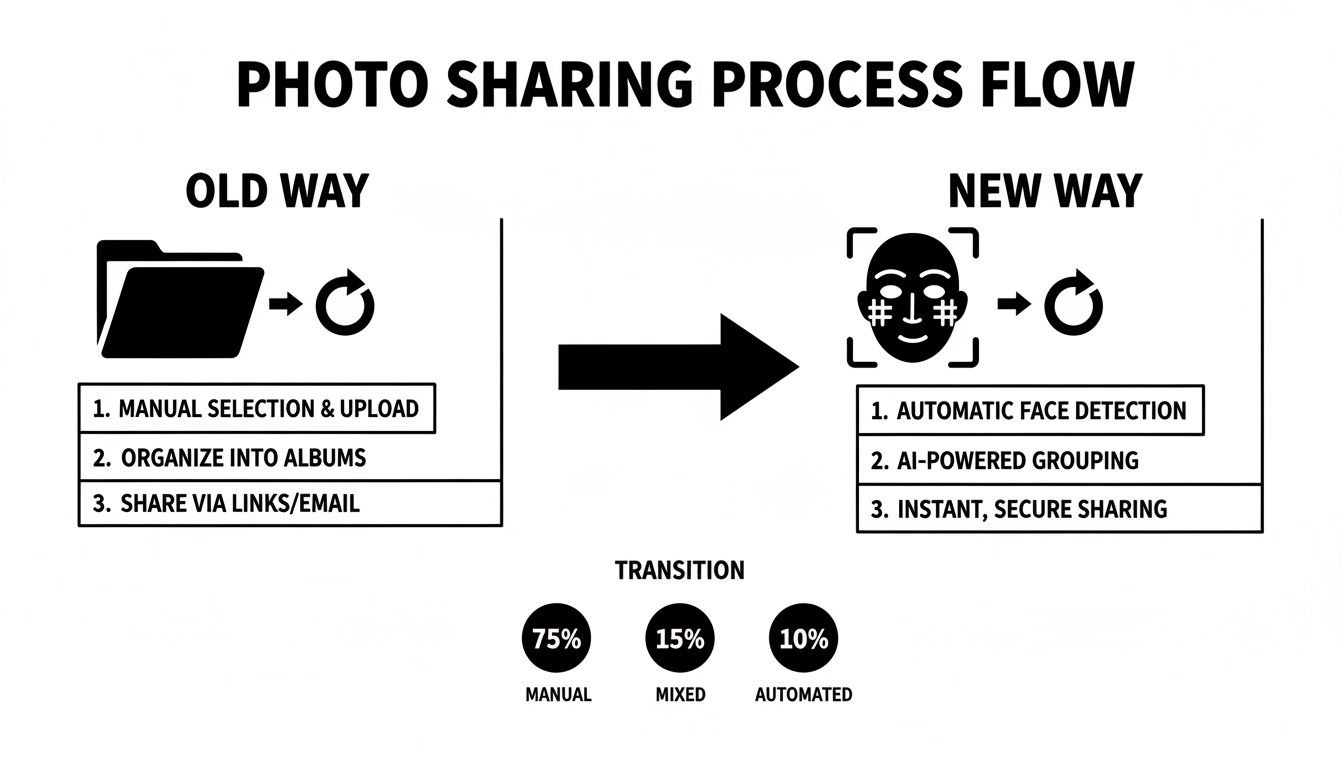
The biggest win here is the removal of friction. By eliminating the manual searching, we see engagement and social sharing skyrocket. People actually find and use their photos.
A Simple Three-Step Workflow
For your attendees, finding their photos is now an incredibly simple, three-step process. Best of all, it requires no app downloads or clunky account creation.
- The Organizer Uploads Everything: The photographer or event manager drops the entire, unedited photo gallery into the platform. Behind the scenes, the AI immediately gets to work, analyzing each image and preparing it for matching.
- A Single Link is Shared: Guests get one simple link or scan a QR code you've placed around the venue. This single link works for everyone, whether you have 50 guests or 5,000.
- Guests Take a Quick Selfie: When they open the link, guests are prompted to take a selfie. Seconds later, the system matches their face to the photos in the gallery and reveals a private collection of just their moments.
This straightforward workflow solves the most persistent headaches for event professionals. Photographers can stop spending hours manually tagging people, and organizers are finally free from the endless stream of "can you find my photo?" emails.
What About Privacy in an AI World?
It's natural to have questions about privacy whenever facial analysis is involved. Modern event photo sharing platforms are built from the ground up on a privacy-first, permission-based framework. You and your guests are always in control.
The selfie a guest provides is used for one purpose only: to perform a single, temporary search within that specific event gallery. It is not stored long-term, used for training data, or shared with any third parties.
This model is actually far more secure than the old public galleries where anyone with a link could see and download photos of other people. It guarantees attendees only see their own pictures, giving them a much more secure and comfortable experience. You can manage these privacy and access controls directly within your event settings.
The Measurable Impact of Instant Access
The payoff here goes way beyond just convenience. The global Event Photography & Videography Service Market is expected to hit $15.22 billion by 2032. That growth underscores how much people value professional event content, but that value disappears if no one ever sees the photos.
Think about it: at a typical trade show, only about 30% of photos in a traditional gallery ever get shared. AI-powered platforms completely turn that around. We've seen photographers boost their sales by up to 25% at events like sports tournaments. To dig deeper, you can check out the full report on the event photography market.
This isn't just a new feature; it’s a fundamental shift that transforms photo delivery from a sunk cost into a powerful engagement engine.
Driving Post-Event Engagement with Instant Photo Access
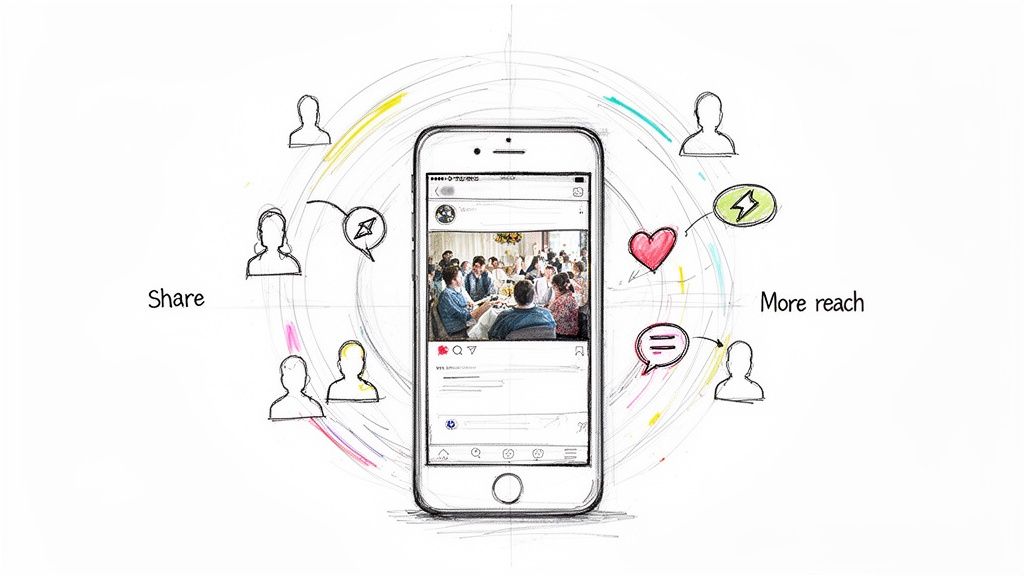
Delivering photos after an event isn't just a chore to check off your list; it’s one of the most powerful marketing tools you have. There's a small, golden window right after an event when attendees are still buzzing with excitement. If you make them wait days for a link or force them to dig through a messy, unorganized folder, that energy just evaporates. The opportunity is gone.
But when you give people instant access, everything changes. By providing a super-simple way for attendees to find and download their favorite pictures, you're essentially turning them into your best brand ambassadors. They start sharing while the memories are fresh, creating a powerful, organic wave of user-generated content that pushes your event's reach far beyond the four walls of the venue.
Turning Moments into Marketing Assets
Let's think about what this looks like in the real world. A company spends a fortune on its annual conference to create an unforgettable experience. An attendee gets a notification, instantly finds a branded photo of themselves winning an award, and posts it to LinkedIn. Just like that, a single share can rack up thousands of views from a perfectly targeted professional network.
The same magic works for consumer events. Imagine a music festival where fans are sharing incredible shots of their favorite band's set on Instagram just minutes after it ends. This kind of content builds a real, vibrant community. It feels authentic because it is authentic, creating a level of social proof that a paid ad could never hope to match.
This is how event photo sharing evolves from a simple service into a core part of your marketing strategy. It's not just about saving memories anymore—it's about putting them to work.
The goal is to remove every single obstacle standing between an attendee and their urge to share. Instant, personalized delivery is what unlocks that massive wave of free, organic promotion.
The Measurable Impact of Instant Sharing
This isn't just about good vibes; it's about real, measurable results. While the overall photo sharing market is expected to grow from $5,299.9 million to $9,032.0 million by 2035, event-specific sharing often gets stuck in the past. It’s no surprise that generic, hard-to-search galleries often see dismal interaction rates, sometimes as low as 20-30%. You can dive deeper into the growth of the photo sharing market to see the trends.
AI-powered face recognition completely flips the script. We've seen digital sharing from corporate events deliver 8x higher engagement than old-school static albums. For B2B trade shows, photos shared through branded links or QR codes have even produced up to 96% brand recall.
The numbers tell a pretty clear story. When you make photos easy to find and share, you directly boost:
- Increased Social Media Mentions: More shares mean more eyeballs on your event, your brand, and your sponsors.
- Higher Brand Recall: Branded photo frames and effortless sharing keep your event at the front of people's minds long after they've gone home.
- A Longer Event Lifecycle: The online conversation keeps going for days or even weeks, stretching the value of your initial investment.
A smart photo sharing strategy does more than just deliver pictures. By creating a frictionless experience, you not only make your attendees happy but also fire up a powerful marketing engine that drives results you can actually measure. If you're ready to see this in action, you can explore setting up a secure, branded gallery for your next event.
Turning Photos Into Profit for Photographers and Organizers
Let’s be honest: great event photos are more than just a nice-to-have for your guests. They represent a huge, often untapped, opportunity to generate real revenue. When you can get photos into someone's hands right after the moment happens—when they're still buzzing with excitement—you've created the perfect window to offer something more. This is how you flip photo delivery from a line-item expense into a powerful profit engine.
For photographers, this changes the entire game. You’re no longer just working for a flat fee from the organizer. Suddenly, you have a direct sales channel to every single person at the event. Forget the old way of manually sorting through folders and responding to a flood of "can you find my picture?" emails. Now, you can give each attendee their own personal, automated gallery that also happens to be a digital storefront.
How Photographers Can Monetize Their Work
Having a direct line to each attendee means you can offer valuable upgrades right inside their personal gallery. This is infinitely more effective than sending out a generic link to a sales page a week after the event has ended.
- Premium Downloads: Give away low-resolution, watermarked images perfect for social media. Then, offer the high-resolution, watermark-free versions for a small price.
- Print Sales: Why not connect your gallery to a print-on-demand service? Guests can order framed prints, canvases, or photo albums of their favorite shots with just a couple of taps.
- Premium Editing: Offer an upsell for professional retouching or unique artistic edits on a guest’s favorite photo. You can turn a fantastic shot into a true work of art.
This whole approach feels natural. It meets attendees right where they are—on their phones, admiring their pictures—making it easy and almost impulsive for them to buy.
How Organizers Can Generate Direct Revenue
And it's not just the photographers who benefit. For event organizers, especially for things like fundraisers, sports competitions, or big community festivals, the photo gallery itself can become a serious money-maker.
Think of the photo gallery as a sponsored experience. It’s no longer just a logistical headache; it’s a financial tool that can offset costs or open up an entirely new revenue stream.
One of the most effective ways to do this is by selling branded photo frames. Imagine your title sponsor's logo appearing tastefully on every single photo that gets downloaded or shared. This gives your sponsors incredible exposure as their brand gets attached to your attendees' favorite memories all over social media. You can package this up as a premium sponsorship offering with a clear ROI.
This strategy fits perfectly with where the event industry is heading. Photo booths are already part of a global market expected to reach $1,961.7 million by 2035. The right photo platform can slash a photographer’s admin work by 80%, giving them more time to focus on making money, while organizers can see attendee engagement jump by as much as 73%. For every dollar invested in these kinds of experiences, the average return can be 5x thanks to all the user-generated content and social sharing. If you want to dive deeper into the numbers, you can find more insights on the photo booth market's growth.
Your Step-By-Step Plan for Your Next Event
Knowing the theory is one thing, but turning it into a flawless plan is what really separates a good event from a truly great one. A modern event photo sharing strategy doesn’t need to be complicated, but it does need a simple, structured approach.
When you break down your workflow into three distinct phases—before, during, and after the event—you take all the guesswork out of the equation. This simple guide is your playbook, outlining the key moves for both organizers and photographers to get photos delivered instantly and keep guests buzzing. Let's build your action plan.
Phase 1: Pre-Event Preparation
Success starts long before the doors open. This is where you lay the groundwork for a smooth photo delivery system and start building excitement among your attendees.
Select Your Platform: First things first, choose an AI-powered photo sharing platform that gives guests a simple "find my photos" experience. Make sure it has the essentials: QR code access, branding options, and any monetization tools you plan on using.
Create the Event Gallery: Get your gallery set up well in advance. This is your chance to configure privacy settings, upload your event branding or sponsor logos, and generate the unique QR code and shareable link you'll need.
Communicate with Guests: Don’t keep this awesome feature a secret! Let attendees know in your pre-event emails, social media posts, and event app notifications that they’ll get instant access to their photos. Tease how easy the selfie-matching is to get them hyped.
Phase 2: During-Event Execution
On the big day, your main job is making it incredibly easy for guests to find and use the photo gallery. Visibility and clear instructions are everything.
- Promote the QR Code: That QR code is the key to everything. Put it everywhere. We're talking welcome signs, registration desks, table tents, and even on the main presentation screen between sessions. The more places they see it, the more people will use it.
- Make Announcements: Don't be afraid to use the mic. Have the emcee or host make a quick announcement explaining how simple it is: “Scan any QR code you see, snap a selfie, and get your pictures sent right to you!”
- Brief Your Team: Make sure your event staff and photographers know exactly how the system works. They’re your on-the-ground ambassadors and can help answer questions or encourage people to scan the code.
The key to high engagement is minimizing friction. By placing the QR code in high-traffic areas and making clear announcements, you ensure that every attendee knows how to access their personal gallery with zero effort.
Phase 3: Post-Event Follow-Through
The event might be over, but your most important work is just beginning. This final phase is all about delivering the goods efficiently and riding the wave of post-event excitement.
The Photographer’s Workflow: Life just got a lot simpler for the photographer. Instead of spending hours sorting photos for individual guests, they just need to finish their final edits. Once the images are ready, they can do a single bulk upload into the gallery you already created. The AI does the rest. For those looking to make this even faster, check out these efficient photo upload workflows.
Distribute the Final Link: The moment the photos go live, blast out the gallery link through all your post-event channels. Send a thank-you email to all attendees, share it on social media, and push one last notification through your event app.
Activate Monetization: If you’re offering paid extras like high-resolution downloads or prints, now is the time to switch those features on. That window right after the event is prime time for sales, when guests are still feeling the emotional high and want to hold on to those memories.
Even with the best-laid plans, new tech always comes with questions. Let's tackle some of the most common ones we hear about modern event photo sharing so you can get a feel for how it works in the real world.
How Does Face Recognition for Event Photos Handle Privacy?
This is the big one, and for good reason. Privacy isn't an afterthought; it's the entire foundation. The best systems are built on a "privacy-first" model, which means everything hinges on guest permission.
Think of it this way: an attendee has to take a selfie to start a search. That's their key. That selfie is only used for that single search, in that specific event gallery, and is then discarded. It's never stored long-term, used for training AI models, or shared with anyone. The event organizer always holds the keys to the kingdom and controls who can access the gallery.
The core difference here is that guests pull their photos with permission, rather than you pushing them into a public space. It’s a fundamentally more secure and respectful approach than open galleries or social media tagging.
Can This System Work for Large-Scale Events?
Absolutely. In fact, this is where AI-powered photo sharing really shines. For a small get-together, a simple gallery might be fine. But for large festivals, sprawling trade shows, or massive conferences? Manually finding a photo is like finding a needle in a haystack.
A selfie-matching system automates the entire sorting process, delivering a personalized gallery to every single guest almost instantly. It scales beautifully. Whether you have 100 attendees or 10,000, the experience is just as fast and seamless. This isn't just a nice-to-have; it's a massive time-saver that ensures everyone gets their photos without a single complaint.
What Is the Setup Process for Organizers and Photographers?
You'll be surprised at how simple it is. The whole workflow is designed to slip right into your existing process without any friction. There's no complex software to install or a steep learning curve to climb.
For the organizer or photographer, it really boils down to three quick steps:
- Create an event gallery on your chosen platform.
- Drag and drop all your photos into the uploader. The AI does all the heavy lifting in the background.
- Get a single, shareable link and a QR code for the gallery to give to your guests.
That’s it. You don't have to manually tag anyone, sort images into a dozen different folders, or spend hours organizing. The entire process, from upload to sharing, is built to take minutes, not days.
Ready to deliver a "find my photos" experience that actually wows your guests? With Saucial, you can create a branded, AI-powered gallery in minutes. Give every attendee instant, private access to their best moments and watch your post-event engagement soar.


