Choosing the Best Facial Recognition Software for Events
Let's be honest, nobody wants to spend hours scrolling through hundreds—or even thousands—of event photos just to find the two or three they're actually in. That old way of dumping everything into a massive, unorganized gallery is a recipe for frustration, low engagement, and a ton of missed marketing opportunities. Thankfully, that era is over. Today, the best facial recognition software has completely changed the game, turning static photo albums into dynamic, engaging experiences.
How AI Is Modernizing Event Photography
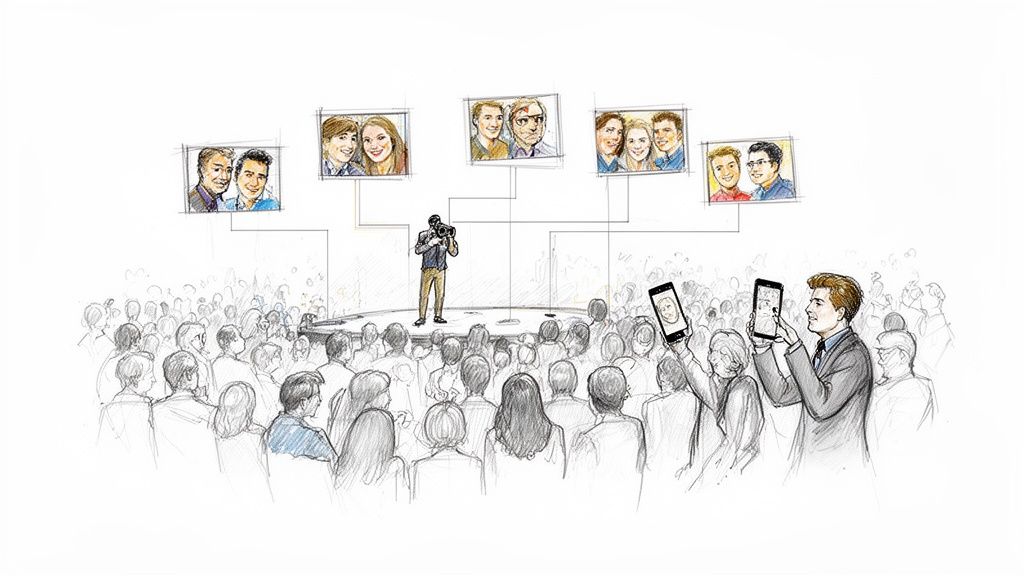
The biggest headache in event photography has always been photo discovery. How do you efficiently connect a guest with their specific photos from a sea of images? The traditional method puts all the work on the attendee, forcing them to manually search for themselves. It’s clunky and ineffective.
This is where AI-driven platforms come in. By automating the identification process, they create a simple, almost magical "find my photos" experience for every single guest. This technology isn't some futuristic, expensive novelty anymore; it's an accessible, surprisingly accurate solution that's ready to use right now.
The Shift to Attendee-Centric Experiences
Instead of a one-size-fits-all gallery, modern software delivers a personalized collection of photos directly to the individual. This simple change turns photo delivery from a boring logistical task into a powerful and memorable touchpoint. The process is incredibly straightforward:
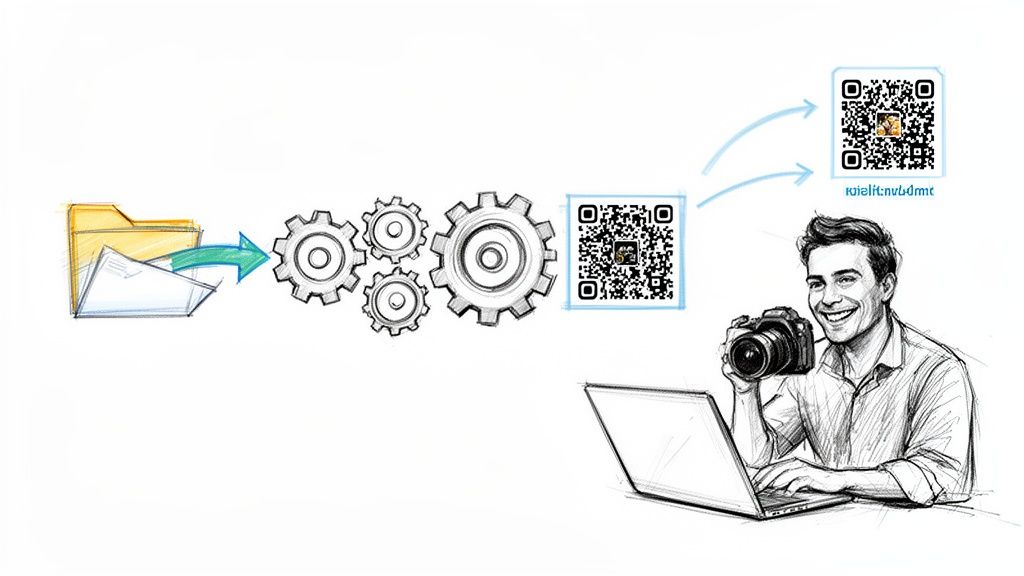
- Simplified Upload: The photographer or event organizer uploads the entire event gallery to the platform.
- Automated Tagging: The software scans every photo, creating a unique facial signature for each person it finds.
- Frictionless Discovery: Attendees follow a link or scan a QR code, snap a quick selfie, and are instantly shown every photo they appear in.
This approach respects your guests' time and dramatically increases the likelihood they'll share their favorite moments on social media. After all, people are far more likely to post a photo when it's easy to find.
By making photo access immediate and personal, organizers and photographers can dramatically increase post-event engagement. The focus moves from simple delivery to creating a memorable, interactive experience that adds value long after the event ends.
The rapid move toward this technology is obvious when you look at the numbers. The global facial recognition market is expected to hit between USD 21.12 billion and USD 32.53 billion by 2032. What’s really telling is that software solutions make up over half of that market, showing a clear industry-wide shift toward cloud-based platforms that don't require any complex, on-site hardware.
Platforms built specifically for this purpose, like Saucial, are leading the charge. They are designed from the ground up for the event workflow, setting a new standard for how photographers and organizers deliver value and measure their success after an event wraps up.
The Core Criteria for Evaluating Photo Recognition Software
When you're picking a facial recognition platform, it's easy to get lost in a long list of flashy features. But for events, the best software isn't just about identifying a face—it’s about creating a seamless experience for your guests and a super-efficient workflow for you. A solid evaluation framework helps you cut through the noise and make a choice that actually improves your event, instead of causing new headaches.
Your decision should really hinge on five critical pillars. Each one tackles a specific challenge you'll face in a live event environment, ensuring you pick a tool that won't let you down when it counts.
Accuracy and Speed
In the middle of a bustling event, accuracy is everything. The software has to nail face identification in tricky situations—think low light, weird angles, and people wearing hats or glasses. The top systems are incredibly precise, but speed is just as crucial.
From the moment a guest snaps a selfie to the second they see their photos, the whole thing needs to feel instant. If there's more than a few seconds of lag, the magic is lost, and people will just walk away. You need a platform built for fast, real-time matching.
Scalability and Reliability
Events come in all sizes, from a small 50-person gala to a massive festival with thousands of attendees. The software you choose has to handle that range without crashing or slowing to a crawl. A system that’s perfect for a wedding might completely buckle under the pressure of a major conference.
The real test of scalability is whether the platform can handle a huge number of photos and user searches all at once. A cloud-based system is a must-have for managing those peak moments without you having to worry about the tech infrastructure.
And that reliability has to be rock-solid. The platform needs to be up and running without a hitch, especially during and right after the event when everyone is excited to see their photos.
Privacy and Compliance
Let's be clear: privacy isn't a feature, it's a fundamental requirement. The best facial recognition tools for events are built on a consent-first model. Attendees should always opt-in by providing a selfie to find their photos, and you need to have complete control over the data policies.
Make sure any platform you consider complies with major privacy laws like GDPR and CCPA. This means having clear, transparent policies on how data is stored, used, and deleted. Building trust with your guests starts with picking a partner who takes their data security seriously.
Attendee Experience and Workflow Integration
At the end of the day, the technology should feel invisible to your guests. The process has to be dead simple: scan a QR code, take a selfie, and get your photos. Anything that requires downloading an app, creating an account, or navigating a complicated menu is just adding friction that will tank your engagement rates.
For photographers and event organizers, a smooth workflow is just as important. The system should make your life easier, not harder. Look for features like a simple, drag-and-drop system to upload event photos, which can save you hours of tedious work. The goal is to get photos from the camera to the attendee as quickly as possible, turning what used to be a logistical nightmare into a powerful engagement tool.
Comparing Turnkey Platforms vs. DIY AI Solutions
When you start looking for facial recognition software, you’ll quickly find yourself at a fork in the road. One path leads to building a custom solution from the ground up using powerful AI services like AWS Rekognition. The other path is to use a specialized, ready-to-go platform like Saucial.
Which one is right for you? It really boils down to your event's specific needs, your team's technical skills, and what you’re ultimately trying to achieve.
Going the Do-It-Yourself (DIY) route with a cloud AI service gives you an incredible amount of power and flexibility. If you have a team of developers and a truly unique problem to solve, you can craft a system that fits your exact requirements.
But let’s be realistic—that path demands a massive investment. You're on the hook for everything: designing the user experience, building the data pipeline, ensuring you're compliant with privacy laws, and making sure the whole thing doesn't crash when everyone tries to find their photos at once. It might make sense for a huge corporate conference with complex integration needs, but it's often overkill for most events.
The Turnkey Advantage for Events
This is where specialized platforms, or "turnkey" solutions, come in. They're built from the ground up with the event workflow in mind. All that complex AI technology is neatly packaged into a simple, intuitive interface made for photographers and organizers, not software engineers.
Think about a marathon or a big music festival. Your main goal is to get thousands of photos into the hands of attendees as fast as possible. A turnkey platform gives you a pre-built "find my photos" experience that you can get running in minutes. No code to write, no servers to manage, and no user interface to design from scratch.
This decision tree shows how an event's size can shift your priorities between core features like accuracy and scalability.

As you can see, while every event demands accuracy, scalability becomes the make-or-break factor for larger events trying to handle massive photo volumes and simultaneous user requests.
Practical Differentiators in Action
To really understand the difference, let's look at a few key operational factors that directly affect how your event runs. This goes beyond just the tech and into the real-world experience.
Here’s a quick breakdown comparing the two approaches.
Feature Comparison of Event Facial Recognition Solutions
| Feature | DIY Approach (e.g., AWS Rekognition) | Specialized Platform (e.g., Saucial) |
|---|---|---|
| Setup Complexity | Weeks or months of development time and significant technical skill | Ready to use almost immediately after signing up; no coding needed |
| Attendee Experience | You must design and build the entire front-end from scratch | Optimized "find my photos" journey is pre-built and mobile-friendly |
| Monetization Tools | E-commerce features must be custom-built and integrated manually | Built-in tools for print or digital sales are often included |
| Branding and Control | Fully customizable, but requires developer resources to implement | Simple, intuitive controls to add logos and brand colors in minutes |
This table highlights the core trade-off: unlimited customization versus speed and ease of use. For the vast majority of event professionals, the latter is far more valuable.
Let's break it down further:
- Setup Complexity: A DIY project can easily take weeks, if not months, to develop. A turnkey platform is good to go right after you sign up.
- Attendee Experience: With a DIY build, you have to create the entire selfie upload, matching, and gallery display from zero. Specialized platforms have already perfected this process for mobile devices, making it fast and simple for users.
- Monetization Tools: Need to sell photos? With a DIY solution, you’re building an entire e-commerce system. Turnkey platforms often have this functionality built right in, allowing photographers to monetize their work easily.
- Branding and Control: Both options allow for branding, but turnkey solutions make it incredibly easy. You can add logos and tweak colors without a developer. For more granular control, you can always adjust your photo sharing settings.
For most event professionals, the goal is to deliver an exceptional experience, not to become a software development company. A turnkey solution abstracts away the technical complexity, allowing you to focus on what you do best: creating memorable events.
In the end, while a DIY approach offers limitless customization, it comes with a steep learning curve and continuous maintenance costs. For most events, a specialized platform delivers 95% of the value for a fraction of the cost and effort, making it the smarter, more practical choice.
Real-World Scenarios for AI-Powered Photo Sharing

The best facial recognition software isn't just theory; it delivers real results in countless event settings. When you see how different organizations put this tech to work, its power to boost engagement, drive sales, and build brand visibility becomes crystal clear. Suddenly, photo delivery isn't just a chore—it's a strategic move.
Imagine a university alumni gala. The main goal is to strengthen community ties and encourage donations. Instead of forcing graduates to scroll through a massive online gallery, the organizer simply provides a QR code. Attendees take a quick selfie and are instantly handed a personal album from the evening, making it simple to share great memories and feel more connected to their alma mater.
Driving Sales and Amplifying Brands
For a race photographer, the objective is much more direct: sales. A marathon runner crossing the finish line doesn't have the patience to dig through thousands of photos to find their one triumphant moment. A "find my photos" link, however, lets them locate and buy their action shots in seconds. This creates a smooth, direct path to revenue for the photographer.
This technology is more than just a convenience; it's a marketing machine. Market data shows a telling shift: while security and access control used to be the primary uses for facial recognition, commercial applications are now generating serious revenue. This tells us the market is hungry for consumer-focused experiences like AI photo sharing. You can dig into more facial recognition market applications on electroiq.com.
A successful implementation isn't just about finding faces. It's about aligning the technology with a specific business goal, whether that's boosting alumni engagement, driving direct photo sales, or amplifying a brand's message across social media.
Maximizing Conference Engagement
Now, let's think about a large corporate conference. Here, the organizer wants to maximize the brand's reach and prove the event's value. By giving attendees an instant, shareable gallery, they turn hundreds—or even thousands—of people into organic brand ambassadors.
Every photo shared on social media becomes an authentic endorsement for the event. This approach stretches the event's influence far beyond the conference hall. When people have easy access to professional photos of themselves networking or learning, they're naturally much more likely to post about their positive experience.
The common denominator in all these examples is a focus on workflow. The technology fits seamlessly into the event, adding value without making things complicated for the user. In each case, photo delivery is treated as a core part of the engagement strategy, not an afterthought. Ease of use is everything, which is why platforms with a simple, browser-based experience tend to win. You can see how a frictionless user authentication process works on modern platforms built for this purpose.
Why a Workflow-First Approach Matters Most
It’s easy to get lost in the tech specs—accuracy percentages, processing speeds, all of that. But for event professionals, those numbers are only half the story. The best facial recognition software isn’t just about finding faces; it's about whether it works in the real, chaotic world of a live event. A workflow-first approach means the technology saves you time instead of creating new headaches.
Think about the entire journey. It starts the moment a photographer dumps a memory card and ends when a happy attendee shares their favorite photo online. A great system considers everyone: the photographer under pressure, the organizer juggling a dozen tasks, and the guest who just wants their picture. When the workflow is right, the technology fades into the background, and it just works.
From Complex Technology to Simple Execution
A tool built for the event industry should be designed around how you actually work. For a photographer, that means a simple drag-and-drop uploader that won’t choke on thousands of high-res images. For an organizer, it’s about getting a single QR code or a link that can be shared everywhere instantly.
This is exactly where Saucial nails it. The platform is built to do the heavy lifting behind the scenes, processing faces and sorting photos automatically. This directly solves one of the biggest time-sinks for photographers: the hours spent manually tagging photos after a gig.
The ultimate goal is to remove friction. A photographer should be able to upload a gallery and move on to their next shoot, confident that attendees can instantly find their photos without needing any support.
Automating these tedious steps frees you up to focus on what actually matters, whether that's connecting with clients or getting to the next job.
Creating a Frictionless Attendee Journey
The workflow has to be dead simple for attendees, too. The "Find My Photos" process can't involve app downloads, account sign-ups, or confusing instructions. A guest should just scan a QR code, snap a selfie with their own phone, and see their personal gallery pop up in seconds.
That kind of simplicity is what gets people to actually use it. It makes the event feel modern and high-tech, which reflects well on your brand. When photo access is that easy, attendees are far more likely to share their pictures, giving your event a huge organic boost.
This streamlined process also unlocks some serious value for event professionals. Key benefits include:
- New Revenue Streams: Photographers can sell digital downloads or prints directly to attendees, opening up a new way to earn money that was never practical with old-school gallery links.
- Enhanced Brand Visibility: Organizers get a powerful engagement tool that turns guests into brand advocates with zero extra effort.
- Time Savings: Both photographers and organizers get back countless hours they used to waste on sorting and distributing photos.
In the end, choosing the right software means finding a system that understands the real-world problems you face. It’s about finding a reliable tool that makes life easier for you and delivers an amazing experience for your guests, turning event photos from a logistical headache into a valuable asset.
Your Top Questions About Facial Recognition at Events, Answered
New technology always brings up good questions. When it comes to using facial recognition at events, it's wise to dig into the details. Event organizers and photographers often wonder how these systems perform in a hectic, real-world setting and, just as importantly, how they handle guest privacy. Let's get straight to the answers.
We put this section together to tackle the most common concerns head-on. The goal is to demystify how today's event-focused platforms work, build trust, and show you how this technology can be a genuinely helpful—and responsible—tool for your business.
How Does Facial Recognition Find My Guests' Photos?
The whole process is a lot less complicated than you might think. When you upload your event photos, a sophisticated AI gets to work, analyzing every face in the gallery. It creates a unique numerical signature for each person, which is essentially a digital map of their facial features. This is what makes the magic of instant matching happen.
When a guest wants to find their pictures, they just need a reference photo—usually a quick selfie they snap on their phone. The system takes the facial signature from that selfie and compares it against all the signatures it mapped from the event gallery. Within seconds, it pulls up every match, giving the guest a curated album of their moments. No more manual tagging or endless scrolling.
What Are the Privacy Implications?
This is the big one, and the answer comes down to one word: consent. Unlike surveillance systems you see in the news, the best facial recognition software for events is strictly opt-in. Guests are always in the driver's seat and have to voluntarily take a selfie to use the "find my photos" feature.
Any platform worth its salt is built with privacy as a foundational principle. Here’s what that looks like in practice:
- Consent First: Nobody's face is searched for unless they explicitly submit their own selfie.
- Data Control: You, the event organizer or photographer, typically set the rules for how long photos and facial data are stored before being permanently deleted.
- Compliance: The software is designed to comply with major privacy laws like GDPR and CCPA, so you can be confident that all data is handled correctly.
The key distinction is purpose. Event facial recognition is a service for the attendee, not a system used on them. It’s all about creating a better experience, and it’s completely driven by user choice.
Is This Technology Accurate in a Crowded, Messy Event Setting?
Yes, and its ability to perform in real-world conditions is what separates the great platforms from the mediocre ones. The leading AI models are trained on massive, diverse datasets filled with the exact kind of tricky situations you'd find at an event—think low lighting, weird camera angles, and faces partially hidden by hats or glasses.
These systems are fine-tuned for the chaos of a live event, which means they deliver remarkably reliable results. While no technology is 100% perfect, the accuracy rates of modern platforms are high enough to give the vast majority of your guests a seamless and impressive experience.
Can I Use This to Sell Photos Directly to Guests?
Absolutely. For professional photographers, this is a game-changer. Many of the top platforms integrate e-commerce tools right into the gallery. Once a guest finds their personal photos, they can be guided directly to a private storefront.
From that gallery, they can buy digital downloads, order prints, or even purchase other branded items. This opens up a direct line of revenue that was once a logistical nightmare, turning your photo delivery process into a profitable part of your business while giving guests an easy way to cherish their favorite memories.
Ready to see how a workflow-first photo sharing platform can save you time and delight your attendees? Discover Saucial and create your first AI-powered gallery in minutes. Learn more at https://saucial.com.


